
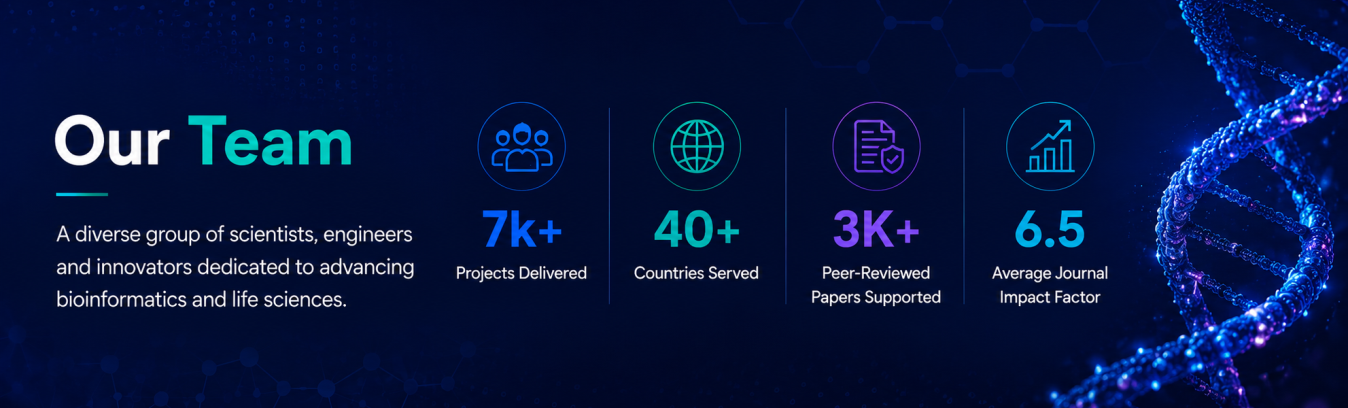
A Core In-House Team Backed by 75+ Domain-Specific Subject Matter Experts
BioinformaticsNext operates on a two-layer model: a core in-house team of 18+ PhD-qualified computational biologists who lead, manage, and quality-check every project — supported by a curated network of 75+ subject matter experts who contribute specialist depth across every domain we cover.
This structure means your project is never handled by a generalist stretching into unfamiliar territory. The right specialist is always assigned based on your exact data type, organism, and biological question — and every analysis is reviewed in-house before it reaches you.
Team at a glance
Core In-House Team
PhD-qualified computational biologists and domain leads who manage and quality-assure every project
Subject matter experts across all domains
A curated network of vetted researchers and industry specialists contributing deep expertise to specific service areas
Omics disciplines covered in-house and through our expert network — from scRNA-seq to structural biology, metabolomics, and clinical genomics
Independent in-house review on every project — a core team member checks all results before delivery, regardless of who contributed
How the Two-Layer Model Works for You
Our structure combines the consistency of a permanent team with the specialist depth that only a large, domain-specific expert network can provide.
Core team: consistency and accountability
Your project is always assigned a named core team lead. This person manages the analysis, communicates with you directly, coordinates any subject matter expert contributions, and owns the quality of the final deliverable from scoping to publication.
Expert network: unmatched specialist depth
When a project requires highly specialised knowledge — a rare organism, an emerging assay type, or a niche statistical method — the core team draws on the appropriate subject matter expert from our network, without any loss of coordination or quality control.
In-house QA on everything
Regardless of whether subject matter experts contribute to an analysis, all results are reviewed internally by a core team member before delivery. The same rigour applies to every project — not just those handled entirely in-house.
Full transparency on contributors
Subject matter experts in our network are individually vetted, known individuals — not anonymous contributors. Your NDA covers all contributors. You can request the credentials of anyone who worked on your analysis and we will share them.
Our Leadership
The senior specialists who founded and lead BioinformaticsNext — setting scientific standards, overseeing quality assurance, and leading the most complex projects personally.
Dr. Ananya Aeron
Founder & Lead Computational Biologist
PhD in Computational Genomics, Imperial College London. 12+ years spanning multi-omics pipeline development, cancer genomics, and NGS analysis. Corresponding author on 45+ peer-reviewed publications including Nature Genetics and Genome Research.
Dr. Sofia Reyes
Head of Transcriptomics
PhD in Molecular Biology, University of Barcelona. Specialist in bulk RNA-seq, single-cell RNA-seq, and spatial transcriptomics with a focus on tumour microenvironment and immunology. Lead analyst on 900+ transcriptomics projects since 2016.
Dr. James Okonkwo
Head of Genomics & Variant Analysis
PhD in Human Genetics, Wellcome Sanger Institute. Expert in WGS, WES, GWAS, population stratification, and clinical variant interpretation. Previously part of the 100,000 Genomes Project analysis team.
Dr. Hassan Al-Farsi
Head of Biostatistics & Machine Learning
PhD in Biostatistics, University of Edinburgh. Specialist in statistical modelling for high-dimensional omics data, ML for genomic feature selection, and clinical trial biostatistics. Active reviewer for Bioinformatics and Briefings in Bioinformatics.
Meet Our Experts
PhD-qualified specialists working directly on client projects, each with deep expertise in their specific domain — from structural biology and metagenomics to long-read sequencing, immunogenomics, and AI-driven omics.
Dr. Mei Lin Zhang
Structural Biology & Drug Discovery
PhD in Structural Bioinformatics, NTU Singapore. Specialises in AlphaFold2/3 structure prediction, molecular docking, MD simulation analysis, and AI-driven drug target identification for oncology and infectious disease.
Dr. Priya Nair
Metagenomics & Microbiome
PhD in Microbial Genomics, ETH Zurich. Expert in 16S amplicon analysis, shotgun metagenomics, microbiome-metabolome integration, and host-microbiome interaction modelling across gut, oral, and skin microbiome programmes.
Dr. Lucas Fernandez
Single-Cell & Epigenomics
PhD in Developmental Biology, University of Heidelberg. Specialist in scRNA-seq, scATAC-seq, multiome analysis, and chromatin accessibility profiling. Particular expertise in cell trajectory inference and developmental cell atlas construction.
Dr. Amara Diallo
Clinical Bioinformatics & Proteomics
PhD in Systems Biology, Karolinska Institute. Expert in LC-MS/MS proteomics, phosphoproteomics, clinical genomics variant reporting, and biomarker validation for diagnostic applications. Extensive experience supporting clinical trial genomics programmes.
Dr. Yuki Tanaka
Epigenomics & DNA Methylation
PhD in Epigenomics, University of Tokyo. Specialist in ChIP-seq, ATAC-seq, RRBS, whole-genome bisulfite sequencing, and chromatin remodelling analysis. Experienced in integrating epigenetic data with transcriptomic and genetic datasets for cancer and ageing research.
Dr. Ravi Kumar
Phylogenomics & Comparative Genomics
PhD in Evolutionary Genomics, Indian Institute of Science, Bangalore. Expert in phylogenetic tree construction, ancestral sequence reconstruction, comparative genome analysis, and molecular clock dating using IQ-TREE, BEAST, and RAxML.
Dr. Elena Vassileva
Proteomics & Mass Spectrometry
PhD in Biochemistry, Max Planck Institute of Biochemistry, Munich. Specialises in DIA and DDA proteomics workflows, post-translational modification analysis, protein-protein interaction networks, and cross-linking mass spectrometry for structural proteomics.
Dr. Omar Al-Hassan
AI & Deep Learning for Omics
PhD in Computational Biology, KAUST, Saudi Arabia. Expert in genomic foundation model fine-tuning, transformer architectures for sequence analysis, CNN-based variant calling, and deep learning approaches for multi-omics data integration and phenotype prediction.
Dr. Fatima Malik
Precision Medicine & Pharmacogenomics
PhD in Clinical Genomics, Indian Institute of Technology, India. Specialises in pharmacogenomics, drug-gene interaction analysis, polygenic risk score development, and clinical decision support genomics for precision medicine programme implementation.
Dr. Carlos Mendez
Long-Read Sequencing & Genome Assembly
PhD in Genomics, University of Chile. Expert in Oxford Nanopore and PacBio long-read data processing, de novo genome assembly, structural variant detection, isoform characterisation, and telomere-to-telomere assembly workflows for complex genomes.
Dr. Aisha Osei
Cancer Bioinformatics & Liquid Biopsy
PhD in Cancer Genomics, University of Cape Town. Specialist in somatic mutation profiling, tumour mutational burden, copy number alteration analysis, ctDNA and cfDNA liquid biopsy, and clonal evolution and tumour heterogeneity modelling.
Dr. Thomas Bergmann
Metabolomics & Systems Biology
PhD in Systems Biology, University of Zurich. Expert in untargeted LC-MS and GC-MS metabolomics, lipidomics, KEGG pathway modelling, flux balance analysis, and multi-omics metabolome integration for cardiovascular disease, diabetes, and ageing research.
Dr. Neha Sharma
Immunogenomics & Immune Repertoire
PhD in Immunology, All India Institute of Medical Sciences, New Delhi. Specialist in TCR and BCR repertoire analysis, HLA typing and haplotype calling, immune cell deconvolution, neoantigen prediction, and tumour-immune microenvironment profiling.
Dr. Jae-Won Kim
Spatial Transcriptomics & Multi-omics
PhD in Genomic Medicine, Seoul National University. Expert in Visium, Xenium, MERFISH, and Slide-seq spatial transcriptomics workflows, spatial deconvolution, cell-cell communication analysis, and spatially resolved multi-omics integration for tissue microenvironment mapping.
75+ Subject Matter Experts
Beyond our core in-house team, BioinformaticsNext maintains a curated network of domain specialists — researchers, experienced academics, and industry experts — who contribute to projects requiring highly specialised knowledge.
Vetted and credentialled
Every network expert holds a doctoral degree or equivalent qualification in a directly relevant discipline — the same standard applied to our core in-house team.
Core team coordinated
SME contributions are always coordinated and reviewed by a core team lead. You communicate with your core in-house contact — not directly with network contributors.
NDA covered
Your confidentiality agreement extends to all contributors on your project. No one outside that agreement ever has access to your data, results, or unpublished findings.
How the Team Works on Your Project
A clear structure ensures accountability at every step — whether handled entirely by the core in-house team or with subject matter expert contribution.
Scoping and specialist matching
Your project brief is reviewed by the leadership team, who identify the right core team lead and whether any SME network contribution is needed. You are told who will work on your project — and their credentials — before work begins.
Direct access to your core team lead
You always communicate with a core in-house team member — never through a ticket system, and never directly with an SME contributor. Your core team lead is your single point of contact by email and WhatsApp from scoping to publication.
In-house peer review before every delivery
Before results leave BioinformaticsNext, a second core team member independently reviews all code, parameter choices, and interpretations. This applies equally to work done in-house and work involving SME contributions.
Core team continuity through to publication
Your core team lead remains your contact through peer review, revision, and resubmission. Reviewer revision requests are handled by the same team, ensuring full continuity of knowledge about your data and analytical decisions.
Talk to the Right Specialist for Your Project
Tell us your data type, your organism, and your research question. Our leadership team will identify whether the work is handled by the core in-house team or with SME network contribution — and will confirm exactly who will be working on your project before you commit.
No commitment required · Response within 24 hours · NDA signed before any data is shared