
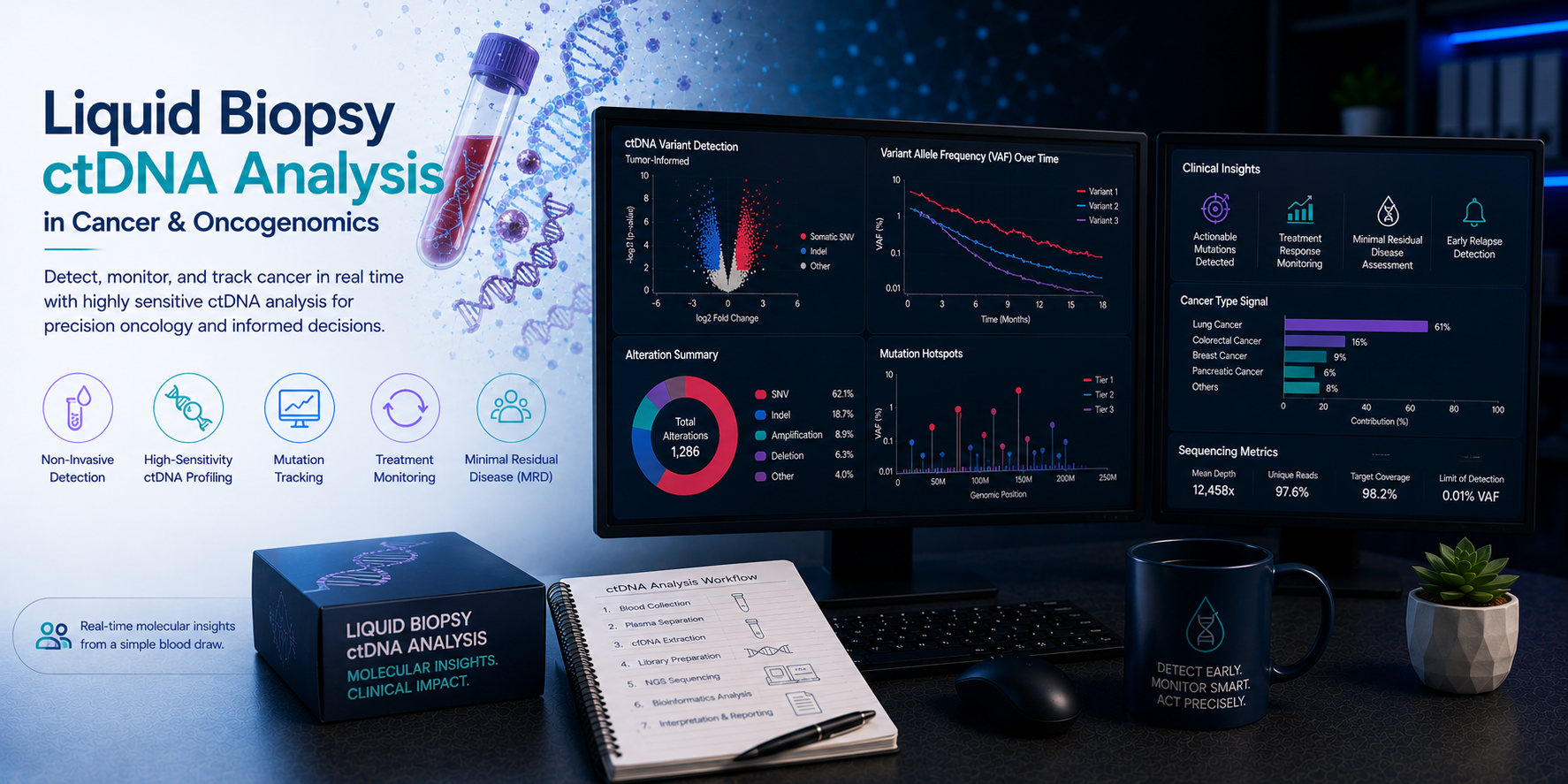
Liquid biopsy and circulating tumour DNA (ctDNA) analysis are transforming cancer diagnosis, treatment monitoring, and early detection — enabling non-invasive, real-time tumour profiling from a simple blood draw. From ultra-sensitive somatic variant detection in plasma cell-free DNA and tumour fraction estimation to longitudinal treatment response monitoring, minimal residual disease (MRD) detection, and methylation-based multi-cancer early detection, liquid biopsy bioinformatics demands specialist expertise at the intersection of genomics, statistics, and clinical oncology. At BioinformaticsNext, we provide expert liquid biopsy and ctDNA bioinformatics services — supporting cancer research groups, pharmaceutical clinical development teams, and diagnostic companies in extracting accurate, clinically actionable signal from circulating tumour DNA and cell-free DNA data.
Liquid Biopsy & ctDNA Bioinformatics: Circulating Tumour DNA Analysis & Early Detection
Expert bioinformatics for ctDNA variant detection, tumour fraction estimation, MRD monitoring, methylation-based early detection, and longitudinal liquid biopsy analysis in oncology clinical research and drug development.
Circulating tumour DNA — shed from tumour cells into the bloodstream — carries the somatic mutations, copy number alterations, methylation patterns, and fragmentomic signatures of the originating tumour. At early disease stages or in the MRD setting, ctDNA may represent a fraction of a percent or less of total circulating cell-free DNA — demanding sequencing depths, error suppression strategies, and bioinformatics pipelines that are fundamentally different from standard tumour tissue genomics. The clinical promise of liquid biopsy is extraordinary: earlier cancer detection before symptoms emerge, real-time treatment response assessment without repeat tissue biopsies, early warning of acquired resistance before radiological progression, and post-surgical MRD detection to guide adjuvant therapy decisions. Realising this promise requires bioinformatics that is rigorously validated, statistically principled, and calibrated to the unique technical challenges of low-allele-frequency variant detection in cell-free DNA.
At BioinformaticsNext, we provide the full liquid biopsy bioinformatics stack — from cfDNA sequencing QC and error suppression through ctDNA variant calling, tumour fraction estimation, MRD analysis, methylation-based tissue-of-origin deconvolution, and fragmentomics profiling.
What We Support
Comprehensive liquid biopsy bioinformatics across ctDNA variant detection, tumour fraction estimation, MRD monitoring, early detection, and multi-cancer screening applications.
- Ultra-sensitive ctDNA somatic variant detection from targeted panel and WGS cell-free DNA sequencing
- Tumour fraction (ctDNA%) estimation from low-pass WGS and targeted sequencing data
- Minimal residual disease (MRD) detection in post-surgical and post-treatment settings
- Longitudinal ctDNA dynamics modelling for treatment response and resistance monitoring
- Methylation-based tissue-of-origin deconvolution for multi-cancer early detection
- cfDNA fragmentomics: nucleosome positioning, fragment length profiling, and end motif analysis
- Copy number alteration (CNA) and structural variant detection from liquid biopsy sequencing
- Acquired resistance mutation tracking from serial plasma samples
- HRD and mutational signature analysis from plasma cell-free DNA WGS
- Analytical validation and regulatory submission support for liquid biopsy IVD and CDx assays
Our Liquid Biopsy & ctDNA Bioinformatics Services
Specialist cfDNA and ctDNA bioinformatics — from sequencing QC and error suppression through variant detection, tumour fraction estimation, MRD analysis, and methylation-based early detection.
All analyses are tailored to your sequencing platform, assay chemistry, tumour type, clinical application, and regulatory or research reporting requirements.
1. cfDNA Sequencing QC & Error Suppression UMI · Duplex Sequencing · Error Correction · QC Metrics
Cell-free DNA sequencing for ctDNA detection operates at the limits of sequencing accuracy — where sequencing errors, PCR artefacts, and oxidative damage can generate false positive variant calls at allele frequencies indistinguishable from true low-level ctDNA signal. Rigorous error suppression and quality control are therefore the most critical foundation of any liquid biopsy bioinformatics pipeline.
- UMI-based error correction and consensus calling — fgbio, fastp, and AGeNT-based UMI extraction, grouping, and consensus read family generation; single-strand consensus sequence (SSCS) and duplex consensus sequence (DCS) calling for maximum error suppression; UMI family size distribution QC and minimum family size filtering
- cfDNA-specific sequencing QC — Fragment length distribution analysis with expected mononucleosomal peak (166 bp) verification; GC content bias assessment and correction; on-target rate, uniformity, and mean depth reporting; strand bias and oxidative damage artefact (C>A/G>T) detection and filtering
- Background error rate estimation — Panel of normals (PoN) construction from healthy donor cfDNA samples; position-specific background error rate modelling; systematic artefact filtering using matched germline or healthy control cfDNA data
- Platform-specific pipeline adaptation — Optimised pipelines for Illumina paired-end, Element Biosciences, and MGI sequencing platforms; library chemistry-specific adaptations for hybrid capture (Twist, Agilent SureSelect), amplicon (AVENIO, Guardant, Foundation), and low-pass WGS approaches
2. ctDNA Variant Detection & Tumour Fraction Estimation MAESTRO · CtDNA Callers · ichorCNA · FAST-SeqS
Accurate ctDNA variant detection at allele frequencies as low as 0.01–0.1% — and reliable tumour fraction estimation across a range from less than 0.1% to greater than 50% — requires purpose-built ctDNA variant callers, appropriate error models, and validated statistical frameworks that are fundamentally different from standard somatic variant calling from tumour tissue.
- Ultra-sensitive ctDNA somatic variant calling — MAESTRO, ctSNV, Vardict, and Mutect2 ctDNA mode-based somatic variant calling at ultra-low allele frequencies; VAF-aware filtering with PoN subtraction; tumour-informed calling using matched tissue mutation catalogue for maximum sensitivity in the MRD setting
- Tumour-naïve ctDNA detection — Tumour-agnostic ctDNA detection pipelines for early detection and monitoring applications without prior tumour tissue sequencing; personalised error-corrected sequencing (PhasED-seq, MAESTRO) approaches for ultra-sensitive tumour-naïve detection
- Tumour fraction estimation from low-pass WGS — ichorCNA and ASCAT-based genome-wide copy number alteration profiling and tumour fraction (ichorCNA ctDNA%) estimation from 0.1x–1x WGS; allele-specific copy number analysis for ploidy and tumour purity estimation; FAST-SeqS ultra-low pass WGS tumour fraction screening
- Somatic copy number and structural variant detection — CNA calling from targeted panel and WGS cfDNA data; focal amplification and deletion detection; structural variant and fusion gene identification from cfDNA sequencing for therapy eligibility and resistance monitoring
3. MRD Detection & Longitudinal Treatment Monitoring MRD · Clearance Kinetics · Resistance · Serial Plasma
Post-surgical and post-treatment ctDNA detection is one of the most clinically impactful applications of liquid biopsy — identifying patients with molecular residual disease who are at high risk of relapse and may benefit from adjuvant or escalated therapy. Longitudinal ctDNA monitoring during treatment provides real-time response assessment and early warning of acquired resistance weeks to months before radiological progression.
- Post-surgical MRD detection — Tumour-informed personalised ctDNA assay design from matched tumour WGS or panel sequencing; detection of patient-specific somatic variants in post-surgical plasma samples at ultra-low allele frequencies; MRD positivity classification with validated statistical thresholds and confidence intervals
- ctDNA clearance kinetics modelling — Longitudinal ctDNA VAF and tumour fraction trajectory modelling across treatment timepoints; early molecular response (EMR) classification from ctDNA kinetics; half-life estimation and clearance rate modelling for different treatment modalities
- Acquired resistance mutation tracking — Emergence detection of known resistance mutations (EGFR T790M, C797S; KRAS G12C; PIK3CA; ESR1) in serial plasma samples before radiological progression; allele frequency trajectory analysis for resistance clone expansion kinetics; co-occurring resistance mechanism identification
- Molecular response and landmark analysis — ctDNA-based molecular response rate calculation at defined on-treatment timepoints; landmark survival analysis stratified by ctDNA clearance status; correlation of ctDNA dynamics with RECIST radiological response, PFS, and OS outcomes
4. Methylation-Based Early Detection & Tissue-of-Origin Analysis cfDNA Methylation · WGBS · Multi-Cancer · Tissue Deconvolution
DNA methylation patterns in cfDNA are highly tissue-specific and cancer-associated — enabling both multi-cancer early detection from a single blood sample and tissue-of-origin identification for cancers of unknown primary. Methylation-based liquid biopsy represents the scientific basis of commercially deployed multi-cancer early detection tests and is an active area of diagnostic development.
- cfDNA methylation profiling — WGBS, RRBS, and targeted methylation sequencing (cfMeDIP-seq, EPIC array) data processing and CpG methylation calling; bismark and bsseq-based methylation extraction; cancer-associated differentially methylated region (DMR) identification and scoring
- Multi-cancer early detection signature development — CancerSEEK and Galleri-inspired cancer vs. normal methylation classifier development; tissue-specific methylation atlas construction; random forest and neural network-based cancer detection model training and cross-validation
- Tissue-of-origin deconvolution — Reference methylation atlas-based deconvolution (CelFiE, MethAtlas) to identify the tissue or cancer type contributing ctDNA to plasma; cancer of unknown primary (CUP) tissue-of-origin prediction; cell-type specific methylation fraction estimation for plasma cfDNA
- Fragmentomic and methylation integration — Combined cfDNA fragment length, end motif, nucleosome positioning, and methylation feature integration for enhanced early detection sensitivity and specificity; DELFI-inspired fragmentomic score development and validation
5. cfDNA Fragmentomics & Analytical Validation DELFI · Fragment Length · End Motifs · IVD · CDx
Beyond variant detection and methylation, the physical characteristics of cfDNA fragments — their length distribution, nucleosome positioning patterns, end sequence motifs, and preferred genomic localisation — carry tumour-derived signal that can be exploited for cancer detection, tissue-of-origin identification, and treatment response monitoring. Fragmentomics adds an orthogonal dimension to ctDNA analysis that substantially improves detection sensitivity at very low tumour fractions.
- Fragment length distribution profiling — Genome-wide and locus-specific cfDNA fragment length analysis; short fragment (under 150 bp) enrichment scoring as a cancer detection feature; fragment length ratio (FLR) calculation; comparison of fragment length profiles across cancer types and disease stages
- Nucleosome positioning and chromatin accessibility inference — ATAC-seq-equivalent chromatin accessibility inference from cfDNA coverage at transcription factor binding sites; promoter nucleosome occupancy profiling; cell-type-specific open chromatin region enrichment from cfDNA as a tissue-of-origin feature
- cfDNA end motif and preferred end analysis — 4-mer end motif frequency profiling across the genome; preferred end site analysis for tissue-of-origin and cancer type discrimination; end motif diversity scoring as a cfDNA quality and cancer detection metric
- Analytical validation for IVD and CDx submissions — Limit of detection (LoD), limit of blank (LoB), and limit of quantitation (LoQ) determination for ctDNA assays; analytical sensitivity, specificity, reproducibility, and concordance assessment against reference standards; regulatory-grade analytical validation report preparation for FDA 510(k), De Novo, PMA, and CE-IVD IVDR submissions
Key Applications
Liquid biopsy and ctDNA bioinformatics across cancer types, clinical settings, and drug development applications.
- Post-surgical MRD detection for colorectal, lung, breast, and bladder cancer
- Treatment response monitoring and acquired resistance early detection
- Immunotherapy ctDNA dynamics and molecular response biomarker development
- Multi-cancer early detection test bioinformatics development and validation
- Cancer of unknown primary tissue-of-origin identification from cfDNA methylation
- Companion diagnostic ctDNA assay analytical validation for targeted therapy trials
- Pharmacodynamic ctDNA endpoint development for Phase I/II clinical trials
- Longitudinal resistance mutation surveillance in EGFR, KRAS, and ESR1-driven cancers
Tools, Technologies & Reference Resources
Validated, specialist liquid biopsy bioinformatics tools and all major cfDNA reference resources.
- UMI & Error Correction: fgbio, fastp, AGeNT, Picard, Connor
- ctDNA Variant Calling: MAESTRO, Mutect2 (cfDNA mode), VarDict, ctSNV, smCounter2
- Tumour Fraction: ichorCNA, ASCAT-cfDNA, FAST-SeqS, CNVkit (cfDNA), PURPLE
- Methylation: Bismark, bsseq, MethylDackel, cfMeDIP pipeline, CelFiE, MethAtlas
- Fragmentomics: DELFI pipeline, Griffin, FragProfiler, cfDNApipe
- Survival & Statistics: survival, timeROC, survminer, pROC, boot (R)
- TCGA / GEO / ICGC — Public cancer genomic cohorts for ctDNA biomarker training and validation
- Genome in a Bottle / SEQC2 — Reference standards for analytical validation of ctDNA assay sensitivity and specificity
- COSMIC / OncoKB / ClinVar — Somatic variant and resistance mutation annotation databases
- ENCODE / Roadmap Epigenomics — Tissue-specific methylation and chromatin reference atlases for cfDNA tissue-of-origin deconvolution
Project Deliverables
Structured, clinically relevant liquid biopsy bioinformatics outputs for every project.
- Per-sample sequencing QC report: UMI family sizes, fragment length distribution, on-target depth, strand bias
- ctDNA variant calls with VAF, confidence scores, and PoN-filtered annotated VCF/TSV files
- Tumour fraction estimates with confidence intervals across all timepoints
- Longitudinal ctDNA dynamics plots: VAF trajectories, tumour fraction trends, and MRD status calls
- MRD detection report with positivity classification and statistical confidence thresholds
- Methylation DMR or fragmentomic feature table with cancer detection scores (where applicable)
- Publication-ready figures (PDF/SVG/PNG at 300 dpi): ctDNA waterfall plots, kinetics curves, ROC curves
- Full written scientific report with methods, results, interpretation, and clinical context
- Analytical validation report for FDA 510(k), De Novo, PMA, and CE-IVD IVDR submissions
- Clinical trial ctDNA SAP biomarker analysis plan and endpoint specification
- Multi-cancer early detection classifier development and cross-cohort validation
- Tissue-of-origin cfDNA methylation deconvolution for CUP diagnosis
- Manuscript methods section and supplementary figure legends
- Grant application liquid biopsy bioinformatics sections and preliminary data
- Long-term retainer for ongoing clinical trial sample monitoring and reporting
Frequently Asked Questions
Common questions from clinical oncology researchers, pharmaceutical development teams, and liquid biopsy diagnostic companies.
Required sequencing depth depends on the expected ctDNA fraction and the variant calling approach. For tumour-informed targeted ctDNA detection in the MRD setting — where ctDNA fractions can be below 0.01% — ultra-deep targeted sequencing at 10,000–100,000x effective depth with duplex UMI error correction is typically required. For tumour fraction estimation from low-pass WGS, 0.1x–1x depth is sufficient using ichorCNA. For methylation-based early detection, 10–30x WGBS or targeted methylation capture at high depth is appropriate. We advise on sequencing depth, assay design, and error suppression strategy at project scoping.
Tumour-informed ctDNA analysis uses a personalised panel of somatic variants identified from matched tumour tissue sequencing — targeting these exact positions in plasma cfDNA for maximum sensitivity, as the signal space is pre-defined and background noise can be minimised. Tumour-naïve approaches detect ctDNA without prior tumour sequencing — relying on broader error-corrected panels, methylation signatures, or copy number profiles to detect cancer signal. Tumour-informed approaches achieve lower detection limits (down to 1 in 100,000 molecules) but require prior tissue sequencing; tumour-naïve approaches sacrifice some sensitivity but are essential for early detection and screening applications.
Yes. We provide ctDNA bioinformatics support for Phase I and II clinical trials — including pharmacodynamic ctDNA endpoint analysis, molecular response rate calculation at defined on-treatment timepoints, acquired resistance mutation tracking, and landmark survival analysis stratified by ctDNA clearance. We assist with the bioinformatics sections of ctDNA statistical analysis plans (SAPs) and produce analysis outputs formatted for clinical study reports and regulatory submission packages.
Ultra-low ctDNA fractions below 0.1% require duplex UMI consensus sequencing to reduce the sequencing error rate below the expected signal level; tumour-informed variant calling using a personalised mutation panel to focus sensitivity on known tumour-derived positions; panel of normals (PoN) filtering to remove recurrent technical artefacts at specific genomic positions; and Bayesian statistical models that incorporate prior probability of ctDNA positivity based on clinical context. We apply all of these strategies in combination for MRD-level ctDNA detection and are transparent about the detection limits and confidence intervals associated with each sample.
Yes. We produce analytical validation documentation — including LoD, LoB, LoQ, analytical sensitivity, specificity, precision, and concordance assessments against Genome in a Bottle and SEQC2 reference standards — suitable for FDA 510(k), De Novo, PMA, and CE-IVD IVDR companion diagnostic submissions. All pipelines are version-controlled with complete software documentation, parameter logs, and audit trail records required for regulatory compliance.
Related Research Areas & Services
Liquid biopsy and ctDNA bioinformatics connects to multiple complementary services we support.
- Biomarker Discovery & Validation — Multi-omics cancer biomarker development, prognostic gene signature validation, survival analysis, and companion diagnostic regulatory support complementing ctDNA biomarker programmes
- Cancer & Oncogenomics — Matched tumour WGS and panel sequencing for tumour-informed personalised ctDNA assay design, somatic variant catalogue generation, and clonal evolution integration
- Clinical Genomics & Variant Interpretation — Germline variant calling, ACMG classification, and hereditary cancer risk assessment providing the germline context for somatic ctDNA variant interpretation
- Drug Development & AI-Driven Discovery — ctDNA-based pharmacodynamic endpoint development, patient stratification, and companion biomarker integration into pharmaceutical clinical development programmes
- Cell & Gene Therapy Bioinformatics — cfDNA-based MRD monitoring in haematological malignancies treated with CAR-T; ctDNA disease burden quantification for adoptive cell therapy trial endpoints
- Custom Software & Pipeline Development — Bespoke ctDNA analysis platforms, automated liquid biopsy reporting pipelines, and clinical trial sample tracking and biomarker reporting tools
Ready to Advance Your Liquid Biopsy Programme?
Tell us about your ctDNA assay, your sequencing platform, your tumour type, and your clinical or research objectives. Our liquid biopsy bioinformatics team will design a tailored analytical plan — typically within 48 hours of your enquiry. Whether you need ultra-sensitive MRD detection pipelines, longitudinal treatment monitoring analysis, methylation-based early detection classifier development, fragmentomic profiling, or analytical validation for a regulatory submission, we are here to deliver expert, clinically actionable liquid biopsy results from day one.