
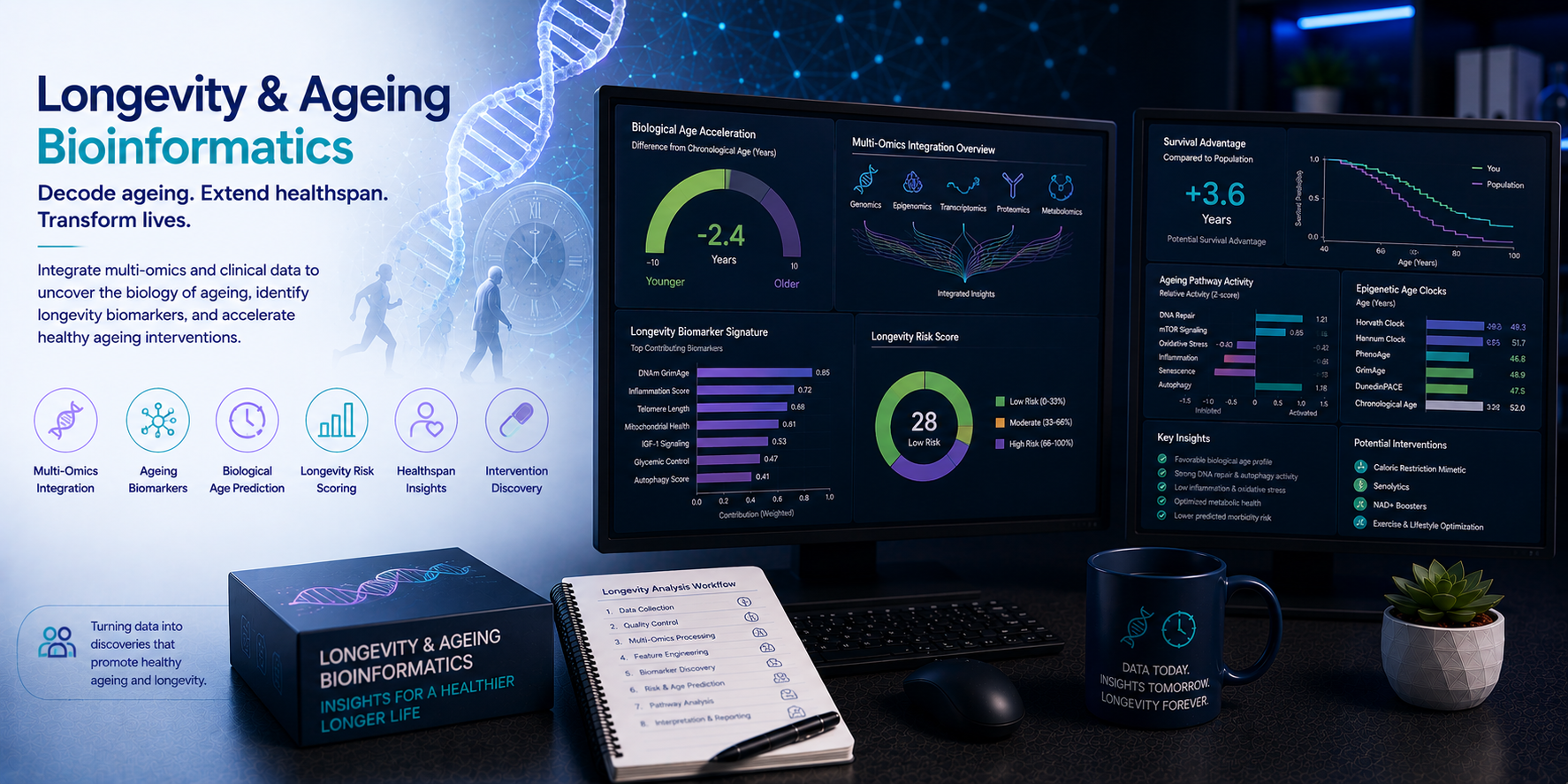
Longevity and ageing bioinformatics sits at the frontier of genomics, epidemiology, and precision medicine — combining large-scale genetic association studies, epigenetic clocks, multi-omics profiling, and population cohort data to uncover the biological determinants of healthy ageing and exceptional longevity. From genome-wide association studies of lifespan and healthspan, polygenic longevity scores, and epigenetic age acceleration analysis to cellular senescence transcriptomics, telomere length genomics, and the identification of genetic modifiers of age-related disease, ageing biology generates complex, multi-layered datasets that demand specialist bioinformatics expertise. At BioinformaticsNext, we provide expert longevity and ageing bioinformatics — supporting academic geroscience groups, longevity biotech companies, pharmaceutical healthy ageing programmes, and clinical research teams in extracting rigorous, reproducible, and translatable insights from ageing genomics data.
Longevity & Ageing Bioinformatics: Polygenic Ageing Scores, Longevity GWAS & Multi-Omics Ageing Analysis
Expert bioinformatics for longevity and healthspan GWAS, epigenetic clocks, polygenic ageing scores, senescence transcriptomics, telomere genomics, and multi-omics ageing biology — supporting geroscience research, longevity biotech, and healthy ageing drug discovery programmes.
Human lifespan is influenced by a complex interplay of genetics, epigenetics, lifestyle, and environment. Twin studies estimate that roughly 25% of lifespan variation is heritable — but the specific genetic variants, pathways, and biological mechanisms underlying this heritability remain incompletely understood. Epigenetic clocks — mathematical models that predict biological age from DNA methylation patterns — have revealed that biological ageing rate varies substantially between individuals with the same chronological age, and that accelerated epigenetic ageing predicts mortality and age-related disease independently of conventional risk factors. Meanwhile, transcriptomic, proteomic, and metabolomic signatures of cellular senescence, inflammageing, and mitochondrial dysfunction are providing new molecular targets for geroprotective interventions. At BioinformaticsNext, we provide the full longevity and ageing bioinformatics stack — from GWAS and multi-omics profiling through epigenetic clock analysis, polygenic score development, and drug target identification for the biology of ageing.
What We Support
Comprehensive longevity and ageing bioinformatics across genetic, epigenetic, transcriptomic, and multi-omics ageing biology applications.
- Longevity and lifespan GWAS using parental lifespan and survival phenotypes from biobank data
- Healthspan GWAS for disease-free survival, multimorbidity, and healthy ageing phenotypes
- Epigenetic clock calculation and biological age acceleration analysis
- Polygenic ageing and longevity score development and clinical validation
- Mendelian randomisation for causal inference on ageing-related exposures and outcomes
- Cellular senescence transcriptomics and senescence gene signature scoring
- Telomere length GWAS and telomere length association with age-related disease
- Proteomics and metabolomics of ageing: inflammageing biomarker discovery
- Single-cell transcriptomics of aged tissues and age-related cell state characterisation
- Geroprotective drug target identification from multi-omics ageing data
Our Longevity & Ageing Bioinformatics Services
Specialist ageing and longevity bioinformatics — from longevity GWAS and epigenetic clocks through polygenic score development, senescence transcriptomics, and geroprotective drug target identification.
All analyses are tailored to your research question, data type, cohort, and geroscience, clinical, or drug discovery objectives.
1. Longevity & Healthspan GWAS Parental Lifespan · Survival · Healthspan · REGENIE · Meta-Analysis
Identifying the genetic variants that influence human lifespan and healthspan requires innovative phenotyping strategies — using parental lifespan as a proxy trait in biobank populations, combining survival and disease-free survival endpoints, and meta-analysing across multiple cohorts to achieve the statistical power needed to detect the small individual effects of longevity-associated variants.
- Parental lifespan and survival GWAS — REGENIE and BOLT-LMM GWAS of parental age at death as a proxy lifespan phenotype in UK Biobank, FinnGen, and equivalent biobanks; survival analysis GWAS using Cox proportional hazards models for time-to-event lifespan outcomes; cohort participant survival GWAS in long-term follow-up cohorts (EPIC, Generations Study, 100+ Study)
- Healthspan and multimorbidity GWAS — Healthspan phenotype construction from disease-free survival across major age-related conditions (cardiovascular disease, cancer, type 2 diabetes, COPD, dementia); Whitehall-style healthy ageing composite phenotype GWAS; multimorbidity count and age at first chronic disease diagnosis GWAS; frailty index and biological ageing composite phenotype association analysis
- Centenarian and exceptional longevity genetics — Case-control GWAS comparing centenarians and super-centenarians with normal-lifespan controls; APOE, FOXO3, CETP, and TOMM40 known longevity locus replication and fine-mapping; rare variant burden testing in centenarian cohorts; identification of protective alleles enriched in long-lived individuals against age-related disease genetic risk
- Cross-cohort meta-analysis and genetic correlation — METAL-based fixed effects meta-analysis across longevity cohorts; genetic correlation between lifespan and healthspan traits with LDSC; bivariate LDSC analysis of lifespan genetic overlap with age-related disease GWAS; trans-ethnic meta-analysis for multi-ancestry longevity genetic architecture
2. Epigenetic Clocks & Biological Age Analysis Horvath · GrimAge · DunedinPACE · Acceleration · Biomarkers
Epigenetic clocks are algorithmic models that predict biological age from DNA methylation patterns — providing the most accurate molecular measure of ageing rate currently available. Epigenetic age acceleration — the difference between biological and chronological age — predicts all-cause mortality, age-related disease, and functional decline independently of conventional risk factors, and is increasingly used as a primary or secondary endpoint in geroprotective intervention trials.
- Multi-clock biological age estimation — Horvath pan-tissue, Hannum blood, PhenoAge, GrimAge, GrimAge2, DunedinPACE, DunedinPoAm, and PCClocks biological age calculation from Illumina 450K, EPIC, and EPICv2 methylation array data; clock concordance and inter-clock correlation assessment; longitudinal biological age change calculation from repeated methylation measurements
- Epigenetic age acceleration analysis — Intrinsic epigenetic age acceleration (IEAA) and extrinsic epigenetic age acceleration (EEAA) calculation; age acceleration residual regression on chronological age; association of age acceleration with mortality, disease incidence, and functional outcomes in survival analysis; tissue-specific age acceleration comparison across blood, buccal, adipose, and brain tissue
- Intervention and treatment response epigenetic clock analysis — Longitudinal epigenetic clock change analysis in clinical trials of caloric restriction, rapamycin, senolytics, and other geroprotective interventions; DunedinPACE pace-of-ageing as a sensitive short-term intervention biomarker; paired pre-post intervention methylation analysis with appropriate statistical correction; effect size estimation and clinical significance assessment
- GWAS of epigenetic age acceleration — Genome-wide association study of GrimAge acceleration, PhenoAge acceleration, and DunedinPACE as quantitative traits; identification of genetic determinants of biological ageing rate; Mendelian randomisation using epigenetic age acceleration GWAS instruments for causal inference on ageing outcomes
3. Polygenic Longevity Scores & Mendelian Randomisation PRS · LDpred2 · MR · Causal Ageing Factors · Drug Targets
Polygenic longevity scores aggregate the cumulative genetic contribution to lifespan and healthspan into individual-level risk estimates — enabling stratification of individuals by genetic predisposition to healthy ageing, identification of biological pathways enriched for longevity genetic signal, and prioritisation of drug targets whose genetic perturbation mimics the effect of longevity-associated alleles.
- Polygenic longevity score development — LDpred2, PRSice-2, and PRS-CS polygenic score construction from longevity GWAS summary statistics; lifespan PRS from Timmers et al. and Pilling et al. summary statistics; healthspan PRS from disease-free survival GWAS; validation in independent survival cohorts; PRS percentile-to-absolute lifespan risk conversion
- Longevity pathway enrichment analysis — Gene set enrichment of longevity GWAS signals against hallmarks of ageing pathway gene sets; mTOR, IGF-1/insulin signalling, AMPK, sirtuins, NAD+ metabolism, and autophagy pathway enrichment; MAGMA gene-level and gene-set analysis from longevity GWAS; cross-species longevity pathway conservation analysis
- Mendelian randomisation for causal ageing exposures — Two-sample MR for causal effects of BMI, smoking, physical activity, sleep, lipids, inflammation, and other modifiable risk factors on lifespan and healthspan; MR identifying modifiable determinants of epigenetic age acceleration; bidirectional MR for age-related disease and lifespan causal relationship mapping
- Drug target identification from longevity genetics — Cis-pQTL and cis-eQTL MR for longevity-associated gene expression and protein level causal effects on lifespan; comparison of MR drug target evidence with known geroprotective compound mechanisms (rapamycin/mTOR, metformin/AMPK, NAD+ precursors/sirtuins); genetic proxy analysis for candidate longevity drug targets
4. Senescence Transcriptomics & Inflammageing Profiling SASP · Senescence Signatures · Single-Cell · Inflammageing · SenMayo
Cellular senescence — the irreversible cell cycle arrest of damaged or stressed cells accompanied by the senescence-associated secretory phenotype (SASP) — is a central mechanism of tissue ageing and age-related pathology. Transcriptomic profiling of senescent cell populations and inflammageing biomarker analysis from plasma proteomics data provide molecular readouts of biological ageing state and geroprotective intervention response.
- Senescence gene signature scoring — SenMayo, GenAge, CellAge, and custom senescence gene panel scoring from bulk and single-cell RNA-seq data; SASP factor expression profiling; p16INK4a (CDKN2A), p21 (CDKN1A), and p53 pathway activation scoring; senescence score association with chronological age, disease stage, and clinical outcomes
- Single-cell ageing and senescence analysis — snRNA-seq and scRNA-seq cell type composition analysis across aged vs. young tissue samples; age-associated cell state identification and proportion comparison; senescent cell population identification and marker characterisation; pseudotime trajectory modelling of age-related cell state transitions; cell-cell communication rewiring analysis in aged tissue microenvironments
- Inflammageing biomarker profiling — Olink proximity extension assay and mass spectrometry-based plasma proteomics differential abundance analysis between age groups; IL-6, TNF-α, CRP, GDF-15, GDF11, and inflammatory cytokine signature scoring; SomaScan-based ageing protein biomarker discovery; longitudinal inflammageing biomarker trajectory analysis in ageing cohorts
- Senolytic and geroprotective drug response transcriptomics — DESeq2 differential gene expression analysis before and after senolytic (navitoclax, dasatinib+quercetin) or geroprotective (rapamycin, metformin, NAD+ precursor) treatment; SASP suppression scoring; senescence gene signature reversal assessment; connectivity mapping against LINCS drug perturbation profiles for geroprotective compound identification
5. Telomere Genomics, Multi-Omics Ageing Integration & Model Organism Bioinformatics Telomere Length · Multi-Omics · C. elegans · Model Organisms
Telomere length — the protective caps of chromosomes that shorten with each cell division — is a widely studied molecular marker of replicative ageing, and multi-omics integration across genomics, epigenomics, proteomics, and metabolomics provides the most comprehensive molecular portrait of biological ageing state. Model organism ageing bioinformatics bridges mechanistic insights from C. elegans, Drosophila, and mouse to human ageing biology.
- Telomere length analysis and GWAS — TelSeq, Telomerecat, and EAGLE telomere length estimation from WGS data; qPCR-based relative telomere length analysis; GWAS of leukocyte telomere length in biobank cohorts; Mendelian randomisation using telomere length GWAS instruments for causal effects on cancer, cardiovascular disease, and other age-related conditions; telomere attrition rate analysis in longitudinal cohorts
- Multi-omics ageing integration — MOFA+ integration of methylation-based epigenetic clocks, transcriptomic senescence scores, plasma proteomics inflammageing markers, and metabolomics ageing signatures; biological age composite score construction from multi-omics ageing biomarkers; biological age clock comparison and cross-platform concordance assessment; multi-omics ageing biomarker association with mortality and age-related disease
- Model organism longevity bioinformatics — C. elegans, Drosophila, and mouse longevity mutant transcriptomic analysis and cross-species pathway conservation; DESeq2 differential expression in long-lived mutants (daf-2, age-1, clk-1); human orthologue identification and longevity pathway cross-species enrichment; GenAge model organism database integration; IIS, mTOR, and mitochondrial pathway conservation scoring
- Metabolomics of ageing — LC-MS and NMR metabolomics age-associated metabolite identification; NAD+, tryptophan, sphingolipid, and branched-chain amino acid ageing metabolite panel analysis; MetaboLights and HMDB metabolite annotation; metabolite-age association analysis with adjustment for BMI, sex, and lifestyle confounders; metabolomics integration with epigenetic clock acceleration
Key Applications
Longevity and ageing bioinformatics across geroscience research, longevity biotech, healthy ageing drug discovery, and clinical ageing programmes.
- Biobank longevity and parental lifespan GWAS for new longevity locus discovery
- Epigenetic clock biological age estimation in clinical intervention trials
- Polygenic longevity score development and healthy ageing risk stratification
- Geroprotective drug target identification from longevity MR and pQTL analysis
- Senolytic and rapamycin trial epigenetic clock and transcriptomic response analysis
- Inflammageing plasma proteomics biomarker discovery in ageing cohorts
- Single-cell characterisation of aged tissue and senescent cell populations
- Cross-species longevity pathway conservation from model organism transcriptomics
Tools, Technologies & Reference Resources
Validated ageing bioinformatics tools and all major longevity and ageing biology reference resources.
- GWAS & PRS: REGENIE, BOLT-LMM, PLINK2, LDpred2, PRSice-2, PRS-CS, METAL, LDSC
- Epigenetic Clocks: methylclock (R), clocks (R), PCClocks, DunedinPACE, minfi, SeSAMe
- MR: TwoSampleMR, MendelianRandomization, MR-PRESSO, MVMR, ieugwasr
- Transcriptomics: DESeq2, edgeR, GSEA, clusterProfiler, SCENIC, scVelo, Monocle3
- Telomere: TelSeq, Telomerecat, EAGLE, telomerecat, Computel
- GenAge / CellAge / DrugAge — Human and model organism ageing gene databases; senescence gene catalogues and geroprotective drug databases for longevity target analysis
- UK Biobank / FinnGen / Generations Study — Biobank-scale cohorts with lifespan and ageing phenotype data for longevity GWAS and PRS development
- IEU Open GWAS / MR-Base — Curated GWAS summary statistics for two-sample MR of longevity-associated exposures and outcomes
- LINCS L1000 / CMap — Drug perturbation transcriptomics for geroprotective compound connectivity mapping
- GTEx / UKBB-PPP / SomaScan GWAS — eQTL and pQTL resources for longevity gene expression and protein-level MR instruments
Project Deliverables
Structured, publication-ready longevity and ageing bioinformatics outputs for every project.
- Longevity GWAS summary statistics with Manhattan and QQ plots and top locus annotation
- Epigenetic clock biological age estimates with acceleration statistics and survival associations
- Polygenic longevity score with validation performance metrics and risk decile survival curves
- MR results table with IVW estimates, sensitivity analyses, and funnel plots
- Senescence gene signature scores and SASP profiling results across conditions
- Inflammageing proteomics differential abundance results with volcano plots
- Publication-ready figures (PDF/SVG/PNG at 300 dpi)
- Full written scientific report with methods, results, biological interpretation, and translational context
- Pipeline scripts and configuration files for complete analytical reproducibility
- Geroprotective drug target MR analysis and longevity pathway enrichment report
- Single-cell ageing tissue atlas construction and senescent cell characterisation
- Multi-omics biological age composite score development and validation
- Model organism longevity transcriptomics and cross-species pathway conservation analysis
- Metabolomics ageing biomarker discovery and NAD+/tryptophan pathway analysis
- Manuscript methods section and supplementary figure legends
- Grant application longevity bioinformatics sections and preliminary data
- Long-term retainer for ongoing longevity programme analytical support
Frequently Asked Questions
Common questions from geroscience researchers, longevity biotech companies, and healthy ageing clinical trial teams.
Lifespan refers to the total length of life — typically measured as age at death or survival time in longitudinal cohorts. Healthspan refers to the period of life spent in good health, free from major age-related disease and functional decline — typically constructed as disease-free survival across a composite of age-related conditions (cardiovascular disease, cancer, type 2 diabetes, COPD, dementia, physical disability). While lifespan GWAS use parental age at death as a proxy phenotype in biobank populations or direct survival data in long-term follow-up cohorts, healthspan GWAS require the construction of composite healthy ageing phenotypes from linked EHR data. Both phenotypes are genetically correlated but capture distinct aspects of ageing biology — lifespan reflects all causes of mortality including accidents and infections, while healthspan captures specifically age-related biological decline.
Clock choice depends on your biological question and sample type. First-generation clocks (Horvath pan-tissue, Hannum blood) were trained to predict chronological age and are useful for estimating deviation from expected biological age. Second-generation clocks (PhenoAge, GrimAge) were trained on mortality and disease outcomes and are more predictive of health and longevity outcomes — GrimAge2 is currently among the strongest predictors of mortality. DunedinPACE was specifically developed to measure pace of ageing rather than age itself, making it particularly sensitive for detecting intervention effects in short-term clinical trials. PCClocks offer improved accuracy by correcting for technical variation. For most longevity and healthy ageing research, we recommend calculating multiple clocks and reporting concordant findings, as different clocks capture complementary aspects of biological ageing.
Yes — and this is one of the most powerful applications of longevity genetics. By using cis-pQTL and cis-eQTL genetic instruments for drug target genes as proxies for drug effects, MR can estimate what happens to lifespan and healthspan when that target is pharmacologically modulated — providing population-level causal evidence before clinical testing. We systematically screen approved and investigational drug targets using pQTL instruments from UKBB-PPP and SomaScan GWAS against longevity and healthspan GWAS outcomes, compare MR effect directions with known geroprotective mechanisms (mTOR inhibition, AMPK activation, senolysis), and identify novel targets where genetic evidence supports healthy ageing benefit.
This is an active and important question in the field. DunedinPACE was specifically designed for this application — measuring the current pace of biological ageing rather than accumulated age, making it more sensitive to short-term intervention effects than accumulated-age clocks like GrimAge. Studies of caloric restriction (CALERIE), rapamycin, and combined interventions (TRIIM, TRIIM-X) have shown measurable DunedinPACE reductions over 12–24 months. However, effect sizes are typically modest, and adequate statistical power requires careful sample size calculation accounting for the expected magnitude of clock change, baseline variation, and measurement precision. We perform power calculations and pilot analysis support at project scoping for geroprotective clinical trial epigenetic clock endpoint design.
Absolutely. We assist with the bioinformatics and computational geroscience sections of grant applications — including proposed longevity GWAS methodology, epigenetic clock analysis plans, MR study design, senescence transcriptomics approaches, and preliminary longevity genomics data. We have experience supporting applications to MRC, BBSRC, Wellcome Trust, NIA, Longevity Impetus Grants, and longevity-focused philanthropic funding bodies. Please contact us as early as possible to allow time for any preliminary analyses that would strengthen the application.
Related Research Areas & Services
Longevity and ageing bioinformatics connects to multiple complementary services we support.
- Genetics & Genomics — GWAS methodology, Mendelian randomisation, polygenic risk scores, and population genetics providing the core statistical genetics toolkit for longevity and ageing genomics research
- RWE & EHR Genomics — UK Biobank and biobank-scale EHR-linked genomic analysis providing the infrastructure for parental lifespan GWAS, healthspan phenotyping, and PRS validation in large population cohorts
- Epigenomics & DNA Methylation — Methylation array processing, WGBS analysis, chromatin accessibility profiling, and multi-omics epigenomic integration providing the epigenetic foundation for biological age clock analysis
- Proteomics & Phosphoproteomics — Plasma and tissue proteomics providing inflammageing biomarker discovery, SomaScan/Olink ageing protein profiling, and pQTL instruments for longevity drug target MR
- Drug Development & AI-Driven Discovery — Geroprotective drug target identification, LINCS connectivity mapping for senolytic and mTOR pathway compounds, and AI-powered longevity target prioritisation
- Single-Cell RNA-seq & TME Analysis — Single-cell transcriptomics of aged tissues, senescent cell population characterisation, and age-related cell state transition analysis from snRNA-seq datasets
Ready to Advance Your Longevity or Ageing Biology Research?
Tell us about your research question, your data type, your cohort or biobank resource, and your geroscience, clinical, or drug discovery objectives. Our longevity and ageing bioinformatics team will design a tailored analytical plan — typically within 48 hours of your enquiry. Whether you need longevity GWAS analysis, epigenetic clock biological age estimation, polygenic longevity score development, Mendelian randomisation for geroprotective drug target validation, senescence transcriptomics, or inflammageing proteomics biomarker discovery, we are here to deliver expert, reproducible longevity biology results from day one.