
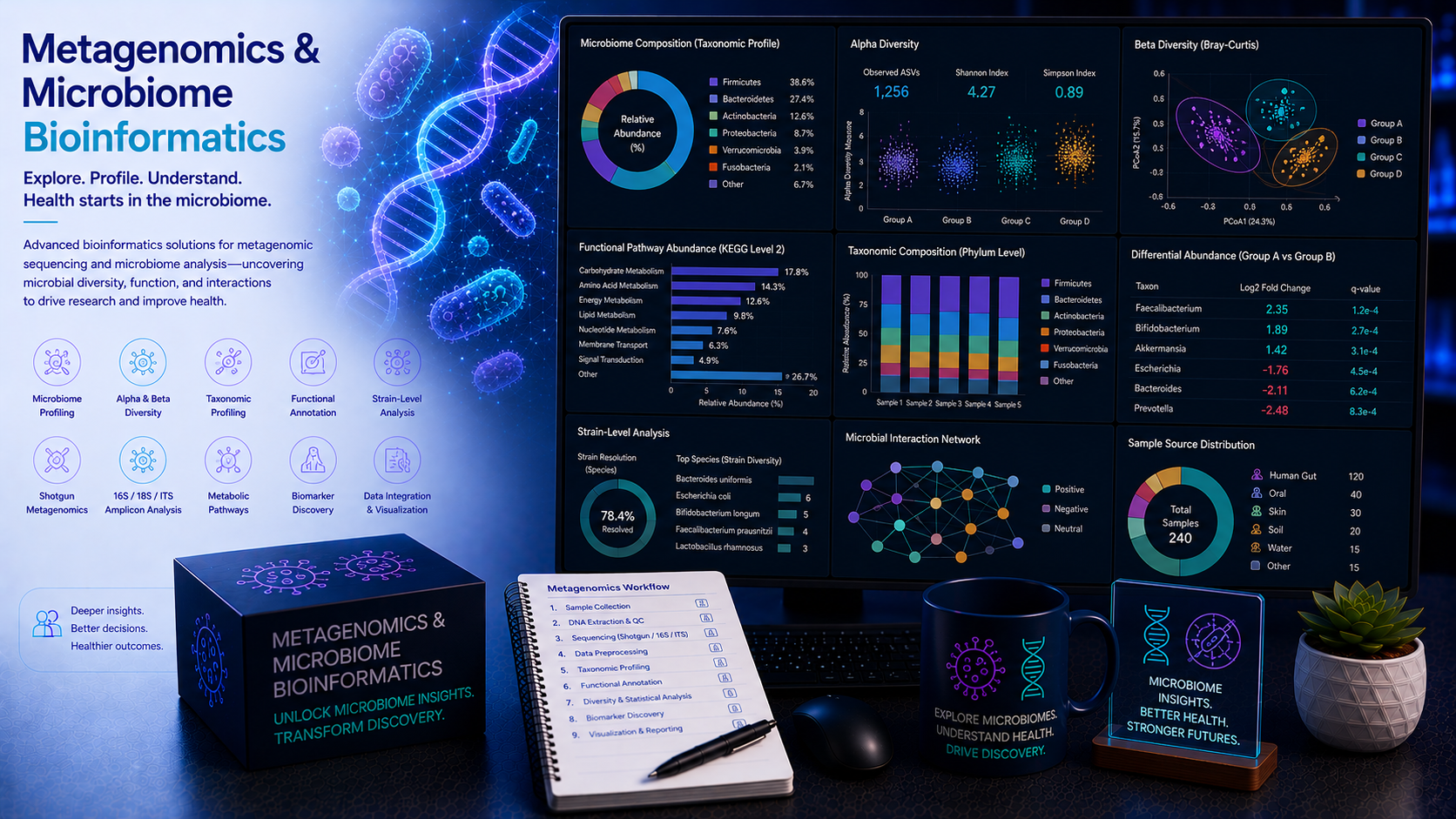
The human microbiome — and microbial communities across soil, ocean, food, and built environments — represent one of the most complex and data-rich frontiers in modern biology. Metagenomics and microbiome sequencing technologies now enable comprehensive profiling of microbial community composition, strain-level diversity, functional potential, and active metabolic pathways from any sample type without the need for culture. From 16S rRNA amplicon surveys and shotgun metagenomics to metatranscriptomics, metabolomics integration, and strain-resolved genome assembly, every layer of microbiome analysis demands specialist bioinformatics expertise. At BioinformaticsNext, we provide expert metagenomics and microbiome bioinformatics services — supporting clinical microbiome research, environmental microbiology, food and agricultural microbiome programmes, and pharmaceutical microbiome-drug interaction studies with rigorous, reproducible, and biologically interpretable analysis.
Metagenomics & Microbiome Bioinformatics: 16S, Shotgun, Strain-Level & Functional Analysis
Expert bioinformatics for 16S rRNA amplicon microbiome profiling, shotgun metagenomics, strain-level resolution, functional pathway analysis, metatranscriptomics, and multi-omics microbiome integration across clinical, environmental, and industrial applications.
Microbial communities shape human health, soil fertility, ocean biogeochemistry, food safety, and industrial biotechnology — yet the vast majority of microorganisms cannot be cultured in the laboratory. Culture-independent metagenomics has unlocked access to this microbial dark matter, enabling taxonomic profiling, functional gene cataloguing, strain tracking, and metabolic pathway reconstruction directly from environmental and clinical samples. The choice of sequencing strategy — 16S amplicon for community composition surveys, shotgun metagenomics for functional depth and strain resolution, metatranscriptomics for active gene expression, or long-read sequencing for complete genome assembly — fundamentally shapes the biological questions that can be answered and the bioinformatics pipeline required. At BioinformaticsNext, we match the analytical approach to your biological question, sample type, and research objectives — delivering microbiome results that are statistically robust, biologically interpretable, and directly actionable.
What We Support
Comprehensive metagenomics and microbiome bioinformatics across amplicon, shotgun, long-read, metatranscriptomic, and multi-omics platforms.
- 16S rRNA, ITS, and 18S amplicon microbiome profiling with DADA2 and QIIME2
- Shotgun metagenomics for taxonomic profiling, functional gene annotation, and resistome analysis
- Strain-level resolution and metagenome-assembled genome (MAG) reconstruction
- Metatranscriptomics for active community gene expression profiling
- Functional pathway analysis and metabolic potential reconstruction
- Longitudinal microbiome dynamics, stability, and perturbation response analysis
- Host-microbiome interaction and metagenome-genome-wide association studies (mGWAS)
- Antimicrobial resistance (AMR) gene and mobile genetic element profiling from metagenomes
- Metabolomics integration for microbiome-metabolite correlation analysis
- Environmental, soil, ocean, and industrial microbiome profiling and comparative analysis
Our Metagenomics & Microbiome Bioinformatics Services
End-to-end metagenomics bioinformatics — from raw sequencing data processing through taxonomic profiling, functional analysis, strain resolution, and multi-omics integration.
All analyses are tailored to your sample type, sequencing platform, target community, study design, and clinical, environmental, or industrial research objectives.
1. 16S rRNA & Amplicon Microbiome Profiling DADA2 · QIIME2 · ASV · Diversity · Taxonomy
16S rRNA amplicon sequencing remains the most widely used approach for bacterial community profiling — providing cost-effective, high-throughput assessment of microbial community composition, diversity, and structure across large sample cohorts. We apply validated, marker-specific pipelines for 16S, ITS (fungi), and 18S (eukaryotes) amplicon data from all major sequencing platforms.
- Amplicon processing and ASV generation — DADA2 and QIIME2-based paired-end read merging, quality filtering, chimera removal, and amplicon sequence variant (ASV) denoising; primer trimming with Cutadapt; marker-specific error model training for V3-V4, V4, and V1-V3 16S hypervariable regions; ITS1/ITS2 fungal and 18S eukaryotic amplicon processing
- Taxonomic classification — SILVA 138, Greengenes2, RDP, and UNITE-based taxonomic assignment using DADA2 naive Bayes, QIIME2 q2-feature-classifier, and VSEARCH exact matching; genus and species-level classification confidence scoring; phylogenetic tree construction with MAFFT and FastTree for UniFrac diversity analysis
- Alpha and beta diversity analysis — Shannon entropy, Simpson index, Faith's PD, Chao1, and ACE alpha diversity with rarefaction and statistical comparison; Bray-Curtis, Jaccard, and weighted/unweighted UniFrac beta diversity; PCoA, NMDS, and PERMANOVA community structure testing; betadisper dispersion homogeneity assessment
- Differential abundance analysis — DESeq2, ANCOM-BC2, ALDEx2, and MaAsLin2 compositionally-aware differential abundance testing between clinical groups, timepoints, or environmental conditions; false discovery rate control; effect size estimation and visualisation with volcano and box plots
2. Shotgun Metagenomics: Taxonomic Profiling & Functional Analysis Kraken2 · MetaPhlAn · HUMAnN · CARD · Resistome
Shotgun metagenomics sequences all DNA in a sample — providing taxonomic resolution to species and strain level, functional gene content characterisation, AMR gene profiling, and the raw material for metagenome-assembled genome reconstruction. We provide comprehensive shotgun metagenomics bioinformatics from quality-controlled reads to interpretable functional community profiles.
- Host read depletion and QC — KneadData, Bowtie2, and BMTagger-based human, mouse, and plant host read removal; FastQC and MultiQC sequencing quality assessment; per-sample read count and quality reporting; low-complexity read filtering with fastp
- Taxonomic profiling — Kraken2 and Bracken species-level taxonomic classification with confidence-based abundance estimation; MetaPhlAn4 marker gene-based species and strain profiling; StrainPhlAn strain-level resolution across samples; species-level abundance comparison and co-occurrence network analysis
- Functional pathway analysis — HUMAnN3-based MetaCyc and KEGG pathway abundance profiling from shotgun reads; gene family (UniRef90) abundance quantification; community-level functional pathway comparison between sample groups; pathway stratification by contributing species
- Resistome and virulence gene profiling — AMRFinderPlus, ResFinder, and CARD RGI-based AMR gene detection and class-level resistance profiling; virulence factor database (VFDB) virulence gene annotation; mobile genetic element and plasmid-associated resistance gene identification; longitudinal AMR gene tracking across treatment timepoints
3. Strain-Level Resolution & Metagenome-Assembled Genomes (MAGs) MAG · Binning · CheckM · GTDB · StrainPhlAn
Strain-level microbiome analysis — resolving the specific genomic variants, gene content, and phylogenetic placement of individual microbial strains within complex communities — is the frontier of metagenomics, enabling transmission tracking, probiotic strain monitoring, pathobiont identification, and the discovery of novel microbial lineages. We provide validated strain-level bioinformatics from shotgun and long-read metagenomics data.
- Metagenome assembly — MEGAHIT and metaSPAdes co-assembly and per-sample assembly of shotgun metagenomes; assembly quality assessment with QUAST; contig depth and coverage calculation for binning; long-read metagenome assembly with Flye and metaMDBG for complete circular genome recovery
- Genome binning and MAG reconstruction — MetaBAT2, CONCOCT, and MaxBin2 automated binning; DAS_Tool ensemble binning for maximum completeness and minimum contamination; CheckM2 MAG quality assessment (completeness, contamination, strain heterogeneity); high-quality MAG selection (≥90% completeness, ≤5% contamination per MIMAG standards)
- MAG taxonomic classification and phylogenomics — GTDB-Tk taxonomy assignment using the Genome Taxonomy Database; phylogenomic tree construction from GTDB marker genes; novel lineage identification and provisional taxonomic naming; ANI-based species boundary assessment with pyANI and fastANI
- Strain tracking and intraspecific variation — StrainPhlAn and InStrain-based intraspecific SNV profiling and strain tracking across samples and timepoints; strain sharing analysis for transmission inference; strain-level functional gene content comparison using Roary and pan-genome analysis
4. Metatranscriptomics & Active Community Profiling RNA-seq · Active Expression · rRNA Depletion · Pathway Activity
Metagenomics characterises the functional potential of a microbial community — but metatranscriptomics reveals which genes are actually being expressed under a given condition, capturing the active metabolic state of the community rather than its genomic repertoire. We provide specialist metatranscriptomics bioinformatics for paired and unpaired metagenomic-metatranscriptomic studies.
- Metatranscriptomic data processing — rRNA depletion quality assessment and residual rRNA filtering with SortMeRNA; host mRNA removal with STAR alignment to host reference genome; transcript assembly with Trinity and reference-based mapping to metagenome-assembled gene catalogues; strand-specific library handling
- Active gene expression profiling — mRNA read quantification against assembled metagenome gene catalogues or reference databases; RPKM, TPM, and FPKM-based expression normalisation; differentially expressed microbial gene identification with DESeq2 between conditions or timepoints
- Active pathway and functional analysis — HUMAnN3 metatranscriptomic mode for active metabolic pathway quantification; comparison of DNA-level (potential) vs. RNA-level (active) pathway abundance; identification of condition-responsive microbial pathways and their taxonomic contributors
- Paired metagenome-metatranscriptome integration — DNA:RNA ratio analysis for gene expression activity scoring; identification of functionally active vs. dormant community members; correlation of active gene expression with community compositional changes and host clinical metadata
5. Multi-Omics Integration, Host-Microbiome Interactions & mGWAS Metabolomics · mGWAS · Host Genetics · Clinical Correlation
The microbiome does not act in isolation — it interacts dynamically with host genetics, immune status, diet, medication, and metabolic phenotype. Integrating microbiome data with metabolomics, host genomics, and clinical metadata reveals the biological mechanisms linking microbial community composition to host health and disease, and identifies actionable microbiome-based biomarkers for clinical translation.
- Microbiome-metabolome integration — LC-MS and GC-MS metabolomics data processing and annotation against HMDB, KEGG, and MetaboLights; MaAsLin2 and mmvec-based microbiome-metabolite correlation analysis; identification of microbially-produced metabolites (SCFAs, bile acids, tryptophan metabolites, TMAO) and their producing taxa
- Host genetics and metagenome GWAS (mGWAS) — Association testing between host SNPs and microbiome species or functional pathway abundance; MiXeR, GEMMA, and PLINK-based mGWAS controlling for population structure, diet, and BMI covariates; identification of host genetic loci influencing microbiome composition
- Longitudinal microbiome dynamics — Mixed-effects models for longitudinal microbiome changes with clinical metadata covariates; intervention response modelling (antibiotic, probiotic, dietary, drug); microbiome stability and resilience assessment; early recovery signature identification post-perturbation
- Microbiome biomarker development — Random forest, LASSO, and elastic net-based microbiome feature selection for disease classification; AUC-ROC and cross-validated predictive model development; microbiome panel optimisation for clinical diagnostic or stratification application; validation in independent cohorts
Key Applications
Metagenomics and microbiome bioinformatics across clinical research, pharmaceutical, environmental, and food science applications.
- Gut microbiome profiling in IBD, IBS, colorectal cancer, and metabolic disease
- Microbiome-drug interaction characterisation in clinical trial samples
- AMR gene surveillance from hospital, community, and environmental metagenomes
- Probiotic and live biotherapeutic strain tracking and safety monitoring
- Soil microbiome diversity and functional profiling for agricultural applications
- Ocean and marine microbiome biogeochemical pathway analysis
- Food fermentation and spoilage microbiome quality monitoring
- Novel MAG discovery and dark matter microbiome characterisation
Tools, Technologies & Reference Databases
Validated, widely adopted metagenomics and microbiome bioinformatics tools and all major reference databases.
- Amplicon: DADA2, QIIME2, VSEARCH, OBITools3, Cutadapt, phyloseq, vegan
- Shotgun Taxonomy: Kraken2, Bracken, MetaPhlAn4, mOTUs3, Kaiju
- Functional: HUMAnN3, SUPER-FOCUS, eggNOG-mapper, InterProScan, PROKKA
- MAG Binning: MetaBAT2, CONCOCT, MaxBin2, DAS_Tool, CheckM2, GTDB-Tk
- Strain-Level: StrainPhlAn, InStrain, Roary, pyANI, fastANI
- SILVA / Greengenes2 / RDP — 16S rRNA reference databases for amplicon taxonomic classification
- GTDB (Genome Taxonomy Database) — Standardised prokaryotic genome taxonomy for MAG classification and phylogenomics
- CARD / ResFinder / VFDB — AMR gene and virulence factor reference databases for resistome profiling
- KEGG / MetaCyc / UniRef90 — Metabolic pathway and gene family databases for functional metagenome annotation
- HMDB / MetaboLights — Metabolite reference databases for microbiome-metabolome integration
Project Deliverables
Structured, publication-ready metagenomics and microbiome bioinformatics outputs for every project.
- ASV or species abundance table with taxonomic assignments and read counts per sample
- Alpha and beta diversity summary with statistical test results and ordination plots
- Differential abundance results with effect sizes, FDR-corrected p-values, and visualisations
- Functional pathway abundance profiles and between-group comparison results
- MAG summary table: completeness, contamination, taxonomy, and key functional genes
- AMR gene and resistance class abundance report with clinical or environmental context
- Publication-ready figures (PDF/SVG/PNG at 300 dpi): PCoA, bar plots, heatmaps, volcano plots
- Full written scientific report with methods, results, biological interpretation, and recommendations
- Pipeline scripts and configuration files for complete analytical reproducibility
- Strain-level tracking and MAG phylogenomic analysis
- Metatranscriptomic active pathway profiling and DNA:RNA ratio analysis
- Microbiome-metabolome integration and SCFA/bile acid correlation analysis
- mGWAS host genetics and microbiome association analysis
- Microbiome biomarker model development and cross-cohort validation
- Manuscript methods section and supplementary figure legends
- Grant application metagenomics sections and preliminary data
- Long-term retainer for ongoing cohort monitoring and database expansion
Frequently Asked Questions
Common questions from clinical researchers, pharmaceutical teams, and environmental microbiology groups.
16S rRNA amplicon sequencing targets a specific hypervariable region of the bacterial 16S gene — providing cost-effective, high-throughput community composition profiling but limited to bacteria and archaea, with resolution typically to genus level. Shotgun metagenomics sequences all DNA in the sample — enabling species and strain-level resolution, functional gene content characterisation, AMR profiling, viral community detection, and MAG reconstruction, but at substantially higher cost and greater bioinformatics complexity. For large cohort studies where compositional profiling is the primary goal, 16S is cost-effective and well-powered. For studies requiring functional depth, strain resolution, or novel genome discovery, shotgun metagenomics is essential. We advise on platform choice at project scoping based on your biological question, sample type, budget, and cohort size.
Microbiome data is inherently compositional — sequencing reads are relative, not absolute, and standard statistical tests designed for count data violate the compositional constraint. We use compositionally-aware differential abundance methods throughout: ANCOM-BC2, which accounts for compositional bias with bias correction; ALDEx2, which uses a Dirichlet-multinomial model and clr transformation; and MaAsLin2, which applies appropriate transformations and mixed-effects models for multi-variable clinical metadata. We avoid methods such as raw DESeq2 on unfiltered microbiome data without appropriate normalisation, and report effect sizes and confidence intervals alongside significance values for clinical interpretability.
Recommended depth depends on community complexity and the analysis goal. For human gut microbiome profiling with MetaPhlAn4, 5–10 million reads per sample provides reliable species-level composition. For functional pathway analysis with HUMAnN3, 20–40 million reads is advisable for comprehensive pathway coverage. For MAG reconstruction, 50–100 million reads or more per sample is typically required for high-quality bin recovery from complex communities. We advise on sequencing depth requirements at project scoping and perform power calculations for differential abundance analyses based on your expected effect sizes and cohort size.
Yes — increasingly so with long-read sequencing. Short-read shotgun metagenomics can produce high-quality MAGs (≥90% completeness, ≤5% contamination) from abundant community members, but fragmented assembly limits complete genome recovery. Oxford Nanopore and PacBio HiFi long-read metagenomics dramatically improves assembly contiguity — often yielding complete circular genomes for dominant community members. Hybrid assembly combining long-read contigs with short-read polishing provides the highest quality genome recovery. We apply the appropriate assembly strategy for your sequencing data and report MAG quality per MIMAG and MISAG community standards.
Absolutely. We assist with the bioinformatics and computational metagenomics sections of grant applications — including proposed 16S or shotgun analysis workflows, functional annotation methodology, strain-level analysis approaches, multi-omics integration plans, and preliminary microbiome data. Please contact us as early as possible in the grant preparation process to allow time for any preliminary analyses that would strengthen the scientific case for funding.
Related Research Areas & Services
Metagenomics and microbiome bioinformatics connects to multiple complementary services we support.
- eDNA & Biodiversity Genomics — Environmental DNA species detection, eukaryotic community metabarcoding, and conservation genomics applications complementing microbial metagenomics in environmental samples
- Infectious Disease & Pandemic Genomics — Pathogen whole-genome sequencing, clinical metagenomics for undiagnosed infection, AMR surveillance, and outbreak phylogenetics from clinical microbiology samples
- Drug Development & AI-Driven Discovery — Microbiome-drug interaction bioinformatics, microbiome biomarker discovery for patient stratification, and computational support for live biotherapeutic product development
- Genetics & Genomics — Host genetics and mGWAS analysis linking human genetic variation to microbiome composition; population genomics approaches shared between microbial and human genomics
- Agricultural Genomics — Soil and rhizosphere microbiome profiling, plant-microbe interaction genomics, and microbiome-based soil health assessment for sustainable agriculture
- Custom Software & Pipeline Development — Bespoke metagenomics analysis platforms, automated microbiome reporting dashboards, and scalable cloud-based pipeline deployment for high-throughput microbiome programmes
Ready to Advance Your Metagenomics or Microbiome Research?
Tell us about your sample type, your sequencing platform, your target microbial community, and your research or clinical objectives. Our metagenomics and microbiome bioinformatics team will design a tailored analytical plan — typically within 48 hours of your enquiry. Whether you need 16S amplicon diversity analysis, shotgun metagenomics functional profiling, MAG reconstruction, metatranscriptomics, AMR resistome characterisation, or microbiome-metabolome integration, we are here to deliver expert, reproducible microbiome results from day one.