
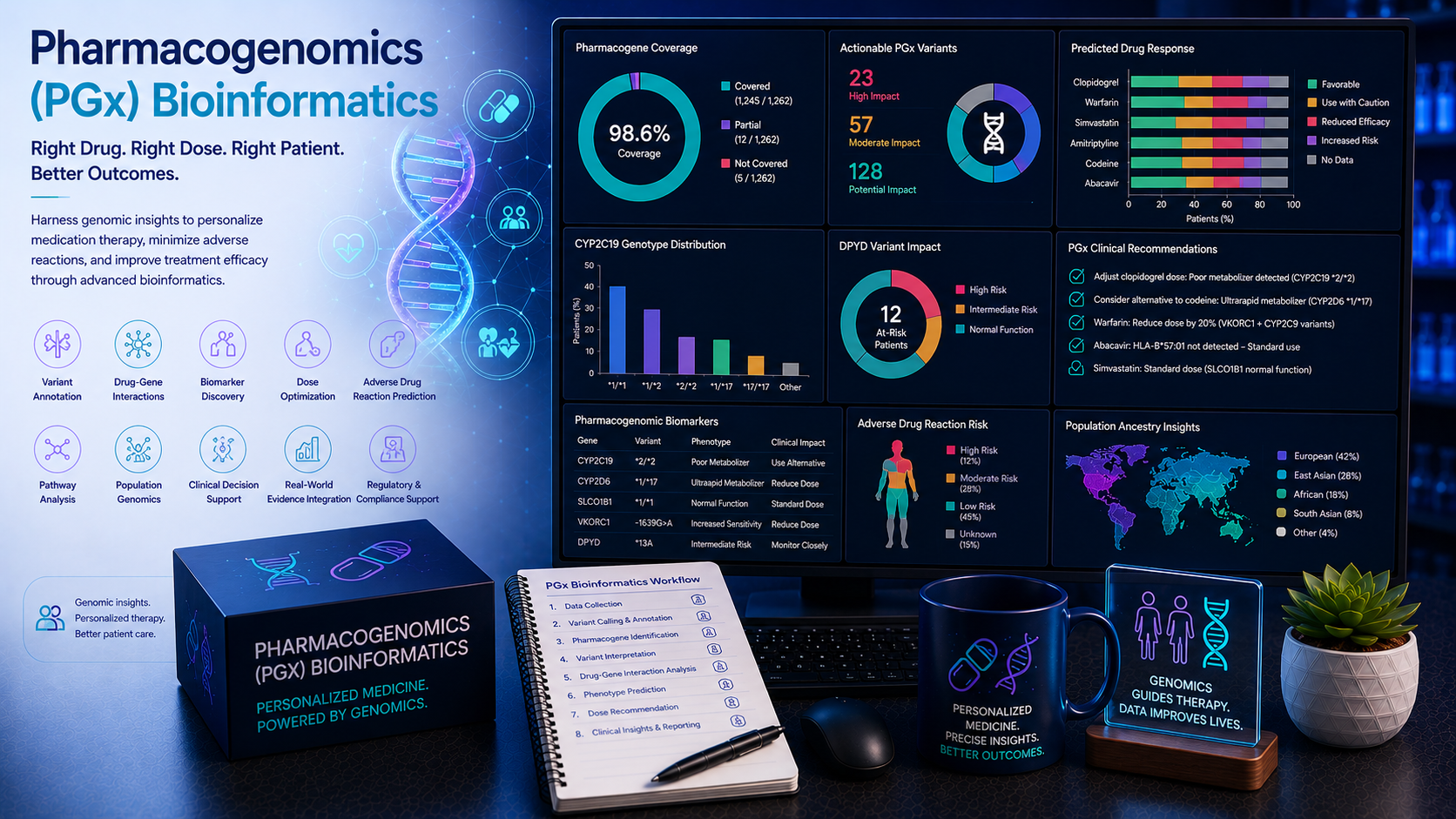
Pharmacogenomics (PGx) is the study of how an individual's genetic variation influences their response to drugs — determining whether a medicine will be effective, ineffective, or cause serious adverse effects. From CYP2D6 and CYP2C19 metabolism profiling to DPYD toxicity risk assessment, HLA-B*57:01 hypersensitivity screening, and BRCA1/2 PARP inhibitor eligibility, pharmacogenomic variant analysis is now central to precision prescribing, clinical trial design, and companion diagnostic development. At BioinformaticsNext, we provide specialist pharmacogenomics bioinformatics services — delivering accurate PGx variant calling, star allele assignment, CPIC and DPWG-aligned phenotype translation, and clinical reporting support for diagnostic laboratories, pharmaceutical companies, and clinical research groups.
Pharmacogenomics Bioinformatics: From Genetic Variants to Personalised Drug Response
Expert PGx variant analysis, star allele calling, CPIC/DPWG phenotype translation, and clinical reporting support for precision medicine and drug development programmes.
Adverse drug reactions and drug inefficacy account for a substantial proportion of hospital admissions, treatment failures, and clinical trial attrition — and a significant fraction of these outcomes are genetically predictable. Pharmacogenomic testing identifies patients who are poor, intermediate, normal, rapid, or ultrarapid metabolisers of key drug-metabolising enzymes, enabling clinicians to adjust doses or select alternative therapies before harm occurs. Yet accurate PGx bioinformatics is technically demanding: star allele assignment requires detection of SNVs, indels, copy number variants, and structural variants within complex, highly homologous gene loci. At BioinformaticsNext, we provide validated, clinically aligned PGx bioinformatics pipelines that deliver accurate genotype and phenotype calls — formatted for clinical reporting, EHR integration, and regulatory submission.
What We Support
Comprehensive pharmacogenomics bioinformatics across all major PGx genes, sequencing platforms, and clinical applications.
- Star allele calling for all CPIC Level A and B drug-gene pairs from WGS, WES, and targeted PGx panel sequencing
- CYP2D6 copy number variant and structural variant analysis including duplications, deletions, and hybrids
- CPIC and DPWG-aligned metaboliser phenotype translation and actionable prescribing guidance
- Oncology PGx: DPYD, TPMT, NUDT15, UGT1A1, and BRCA1/2 somatic biomarker analysis
- HLA allele typing for drug hypersensitivity risk screening (HLA-B*57:01, HLA-B*15:02, HLA-A*31:01)
- PGx panel design, analytical validation, and IVD/CDx regulatory submission support
- Population-scale PGx cohort analysis and actionable variant frequency reporting
- Pre-emptive PGx result formatting for electronic health record (EHR) integration
Our Pharmacogenomics Bioinformatics Services
Validated, clinically aligned PGx bioinformatics across star allele calling, phenotype translation, oncology biomarkers, and regulatory support.
All analyses are tailored to your sequencing platform, gene panel, clinical indication, and reporting requirements.
1. PGx Variant Calling & Star Allele Assignment PharmCAT · Stargazer · PyPGx · WGS · Panel
Accurate star allele assignment requires detection of SNVs, indels, copy number variants, and structural variants — including the highly complex CYP2D6 locus. We deploy validated, multi-tool PGx calling pipelines across WGS, WES, and targeted panel sequencing platforms.
- PharmCAT and PyPGx star allele calling — Comprehensive star allele diplotype calling for CYP2D6, CYP2C19, CYP2C9, CYP3A5, CYP3A4, DPYD, TPMT, NUDT15, SLCO1B1, UGT1A1, VKORC1, F5, IFNL3, and CACNA1S from WGS and WES data aligned to GRCh38
- CYP2D6 copy number and structural variant analysis — Stargazer and Cyrius-based CYP2D6 copy number calling; detection of CYP2D6 gene duplications (*1xN, *2xN), deletions (*5), and CYP2D6/CYP2D7 hybrid alleles; long-read sequencing-based CYP2D6 phasing for ambiguous diplotypes
- Targeted PGx panel analysis — Custom bioinformatics pipelines for amplicon-based and hybridisation capture PGx panels; allele-specific variant calling for known PGx positions; genotype concordance QC against WGS reference calls
- Phasing and diplotype resolution — Statistical and read-based phasing for ambiguous heterozygous PGx calls; trio-based phasing where family sequencing data is available; confidence scoring for uncertain diplotype assignments
2. CPIC & DPWG Phenotype Translation & Clinical Reporting Metaboliser Status · Prescribing Guidance · EHR
Translating genotype into actionable clinical phenotype — and from phenotype into prescribing guidance — requires rigorous application of current CPIC and DPWG guidelines, with appropriate confidence annotation and evidence grading for every gene-drug pair.
- Metaboliser phenotype assignment — Poor (PM), intermediate (IM), normal (NM), rapid (RM), and ultrarapid (UM) metaboliser classification per current CPIC and DPWG activity score frameworks for all actionable drug-metabolising enzyme genes
- CPIC Level A and B drug-gene interaction reporting — Prescribing recommendations for all CPIC Level A gene-drug pairs (e.g. clopidogrel/CYP2C19, codeine/CYP2D6, warfarin/CYP2C9+VKORC1, simvastatin/SLCO1B1, abacavir/HLA-B*57:01); evidence grade and recommendation strength annotation
- Clinical PGx report content preparation — Structured clinical PGx report content including genotype, diplotype, phenotype, evidence grade, and prescribing implications; formatted for laboratory information system (LIS) and EHR integration
- Pre-emptive PGx result formatting — HL7 FHIR-compatible PGx result structuring for pre-emptive pharmacogenomics programmes; genotype-at-a-glance summary tables for clinical decision support tool integration
3. Oncology Pharmacogenomics DPYD · TPMT · NUDT15 · UGT1A1 · BRCA
Oncology PGx biomarkers identify patients at high risk of severe chemotherapy toxicity or those most likely to benefit from targeted therapy — directly informing dose modification, drug selection, and companion diagnostic eligibility decisions in cancer treatment.
- DPYD for fluoropyrimidine toxicity risk — DPYD*2A (rs3918290), c.2846A>T (rs67376798), HapB3 (rs56038477), and c.1679T>G (rs55886062) variant calling and activity score calculation; CPIC-aligned dose reduction recommendations for 5-fluorouracil and capecitabine
- TPMT and NUDT15 for thiopurine dosing — TPMT and NUDT15 star allele calling and phenotype assignment for mercaptopurine, thioguanine, and azathioprine dose optimisation; combined TPMT+NUDT15 risk scoring for myelosuppression prediction
- UGT1A1 for irinotecan toxicity — UGT1A1*28 and *6 genotyping for irinotecan-induced severe neutropenia and diarrhoea risk prediction; DPWG-aligned dose modification guidance
- Somatic BRCA1/2 and HRD for PARP inhibitor eligibility — Somatic BRCA1/2 variant classification for olaparib, niraparib, and rucaparib eligibility; homologous recombination deficiency (HRD) scoring with CHORD and HRDetect; germline BRCA1/2 companion diagnostic analysis
4. HLA Typing & Drug Hypersensitivity Screening HLA-B*57:01 · HLA-B*15:02 · HLA-A*31:01
HLA allele variants are the strongest known genetic risk factors for severe immune-mediated adverse drug reactions — including Stevens-Johnson syndrome, toxic epidermal necrolysis, and drug-induced hypersensitivity syndrome. We provide high-resolution HLA typing for all clinically actionable drug hypersensitivity alleles.
- High-resolution HLA typing — HLA-HD, OptiType, and HISAT-genotype-based HLA class I (HLA-A, -B, -C) and class II (HLA-DRB1, -DQB1, -DPB1) typing from WGS, WES, and RNA-seq data to four-digit allele resolution
- Drug hypersensitivity allele screening — HLA-B*57:01 (abacavir), HLA-B*15:02 (carbamazepine, phenytoin — South/Southeast Asian populations), HLA-A*31:01 (carbamazepine — European populations), HLA-B*58:01 (allopurinol), and HLA-A*02:01 (clozapine) risk allele identification
- Population-stratified HLA frequency reporting — Ancestry-aware HLA allele frequency reporting; population-specific risk allele prevalence context for clinical screening programme design and health economic modelling
5. PGx Panel Development, Validation & Regulatory Support IVD · CDx · Analytical Validation · FDA · CE-IVD
Developing and validating a clinical PGx panel for diagnostic or companion diagnostic use requires rigorous analytical validation and regulatory-grade documentation. We provide end-to-end bioinformatics support for PGx assay development and IVD/CDx regulatory submissions.
- PGx panel design and variant selection — Evidence-based selection of PGx variants for inclusion based on CPIC Level A/B evidence, population frequency, and clinical actionability; panel performance modelling against reference datasets
- Analytical validation bioinformatics — Accuracy, precision, sensitivity, specificity, and reproducibility assessment against reference standards (NA12878, GeT-RM reference samples); concordance analysis between PGx panel and WGS calls
- Regulatory submission support — Bioinformatics sections for FDA 510(k), De Novo, PMA, and CE-IVD IVDR regulatory submissions; software documentation, version control records, and pipeline qualification summaries
Key Applications
Pharmacogenomics bioinformatics across clinical diagnostics, drug development, and population genomics settings.
- Pre-emptive PGx panel testing programmes for hospital and primary care prescribing
- Oncology chemotherapy toxicity risk prediction (DPYD, TPMT, NUDT15, UGT1A1)
- PARP inhibitor companion diagnostic BRCA1/2 and HRD analysis
- HLA drug hypersensitivity screening for abacavir, carbamazepine, and allopurinol
- Psychiatric and cardiology PGx for antidepressant, antipsychotic, and antiplatelet prescribing
- Population cohort PGx profiling and actionable variant frequency analysis
- Clinical PGx panel analytical validation and IVD regulatory submission support
- Pharmaceutical PGx biomarker discovery and clinical trial stratification
Tools, Technologies & Reference Databases
Validated, clinically proven PGx bioinformatics tools and all major pharmacogenomics reference databases.
- Star Allele Calling: PharmCAT, PyPGx, Stargazer, Cyrius, Aldy
- HLA Typing: HLA-HD, OptiType, HISAT-genotype, HLA-VBSeq
- Variant Calling: GATK HaplotypeCaller, DeepVariant, Strelka2
- CNV Analysis: ExomeDepth, GATK gCNV, CNVkit, Cyrius (CYP2D6)
- Workflow: Snakemake, Nextflow, Docker, Git, HPC/SLURM
- PharmGKB / CPIC — Gene-drug interaction annotations and Level A–D prescribing guidelines
- DPWG — Dutch Pharmacogenetics Working Group clinical annotation database
- PharmVar — Pharmacogene Variation Consortium star allele nomenclature and sequence reference
- IPD-IMGT/HLA — HLA allele sequence reference for high-resolution HLA typing
- gnomAD / TOPMed — Population allele frequency reference for PGx variant rarity assessment
Project Deliverables
Structured, clinically aligned PGx bioinformatics outputs for every project.
- Per-sample star allele diplotype and metaboliser phenotype table for all analysed genes
- CPIC and DPWG drug-gene interaction report with prescribing implications
- HLA allele calls and drug hypersensitivity risk allele report (where applicable)
- Oncology PGx toxicity risk and targeted therapy eligibility report (where applicable)
- QC report: coverage, concordance, and confidence metrics for each PGx locus
- Annotated variant files (VCF/TSV) with allele frequency and functional annotations
- Full written methods and results report with pipeline version documentation
- IVD and CDx analytical validation documentation (FDA, CE-IVD IVDR)
- Pre-emptive PGx result formatting for EHR and clinical decision support integration
- Population-scale PGx cohort frequency analysis and actionable variant report
- Manuscript methods section and supplementary data (journal-formatted)
- Grant application pharmacogenomics bioinformatics sections and preliminary data
- Long-term retainer support for ongoing clinical PGx programme development
Frequently Asked Questions
Common questions from diagnostic laboratories, clinical researchers, and pharmaceutical PGx teams.
We support PGx analysis from whole-genome sequencing (WGS), whole-exome sequencing (WES), and targeted PGx panel sequencing on Illumina short-read platforms, as well as long-read sequencing (Oxford Nanopore, PacBio) for phasing of complex loci such as CYP2D6. We use GRCh38 as the primary reference genome alignment for all PGx analyses, with GRCh37 liftover available on request.
CYP2D6 is one of the most complex PGx loci in the human genome — it shares high sequence homology with the nearby CYP2D7 and CYP2D8 pseudogenes, undergoes gene duplications and deletions, and forms CYP2D6/CYP2D7 hybrid alleles that alter enzyme activity in unpredictable ways. Accurate CYP2D6 copy number calling requires specialist tools (Cyrius, Stargazer) and, in some cases, long-read sequencing for definitive phasing. We apply validated multi-tool approaches to maximise accuracy at this challenging locus.
Yes. We produce pre-emptive PGx results formatted for integration into electronic health records and clinical decision support systems — including genotype-at-a-glance summary tables, metaboliser phenotype classifications, and CPIC Level A drug-gene prescribing alerts. We work with your clinical informatics team to ensure outputs are compatible with your LIS and EHR infrastructure.
Yes. We provide PGx biomarker analysis for pharmaceutical drug development programmes — including prospective PGx stratification from clinical trial DNA samples, retrospective PGx analysis of efficacy and safety outcomes, and companion diagnostic development support. All analyses are documented to regulatory standards suitable for inclusion in NDA, MAA, and clinical study reports.
Yes. We produce analytical validation documentation — including accuracy, precision, sensitivity, specificity, and limit of detection assessments against GeT-RM reference standards — suitable for FDA 510(k), De Novo, PMA, and CE-IVD IVDR regulatory submissions. All pipelines are version-controlled with full software and parameter documentation for audit trail compliance.
Related Research Areas & Services
Pharmacogenomics bioinformatics connects to multiple complementary services we support.
- Clinical Genomics & Variant Interpretation — Germline variant calling, ACMG/AMP classification, rare disease diagnosis, and hereditary cancer gene panel analysis
- Drug Development & AI-Driven Discovery — AI-powered biomarker discovery, patient stratification, and companion diagnostic development for pharmaceutical programmes
- Cancer & Oncogenomics — Somatic tumour profiling, TMB and MSI scoring, mutational signature analysis, and HRD scoring for precision oncology treatment decisions
- Genetics & Genomics — Population genomics, GWAS, and polygenic risk score development relevant to drug response and pharmacogenomic trait mapping
- Custom Software & Pipeline Development — Bespoke clinical PGx reporting platforms, automated star allele calling pipelines, and EHR integration tools for diagnostic laboratory deployment
Ready to Advance Your Pharmacogenomics Programme?
Tell us about your sequencing platform, your PGx genes of interest, and your clinical or research objectives. Our pharmacogenomics bioinformatics team will design a tailored analytical plan — typically within 48 hours of your enquiry. Whether you need star allele calling for a clinical PGx panel, oncology toxicity biomarker analysis, HLA hypersensitivity screening, or IVD regulatory validation support, we are here to deliver accurate, clinically actionable PGx results from day one.