
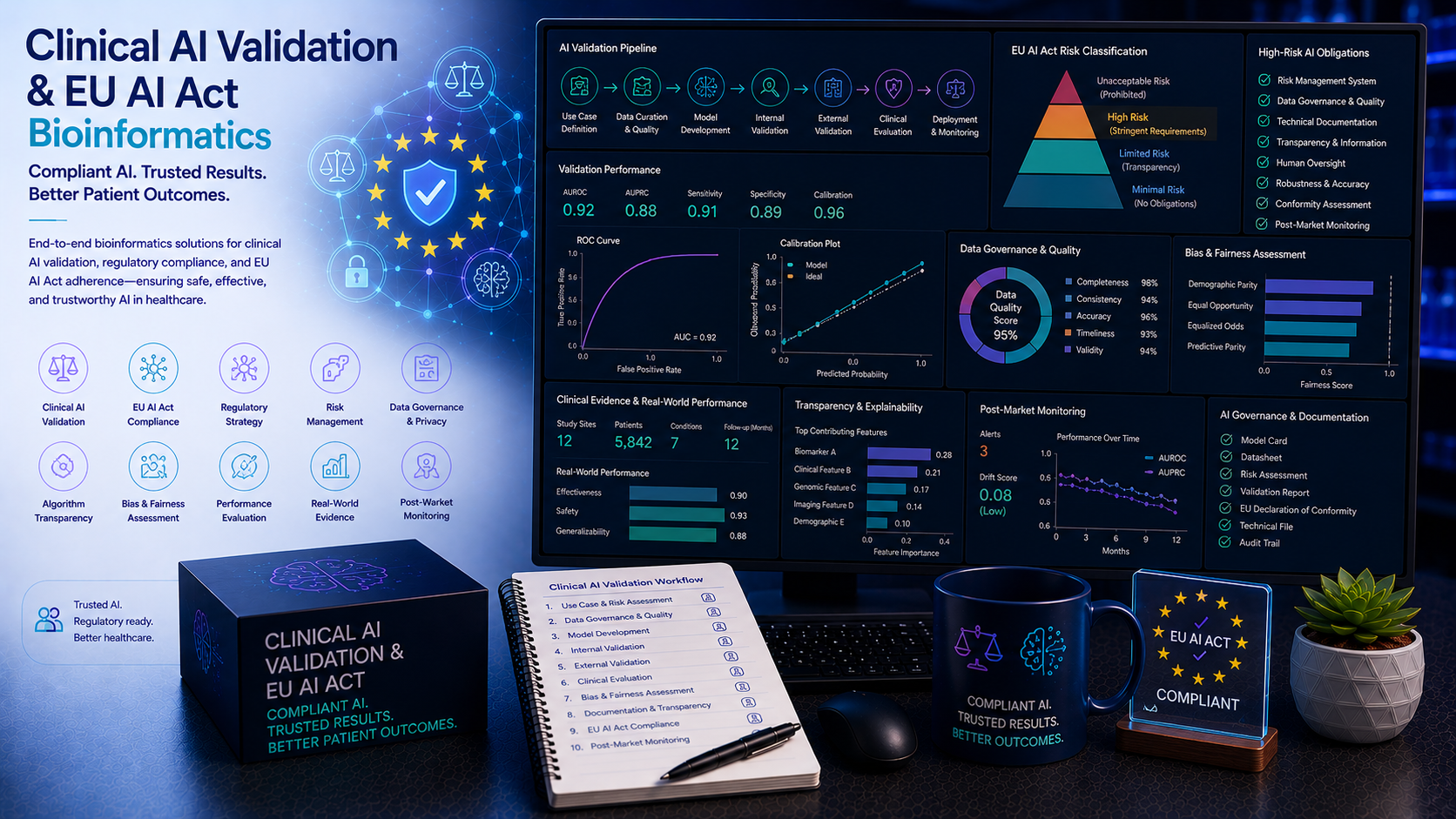
The deployment of artificial intelligence in clinical medicine, genomics, and life science is accelerating — but so is the regulatory scrutiny applied to it. The EU AI Act, FDA AI/ML Software as a Medical Device (SaMD) guidance, and the UK MHRA AI framework have introduced a new compliance landscape in which clinical AI systems must demonstrate transparency, robustness, bias mitigation, and validated performance before deployment in healthcare settings. For AI systems used in genomic variant interpretation, clinical risk stratification, diagnostic imaging, drug response prediction, or patient triage, regulatory-grade validation is no longer optional — it is a legal and ethical requirement. At BioinformaticsNext, we provide specialist clinical AI validation services — delivering independent, expert assessment of AI and machine learning models used in genomics, clinical diagnostics, and life science, aligned with EU AI Act, FDA AI/ML SaMD, and UK MHRA requirements.
Clinical AI Validation & EU AI Act Compliance: Regulatory-Grade AI Model Assessment for Healthcare & Genomics
Expert independent AI model validation, bias assessment, performance benchmarking, explainability analysis, and regulatory documentation for clinical AI systems in genomics, diagnostics, and precision medicine — aligned with EU AI Act, FDA AI/ML SaMD guidance, and UK MHRA AI framework requirements.
The EU AI Act — which entered into force in August 2024 — classifies AI systems used in healthcare as high-risk, imposing mandatory requirements for risk management, data governance, technical documentation, transparency, human oversight, accuracy, robustness, and cybersecurity before market placement. AI systems that influence clinical decision-making — including genomic risk stratification models, diagnostic AI classifiers, patient deterioration prediction algorithms, and treatment recommendation systems — must now demonstrate compliance with these requirements through independent technical validation. Similarly, the FDA's AI/ML SaMD framework requires pre-specified performance specifications, transparency about training data, ongoing monitoring plans, and analytical validation documentation for software that meets the definition of a medical device. At BioinformaticsNext, we provide the independent scientific and technical expertise to navigate these regulatory requirements — combining deep knowledge of clinical AI, genomics, and statistical validation with practical regulatory awareness of the EU AI Act, FDA guidance, and ISO 13485 quality management requirements.
What We Support
Comprehensive clinical AI validation and regulatory compliance support across all healthcare AI system categories, risk classifications, and regulatory jurisdictions.
- EU AI Act high-risk AI system technical documentation and conformity assessment support
- FDA AI/ML SaMD pre-submission, 510(k), De Novo, and PMA AI validation support
- UK MHRA Software as a Medical Device (SaMD) and AI guidance compliance assessment
- Independent AI model performance benchmarking against reference datasets and competitor claims
- Training data representativeness, population diversity, and data governance assessment
- Model bias, fairness, and equity analysis across protected characteristics and clinical subgroups
- Explainability and transparency analysis with SHAP, LIME, and regulatory-aligned interpretability frameworks
- Distribution shift and robustness testing for real-world deployment reliability
- Continuous learning and post-market monitoring plan design
- Clinical AI validation for genomic variant interpretation, polygenic risk scores, and diagnostic classifiers
Our Clinical AI Validation Services
Specialist regulatory-grade clinical AI validation — from EU AI Act technical documentation and FDA SaMD pre-submission support through independent performance benchmarking, bias assessment, and post-market monitoring design.
All assessments are tailored to your AI system category, risk classification, regulatory jurisdiction, intended purpose, and clinical deployment context.
1. EU AI Act Compliance Assessment & Technical Documentation High-Risk · Annex III · Technical File · Conformity · CE
The EU AI Act requires high-risk AI systems — including those used for health and life sciences applications — to undergo conformity assessment and maintain comprehensive technical documentation demonstrating compliance with all applicable requirements before market placement in the EU. We provide specialist technical and scientific support for this process.
- High-risk AI system classification assessment — Assessment of whether your AI system falls within EU AI Act Annex III high-risk category definitions for health, biometrics, critical infrastructure, and education; prohibited AI practice screening; general-purpose AI (GPAI) model applicability assessment; regulatory pathway identification and conformity assessment route selection
- Technical documentation preparation support — AI system description and intended purpose documentation; training, validation, and test data governance and representativeness documentation; system architecture and computational resource documentation; accuracy, robustness, and cybersecurity measure description; human oversight mechanism specification aligned with Article 14 requirements
- Risk management system documentation — ISO 14971-aligned risk management file adapted for AI system risks; foreseeable misuse and reasonably foreseeable failure mode identification; risk control measure design and residual risk assessment; clinical and safety risk documentation for AI systems used in patient-facing clinical decision support
- Post-market monitoring and incident reporting plan — Continuous performance monitoring framework design per EU AI Act Article 72; drift detection strategy for real-world deployment; serious incident reporting procedure design aligned with EU AI Act notification requirements; performance review trigger criteria and re-validation threshold specification
2. FDA AI/ML SaMD Validation & Pre-Submission Support SaMD · Pre-Sub · 510(k) · PMA · Predetermined Change Control
The FDA's regulatory framework for AI/ML-based Software as a Medical Device requires pre-specified performance specifications, transparent training methodology documentation, analytical validation against appropriate reference standards, and a predetermined change control plan (PCCP) for models that learn or update post-deployment. We provide specialist scientific support across the FDA AI/ML SaMD regulatory pathway.
- SaMD device classification and regulatory strategy — AI/ML SaMD device function classification (treat/diagnose/drive/inform); intended use and indications for use specification; predicate device identification for 510(k) strategy; De Novo qualification request criteria assessment; software level of concern (minor, moderate, serious) determination per FDA software guidance
- Pre-submission (Pre-Sub) meeting preparation — Pre-Sub question development for AI/ML-specific regulatory questions; proposed performance testing methodology justification; reference dataset and comparator specification; predetermined change control plan (PCCP) draft preparation; FDA Q&A response strategy for anticipated AI validation questions
- Analytical validation study design and execution — Reference dataset selection and characterisation (Genome in a Bottle, GeT-RM, clinical reference standards); sensitivity, specificity, PPV, NPV, AUC-ROC, and F1 score calculation; confidence interval estimation for performance metrics; subgroup performance analysis across clinically relevant population strata; comparison to predicate or standard-of-care performance
- Predetermined change control plan (PCCP) design — Modification types classification (performance enhancements, input changes, intended use changes); performance monitoring specifications; re-validation trigger criteria and testing protocols; transparency documentation for anticipated AI/ML model updates post-clearance
3. Independent AI Performance Benchmarking & Validation Benchmarking · AUC · Calibration · Reference Standards · Independent
Independent third-party performance validation — evaluating AI model accuracy, calibration, and clinical utility against appropriate reference datasets without involvement of the model developer — is increasingly required by regulators, procurement bodies, and clinical governance committees. Our independent benchmarking provides the objective scientific credibility that internal validation cannot.
- Performance metric assessment — Sensitivity, specificity, positive and negative predictive value, AUC-ROC, AUC-PR, F1 score, Matthews correlation coefficient, and calibration metrics (Brier score, reliability diagrams, expected calibration error) calculation; performance confidence interval estimation with bootstrap resampling; comparison against published state-of-the-art model performance and predicate device claims
- Reference dataset benchmarking — Evaluation against established reference standards: Genome in a Bottle (GIAB) for genomic variant calling AI; GeT-RM for pharmacogenomics models; SEQC2 for sequencing-based classifiers; clinical holdout datasets independent of training and internal validation; de-identified real-world clinical dataset evaluation where available
- Calibration and uncertainty quantification — Platt scaling and isotonic regression post-hoc calibration assessment; expected calibration error (ECE) and maximum calibration error (MCE) calculation; conformal prediction interval coverage assessment; model uncertainty quantification for clinical decision support applications where prediction confidence is critical
- Clinical utility and decision impact analysis — Decision curve analysis (DCA) for net clinical benefit assessment across decision thresholds; number needed to screen and number needed to treat implications of AI system deployment; incremental clinical value above standard-of-care assessment; patient outcome simulation modelling from AI decision support implementation
4. Bias, Fairness & Equity Assessment Subgroup Analysis · Protected Characteristics · Health Equity · Disparities
AI systems trained on non-representative datasets can perform substantially worse for underrepresented patient groups — widening health inequalities rather than reducing them. The EU AI Act explicitly requires accuracy across all population groups, and FDA guidance requires subgroup performance analysis. We provide rigorous bias and fairness assessment across clinically and sociodemographically relevant subgroups.
- Training data representativeness assessment — Demographic composition analysis of training, validation, and test datasets across age, sex, ethnicity, socioeconomic status, and geographic origin; comparison against target deployment population demographics; identification of underrepresented groups with potential for degraded performance; data augmentation and re-sampling strategy recommendations
- Subgroup performance analysis — Stratified performance metric calculation across age groups, sex, ethnicity, comorbidity status, and clinical presentation subgroups; statistical testing for performance differences between subgroups; interaction testing for AI system performance modification by patient characteristics; identification of subgroups where model performance falls below acceptable thresholds
- Algorithmic fairness metric assessment — Demographic parity, equal opportunity, equalised odds, and individual fairness metric calculation; trade-off analysis between competing fairness definitions; calibration equity across demographic groups; fairness-accuracy trade-off characterisation for AI system deployment decisions
- PRS and genomic AI ancestry bias assessment — Performance degradation of polygenic risk score and genomic AI models in non-European ancestry populations; LD structure mismatch and allele frequency difference impact assessment; multi-ancestry model portability evaluation; equitable clinical deployment strategy recommendations for diverse patient populations
5. Explainability, Transparency & Robustness Testing SHAP · LIME · Robustness · Distribution Shift · EU AI Act Art. 13
The EU AI Act Article 13 requires high-risk AI systems to be sufficiently transparent to enable users to interpret their outputs and use them appropriately. FDA guidance similarly emphasises the importance of explainability for clinical AI systems influencing patient management. We provide technical explainability analysis and robustness testing that satisfies regulatory requirements while providing clinically meaningful interpretability.
- Model explainability analysis — SHAP (SHapley Additive exPlanations) global and local feature importance analysis for tabular, genomic, and multi-omics AI models; LIME (Local Interpretable Model-agnostic Explanations) individual prediction explanation; attention weight visualisation for transformer and deep learning models; gradient-based saliency maps for image and sequence-based AI; feature importance stability and consistency assessment across prediction instances
- Regulatory-aligned transparency documentation — EU AI Act Article 13-compliant transparency documentation describing AI system capabilities, limitations, and appropriate use conditions; intended user population and clinical context specification; known performance degradation conditions and contraindications; model card and datasheet preparation following established AI transparency reporting standards
- Distribution shift and robustness testing — Performance evaluation on out-of-distribution samples representing different hospitals, sequencing platforms, patient demographics, and clinical workflows; adversarial robustness testing for AI systems exposed to manipulated inputs; performance degradation profiling across data quality variations; deployment context generalisation assessment
- Post-market monitoring plan and drift detection — Statistical process control and monitoring framework design for real-world AI deployment; population-level input feature drift detection with PSI and KS statistics; output distribution monitoring for prediction drift; re-validation trigger specification and validation dataset curation strategy for ongoing model lifecycle management
Key Applications
Clinical AI validation across genomics, diagnostics, precision medicine, and healthcare AI deployment contexts.
- EU AI Act conformity assessment for genomic AI and diagnostic software
- FDA AI/ML SaMD pre-submission and analytical validation for clinical genomics products
- Independent performance benchmarking for enterprise procurement and regulatory review
- Polygenic risk score clinical deployment equity and bias assessment for NHS
- Clinical decision support AI explainability and transparency documentation
- Investor due diligence independent AI validation for life science SaaS products
- Hospital clinical governance AI evaluation for third-party system procurement
- Pharmaceutical AI model validation for clinical trial regulatory submissions
Regulatory Frameworks We Work With
Expert knowledge across all major clinical AI regulatory frameworks applicable to healthcare and life science AI systems.
EU AI Act (2024)
High-risk AI system requirements for healthcare: technical documentation, risk management, data governance, transparency (Article 13), human oversight (Article 14), accuracy and robustness (Article 15), and post-market monitoring (Article 72). Conformity assessment and notified body engagement support.
FDA AI/ML SaMD Framework
Predetermined change control plans, performance specifications, transparency documentation, analytical validation study design, Pre-Sub meeting preparation, 510(k), De Novo, and PMA submission bioinformatics support for AI-based medical devices and IVDs.
UK MHRA SaMD & AI Guidance
UK MHRA AI and Software as a Medical Device guidance compliance assessment; DTAC (Digital Technology Assessment Criteria) evidence preparation for NHS procurement; NICE Evidence Standards Framework for digital health technologies alignment.
ISO Standards & Good Practice
ISO 13485 quality management-aligned AI validation documentation; ISO 14971 risk management adaptation for AI systems; IEC 62304 software lifecycle documentation; WHO guidance on AI ethics and health equity; EQUATOR TRIPOD+AI reporting standard compliance.
Project Deliverables
Structured, regulatory-grade clinical AI validation outputs for every engagement.
- AI system risk classification assessment and regulatory pathway recommendation
- Independent performance benchmarking report: sensitivity, specificity, AUC, calibration, and clinical utility metrics
- Subgroup bias and fairness analysis across demographic and clinical strata
- SHAP feature importance and explainability analysis report
- Robustness and distribution shift testing results
- EU AI Act technical documentation content or FDA SaMD analytical validation report
- Post-market monitoring plan and drift detection framework design
- Full written regulatory-grade validation report with findings, risk assessment, and recommendations
- EU AI Act conformity assessment technical file preparation support
- FDA Pre-Sub Q&A document development and meeting preparation
- TRIPOD+AI and model card preparation for publication and transparency
- DTAC evidence package for NHS Digital procurement assessment
- Investor or acquirer AI due diligence structured assessment report
- Ongoing post-market AI performance monitoring retainer
- Training and knowledge transfer for in-house AI governance teams
Frequently Asked Questions
Common questions from clinical AI developers, genomics SaaS companies, hospital procurement teams, and pharmaceutical AI teams.
Under the EU AI Act Annex III, AI systems used in healthcare are classified as high-risk when they are intended to be used as a safety component of a medical device or are themselves a medical device subject to conformity assessment under EU medical device regulations (MDR 2017/745 and IVDR 2017/746). This includes AI systems used for diagnostic decision support, patient risk stratification, genomic interpretation, treatment recommendation, and clinical pathway guidance that influence clinical decisions affecting patient health and safety. General purpose AI models (GPAIs) with systemic risk — such as large foundation models used in clinical settings — face additional obligations under the Act. We perform classification assessments as the first step of every EU AI Act engagement.
The EU AI Act is a horizontal regulation governing all high-risk AI systems — it focuses on risk management, data governance, transparency, human oversight, robustness, and post-market monitoring as system-level properties, and requires a conformity assessment process that may involve a notified body. FDA AI/ML SaMD guidance is specific to software that meets the definition of a medical device — it focuses on pre-specified performance specifications, analytical validation against reference standards, predetermined change control plans for adaptive algorithms, and the established 510(k)/De Novo/PMA clearance or approval pathway. For products marketed in both jurisdictions, both frameworks apply and must be addressed — though there is increasing alignment between them. We advise on the most efficient combined validation strategy at project scoping.
Clinical genomics AI bias assessment focuses on performance degradation across ancestry groups (particularly for polygenic risk scores and genomic variant classifiers trained predominantly on European-ancestry data), sex and age-related performance differences in diagnostic AI models, and socioeconomic and geographic biases introduced through healthcare access disparities in training data. We calculate stratified performance metrics across all relevant demographic and clinical subgroups, test statistical significance of performance differences, assess calibration equity, and compare model performance degradation in underrepresented groups against acceptable threshold specifications. For PRS models specifically, we evaluate LD structure mismatch and allele frequency difference effects on prediction accuracy in non-European ancestry validation cohorts.
A Predetermined Change Control Plan (PCCP) is an FDA mechanism allowing AI/ML-based medical devices that learn or update post-market clearance to make specified types of modifications without requiring a new 510(k) submission for each change. A PCCP describes the types of modifications anticipated, the performance specifications the modified device must meet, and the testing and monitoring protocols that will be applied. It is relevant for adaptive AI systems that retrain on new data, update model weights, or expand indications post-clearance. Static AI models that do not update after deployment may not require a PCCP, but must still have a defined change management process. We assess PCCP applicability and draft PCCP content as part of FDA AI/ML SaMD regulatory strategy engagements.
Yes — independent third-party AI validation is one of the most requested services for NHS and hospital clinical governance committees evaluating AI systems for clinical deployment. We evaluate vendor-submitted performance claims against independent reference datasets, assess bias and fairness across the hospital's specific patient population demographics, review training data documentation for representativeness, and produce a structured independent assessment report formatted for clinical governance committee review. We also assess DTAC (Digital Technology Assessment Criteria) evidence completeness for NHS England procurement requirements and NICE Evidence Standards Framework alignment for digital health technology evaluation.
Related Research Areas & Services
Clinical AI validation connects to multiple complementary services we support.
- Bioinformatics SaaS Consulting — Scientific credibility, pipeline benchmarking, competitive landscape analysis, and go-to-market scientific strategy for genomics and clinical AI SaaS products requiring EU AI Act and FDA validation
- Clinical Genomics & Variant Interpretation — Analytical validation of genomic variant interpretation AI against ACMG/AMP classification standards, IVD regulatory submissions, and independent benchmarking against clinical reference standards
- Biomarker Discovery & Validation — AI-based clinical biomarker model development, decision curve analysis, cross-cohort validation, and companion diagnostic regulatory submission analytical validation support
- RWE & EHR Genomics — Polygenic risk score clinical deployment equity assessment, NHS implementation evidence, and NICE framework-aligned clinical utility evaluation for genomic AI systems
- Drug Development & AI-Driven Discovery — AI model development, training dataset curation, QSAR model validation, and drug discovery AI performance benchmarking for pharmaceutical regulatory submissions
- Custom Software & Pipeline Development — Bespoke clinical AI governance platforms, automated model monitoring dashboards, and regulatory documentation management systems for clinical AI product lifecycle management
Ready to Validate Your Clinical AI System for Regulatory Compliance?
Tell us about your AI system, its intended clinical use, your target regulatory jurisdiction, and your deployment timeline. Our clinical AI validation team will design a tailored regulatory compliance and validation plan — typically within 48 hours of your enquiry. All initial consultations are conducted in strict confidence. Whether you need EU AI Act technical documentation, FDA AI/ML SaMD pre-submission support, independent performance benchmarking, bias and fairness assessment, explainability analysis, or NHS procurement DTAC evidence preparation, we are here to deliver expert, credible, and regulatory-grade clinical AI validation from day one.