
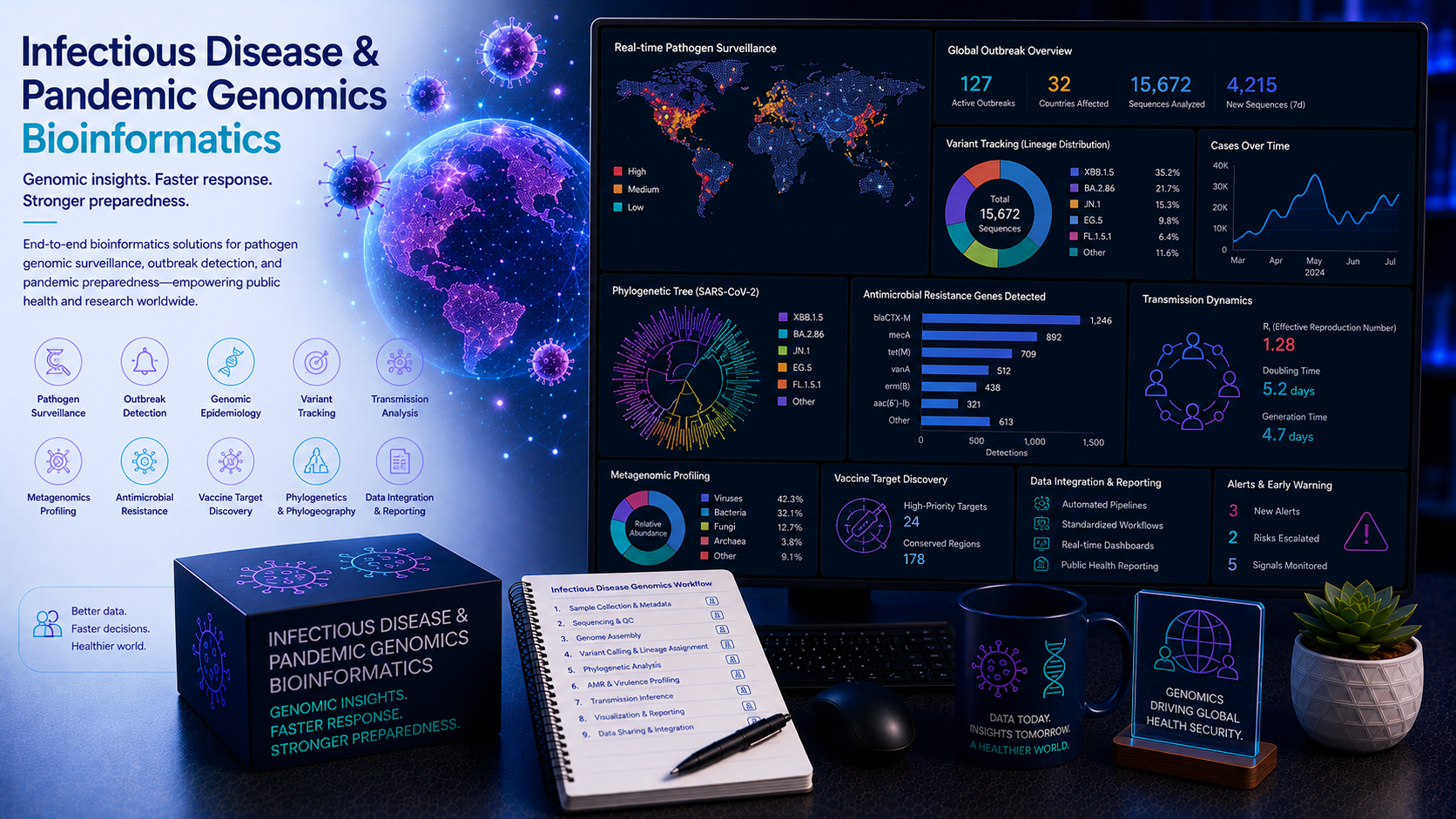
Infectious disease genomics and pandemic preparedness have been transformed by next-generation sequencing — enabling real-time pathogen surveillance, outbreak source tracking, antimicrobial resistance profiling, host genetic susceptibility analysis, and vaccine antigen discovery at unprecedented speed and scale. From SARS-CoV-2 variant tracking and influenza phylodynamics to tuberculosis transmission networks and metagenomics-based pathogen discovery, every application demands specialist bioinformatics expertise. At BioinformaticsNext, we provide expert infectious disease and pandemic genomics bioinformatics services — supporting public health agencies, academic infectious disease groups, pharmaceutical vaccine developers, and clinical microbiology teams with rigorous, reproducible, and scalable pathogen genomics analysis.
Infectious Disease & Pandemic Genomics: Pathogen Surveillance, Host Genomics & Vaccine Discovery
Expert bioinformatics for pathogen whole-genome sequencing, outbreak investigation, AMR profiling, metagenomic pathogen discovery, host susceptibility genomics, and vaccine antigen identification.
The COVID-19 pandemic demonstrated with stark clarity how genomic sequencing of pathogens — combined with rapid, scalable bioinformatics — can transform the speed and precision of public health response. Pathogen whole-genome sequencing now informs variant classification, transmission network reconstruction, antimicrobial resistance surveillance, vaccine strain selection, and therapeutic target identification across a broad spectrum of bacterial, viral, fungal, and parasitic pathogens. Simultaneously, host genomics studies are identifying the human genetic factors that determine susceptibility, severity, and immune response to infection — providing new targets for therapeutic intervention and risk stratification. At BioinformaticsNext, we provide the full infectious disease genomics bioinformatics stack — from raw sequencing data to publication-ready phylogenies, AMR reports, and vaccine candidate prioritisation.
What We Support
Comprehensive bioinformatics across pathogen genomics, outbreak investigation, AMR surveillance, metagenomics, and host genomics for infectious disease research and public health.
- Pathogen whole-genome sequencing assembly, annotation, and quality assessment
- Phylogenetic analysis, variant classification, and outbreak transmission network reconstruction
- Antimicrobial resistance (AMR) gene detection, mutation profiling, and resistance mechanism analysis
- Metagenomic and clinical metatranscriptomic pathogen identification and discovery
- Viral evolution, phylodynamics, and pandemic variant surveillance
- Host genetic susceptibility GWAS and immune response genomics for infectious disease
- Vaccine antigen identification, epitope prediction, and immunogen design support
- CRISPR-based diagnostic target identification and pathogen detection assay design
- Long-read sequencing-based plasmid and mobile genetic element characterisation
- Real-time genomic surveillance pipeline development and automation
Our Infectious Disease & Pandemic Genomics Services
End-to-end pathogen genomics bioinformatics — from sequencing QC and genome assembly to phylodynamics, AMR profiling, metagenomics, and vaccine antigen discovery.
All analyses are tailored to your pathogen, sequencing platform, clinical or epidemiological context, and public health or research reporting requirements.
1. Pathogen Whole-Genome Sequencing & Assembly Illumina · Oxford Nanopore · Assembly · Annotation
Accurate pathogen genome assembly and annotation is the foundation of all downstream infectious disease genomics — whether for outbreak investigation, AMR surveillance, or vaccine antigen discovery. We support both short-read Illumina and long-read Oxford Nanopore and PacBio sequencing data across bacterial, viral, fungal, and parasitic pathogens.
- Viral genome assembly and consensus calling — Reference-based assembly with BWA, Minimap2, and iVar for high-diversity RNA viruses; de novo assembly with SPAdes and Flye for novel or highly divergent viral genomes; SARS-CoV-2, influenza, RSV, HIV, MPOX, and arbovirus-specific pipelines
- Bacterial genome assembly and annotation — Short-read (SPAdes, Velvet) and long-read (Flye, Canu) bacterial genome assembly; Prokka, RAST, and Bakta-based rapid annotation; MLST typing with mlst and PubMLST; plasmid identification with MOB-suite and Platon
- Genome quality assessment — CheckM completeness and contamination assessment for bacterial genomes; QUAST assembly statistics; per-base coverage analysis and low-coverage region flagging; genome-level QC reporting for sequencing batch review
- Variant calling from pathogen sequencing — iVar, LoFreq, and Snippy-based SNP and indel calling relative to reference genomes; within-host diversity quantification; minor variant detection for quasispecies analysis in RNA viruses
2. Phylogenetics, Outbreak Investigation & Transmission Analysis IQ-TREE · Nextstrain · Bayesian · SNP Distance
Phylogenetic analysis of pathogen genome sequences reconstructs evolutionary relationships, identifies outbreak clusters, traces transmission chains, and tracks the emergence and spread of novel variants — providing the evidence base for public health intervention and infection control decision-making.
- Maximum likelihood and Bayesian phylogenetics — IQ-TREE2 and RAxML-NG maximum likelihood phylogenetic tree construction with bootstrap support; BEAST2 and MrBayes Bayesian phylogenetic analysis with temporal signal testing; substitution model selection with ModelTest-NG
- Outbreak cluster identification — SNP distance matrix calculation with snp-dists and pairwise alignment; outbreak cluster definition using epidemiologically calibrated SNP thresholds; transmission network visualisation with GrapeTree and Microreact
- Nextstrain and phylodynamic analysis — Augur and Auspice-based Nextstrain phylodynamic pipelines for real-time viral surveillance; molecular clock analysis and time-resolved phylogeny construction; ancestral state reconstruction and variant emergence dating
- Recombination and reassortment detection — RDP4, GARD, and ClonalFrame-based recombination detection in bacterial and viral genomes; reassortment analysis for segmented RNA viruses including influenza, rotavirus, and norovirus
3. Antimicrobial Resistance (AMR) Genomics ResFinder · RGI · MLST · Plasmid · Mobile Elements
Antimicrobial resistance is one of the most urgent global health threats — and whole-genome sequencing of resistant pathogens provides a comprehensive view of resistance gene content, resistance mutation profiles, and the mobile genetic elements driving AMR transmission. We provide validated AMR genomics bioinformatics for clinical, surveillance, and research applications across all priority WHO pathogens.
- AMR gene detection and resistance profiling — ResFinder, RGI (CARD), AMRFinderPlus, and ABRicate-based AMR gene identification; beta-lactamase, carbapenemase (KPC, NDM, OXA), ESBL, colistin resistance (mcr), and glycopeptide resistance gene reporting; acquired vs. intrinsic resistance classification
- Resistance mutation identification — Point mutation-based resistance profiling for Mycobacterium tuberculosis (TB-Profiler), MRSA (PBP2a), fluoroquinolone-resistant gonorrhoea, and antifungal-resistant Candida; WHO-endorsed resistance mutation catalogue application for TB drug susceptibility prediction
- Plasmid and mobile genetic element analysis — PlasmidFinder and Platon plasmid replicon typing; MOB-suite mobilisation potential assessment; IS element identification and AMR gene-carrying transposon characterisation; long-read-enabled complete plasmid assembly for AMR gene context
- AMR surveillance and epidemiological reporting — Population-level AMR gene frequency tracking across time and geography; resistance trend analysis; concordance between genotypic resistance prediction and phenotypic MIC data; EUCAST and CLSI breakpoint-aligned reporting
4. Metagenomics & Pathogen Discovery mNGS · Kraken2 · DIAMOND · Novel Pathogen · Clinical
Metagenomic next-generation sequencing (mNGS) enables unbiased, culture-independent identification of all microbial species present in a clinical or environmental sample — including novel, unculturable, or unexpected pathogens that would be missed by targeted diagnostic testing. We provide clinical and environmental metagenomics bioinformatics across shotgun, amplicon, and long-read sequencing platforms.
- Taxonomic classification and pathogen identification — Kraken2, Kaiju, and DIAMOND-based taxonomic classification of metagenomic reads; host read depletion with Bowtie2 and KneadData; species-level abundance profiling with Bracken; clinical pathogen shortlist generation with confidence scoring
- 16S rRNA and ITS amplicon analysis — QIIME2 and DADA2-based 16S rRNA amplicon sequence variant (ASV) calling; taxonomic assignment against SILVA and Greengenes2 databases; alpha and beta diversity analysis; microbiome compositional analysis with ALDEx2 and ANCOM-BC
- Novel pathogen discovery and characterisation — De novo assembly of unclassified metagenomic contigs; BLASTx and HMM-based protein domain annotation; phylogenetic placement of novel sequences; genome completeness assessment for novel viral and bacterial genomes
- Functional and resistome metagenomics — HUMAnN3-based metabolic pathway abundance profiling; AMR gene detection from metagenomic reads with AMRFinderPlus and CARD-RGI; virulence gene and mobile element characterisation from environmental and clinical metagenomes
5. Host Genomics, Susceptibility & Vaccine Antigen Discovery Host GWAS · HLA · Epitope Prediction · Immunogen Design
Understanding why some individuals develop severe disease while others remain asymptomatic — and identifying protective immune responses — requires integration of host genomics, immunology, and pathogen biology. We provide bioinformatics support for host susceptibility GWAS, immune response genomics, and computational vaccine antigen identification across bacterial, viral, and parasitic pathogens.
- Host infectious disease GWAS and susceptibility analysis — GWAS analysis of susceptibility, severity, and immune response phenotypes (COVID-19 HGI, GenOMICC, UK Biobank infectious disease phenotypes); colocalisation with immune cell eQTL data; Mendelian randomisation for causal risk factor identification
- HLA typing and immune response genetics — HLA-HD and HISAT-genotype HLA class I and II typing; HLA association analysis for infectious disease susceptibility and vaccine response; KIR gene content analysis for NK cell-mediated viral control
- Vaccine antigen identification and epitope prediction — Reverse vaccinology: surface protein prediction with PSORTb, SignalP, and TMHMM; pan-genome core antigen identification across diverse pathogen strains; NetMHCpan and BepiPred-based T cell and B cell epitope prediction; antigen conservation scoring across circulating variants
- Transcriptomic immune response profiling — Bulk and single-cell RNA-seq analysis of host immune responses to infection and vaccination; interferon response gene signature scoring; innate and adaptive immune activation pathway analysis; correlate of protection identification from vaccine trial transcriptomics
Key Applications
Infectious disease genomics bioinformatics across public health, clinical microbiology, pharmaceutical, and academic settings.
- SARS-CoV-2, influenza, RSV, and mpox genomic surveillance and variant tracking
- Hospital outbreak investigation and transmission chain reconstruction
- Tuberculosis whole-genome sequencing and drug resistance prediction
- Carbapenem-resistant Enterobacteriaceae (CRE) and MRSA AMR surveillance
- Clinical metagenomics for undiagnosed infection and novel pathogen detection
- Vaccine antigen discovery and cross-strain epitope conservation analysis
- Host susceptibility GWAS for COVID-19 severity and infectious disease risk
- Environmental AMR surveillance and One Health genomics programmes
Tools, Technologies & Reference Databases
Industry-standard and cutting-edge infectious disease genomics tools and all major pathogen reference databases.
- Assembly: SPAdes, Flye, Canu, Minimap2, BWA, iVar, Medaka
- Phylogenetics: IQ-TREE2, RAxML-NG, BEAST2, Augur/Auspice, snp-dists, GrapeTree
- AMR: ResFinder, RGI/CARD, AMRFinderPlus, TB-Profiler, PlasmidFinder, MOB-suite
- Metagenomics: Kraken2, Bracken, DIAMOND, QIIME2, DADA2, HUMAnN3, KneadData
- Annotation: Prokka, Bakta, RAST, SnpEff, Roary (pan-genome)
- NCBI RefSeq / GenBank — Reference pathogen genome sequences for assembly, annotation, and phylogenetic analysis
- GISAID — Global influenza and SARS-CoV-2 genome sequence sharing platform for surveillance and phylodynamics
- CARD (Comprehensive Antibiotic Resistance Database) — AMR gene and mutation reference database for resistance profiling
- PubMLST — Multilocus sequence typing reference database for bacterial strain classification
- SILVA / Greengenes2 — 16S rRNA and ITS reference databases for microbiome taxonomic classification
Project Deliverables
Structured, actionable infectious disease genomics outputs for every project.
- Assembled and annotated pathogen genomes with QC metrics and coverage reports
- Phylogenetic trees with bootstrap support and time-calibrated molecular clock (where applicable)
- SNP distance matrix and outbreak cluster assignments with epidemiological context
- AMR gene and resistance mutation report with drug class summary and confidence scores
- Metagenomic species abundance tables and pathogen identification shortlist
- Vaccine antigen candidate list with epitope predictions and cross-strain conservation scores
- Publication-ready figures (PDF/SVG/PNG at 300 dpi): phylogenies, SNP heatmaps, AMR profiles
- Full written scientific report with methods, results, and public health or research interpretation
- Real-time genomic surveillance pipeline development and deployment
- Regulatory submission sections for vaccine IND/CTA and diagnostic IVD applications
- GISAID and NCBI SRA genome sequence submission formatting and support
- Nextstrain build configuration and public or private server deployment
- Manuscript methods section and supplementary figure legends
- Grant application infectious disease genomics sections and preliminary data
- Long-term surveillance retainer for ongoing outbreak monitoring and reporting
Frequently Asked Questions
Common questions from public health agencies, clinical microbiology laboratories, and infectious disease research groups.
We support bioinformatics analysis for all major bacterial, viral, fungal, and parasitic pathogens — including SARS-CoV-2, influenza A/B, RSV, HIV, MPOX, Mycobacterium tuberculosis, Staphylococcus aureus, Klebsiella pneumoniae, Clostridioides difficile, Candida auris, Plasmodium falciparum, and many others. We work with Illumina short-read, Oxford Nanopore long-read, and PacBio HiFi sequencing data, and adapt our pipelines to the specific biology and genome characteristics of your pathogen of interest.
Yes. We have experience providing rapid-turnaround bioinformatics support for active outbreak investigations — including same-week phylogenetic analysis, SNP cluster identification, and transmission network reconstruction from hospital or community sequencing data. We can also develop and deploy automated Nextstrain-based surveillance pipelines for ongoing genomic monitoring programmes, with outputs viewable in real time through Auspice interactive visualisations.
Yes — for many priority pathogens. Genotypic resistance prediction from WGS is now validated for Mycobacterium tuberculosis (using WHO-endorsed resistance mutation catalogues via TB-Profiler), MRSA, ESBL-producing Enterobacteriaceae, carbapenem-resistant organisms, and others. We clearly distinguish between high-confidence resistance predictions supported by validated catalogues and lower-confidence predictions from novel or uncharacterised variants, and we contextualise genotypic predictions against EUCAST and CLSI phenotypic breakpoints.
Reverse vaccinology uses genomic and computational approaches to identify vaccine antigen candidates — predicting surface-exposed proteins, secreted factors, and conserved antigens from pathogen genome sequences without the need for prior experimental testing of every protein. We predict surface localisation (PSORTb, SignalP, TMHMM), assess cross-strain antigen conservation across diverse pathogen isolates, predict T cell and B cell epitopes (NetMHCpan, BepiPred), and rank candidates by antigenicity, conservation, and expression evidence.
Yes. We prepare GISAID-compliant SARS-CoV-2 and influenza genome submission packages — including sequence quality filtering, metadata formatting, and submission file generation — as well as NCBI GenBank and SRA submission packages for all pathogen types. We ensure sequences meet quality thresholds and metadata standards required for public database acceptance.
Related Research Areas & Services
Infectious disease genomics connects to multiple complementary services we support.
- Clinical Genomics & Variant Interpretation — Host germline variant analysis, HLA typing, and immune response genetics for infectious disease susceptibility and vaccine response profiling
- Immunology & Immuno-Oncology — Immune cell profiling, TCR/BCR repertoire analysis, and vaccine-induced immune response characterisation from clinical trial samples
- Drug Development & AI-Driven Discovery — Anti-infective drug target identification, compound activity prediction, and clinical biomarker development for infectious disease drug programmes
- AI Drug Target Identification — AI-powered pathogen and host target prioritisation for anti-infective drug discovery using multi-omics and knowledge graph approaches
- Genetics & Genomics — Host GWAS, Mendelian randomisation, and polygenic risk score development for infectious disease susceptibility and severity traits
- Custom Software & Pipeline Development — Bespoke genomic surveillance platforms, automated AMR reporting pipelines, and real-time Nextstrain dashboard deployment for public health agencies
Ready to Advance Your Infectious Disease Genomics Programme?
Tell us about your pathogen, your sequencing data, and your public health, clinical, or research objectives. Our infectious disease genomics team will design a tailored bioinformatics plan — typically within 48 hours of your enquiry. Whether you need rapid outbreak phylogenetics, AMR surveillance reporting, clinical metagenomics analysis, vaccine antigen discovery, or real-time genomic surveillance pipeline development, we are here to deliver expert, actionable results from day one.