
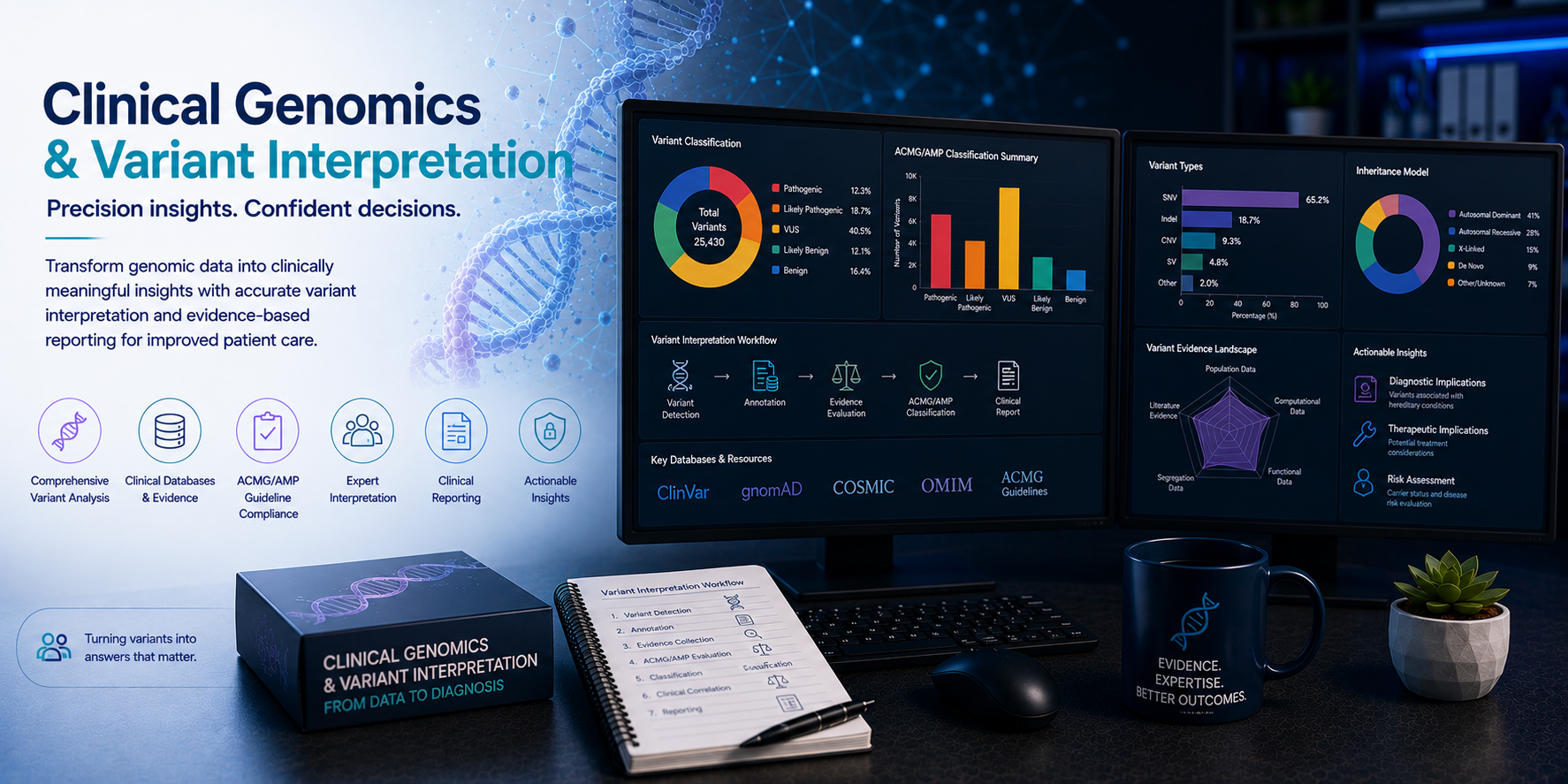
Clinical genomics and variant interpretation sit at the heart of precision medicine — translating whole-genome, whole-exome, and targeted gene panel sequencing data into clinically actionable diagnostic, prognostic, and therapeutic insights. From rare disease diagnosis and hereditary cancer risk assessment to somatic tumour profiling, pharmacogenomics, and newborn genomic screening, every application of clinical sequencing depends on rigorous bioinformatics analysis and expert variant interpretation. At BioinformaticsNext, we provide specialist clinical genomics and variant interpretation services — supporting diagnostic laboratories, clinical research teams, pharmaceutical companies, and academic medical centres with the highest standards of analytical quality, clinical relevance, and regulatory compliance.
Clinical Genomics & Variant Interpretation: From Raw Sequencing Data to Clinical Insight
Expert bioinformatics and variant interpretation services for rare disease diagnosis, hereditary cancer, somatic tumour profiling, and precision medicine programmes.
The rapid expansion of clinical sequencing — from targeted gene panels to whole-exome sequencing (WES) and whole-genome sequencing (WGS) — has fundamentally transformed how genetic disease is diagnosed, how cancer is characterised, and how treatment is personalised. Yet the bottleneck in clinical genomics is rarely the sequencing itself. It is the accurate identification, annotation, classification, and interpretation of variants in the context of the patient's phenotype, family history, and clinical presentation.
At BioinformaticsNext, we provide the full clinical genomics bioinformatics stack — from raw sequencing data processing and variant calling through to ACMG/AMP variant classification, clinical report preparation, and population-scale genomic analysis — delivering outputs that are analytically validated, clinically meaningful, and suitable for diagnostic and regulatory use.
What We Support
Comprehensive clinical genomics bioinformatics across rare disease, oncology, pharmacogenomics, and population genomics applications.
- Whole-genome, whole-exome, and targeted gene panel sequencing data analysis and QC
- Germline variant calling, annotation, and ACMG/AMP classification for rare disease diagnosis
- Somatic variant calling and tumour mutational profiling for clinical oncology
- Copy number variant (CNV) and structural variant (SV) detection and interpretation
- Hereditary cancer gene panel analysis and variant pathogenicity assessment
- Pharmacogenomic variant identification and drug response prediction
- Mitochondrial genome sequencing analysis and heteroplasmy quantification
- Trio and family-based sequencing analysis for de novo and recessive variant identification
- RNA sequencing for splice variant validation and cryptic splice site detection
- Population genomics, cohort variant analysis, and clinical database submission support
Our Clinical Genomics & Variant Interpretation Services
End-to-end clinical genomics bioinformatics — from sequencing QC and variant calling to clinical classification, reporting, and regulatory submission support.
All analyses are tailored to your sequencing platform, clinical indication, variant type, and reporting requirements — with outputs formatted for clinical, research, or regulatory use as required.
1. Sequencing Data Processing & Quality Control WGS · WES · Panel · QC Metrics
Reliable variant identification begins with rigorous sequencing data processing and quality assessment. We apply validated, GATK best-practice bioinformatics pipelines to process Illumina, Oxford Nanopore, and PacBio sequencing data — ensuring every downstream analysis is built on a foundation of high-quality, well-characterised sequencing data.
- Raw data QC and preprocessing — FastQC, MultiQC, and Trimmomatic-based read quality assessment; adapter trimming, quality filtering, and contamination screening; per-sample and batch-level QC reporting with pass/fail flagging
- Read alignment and duplicate marking — BWA-MEM2 and STAR alignment to GRCh38 and GRCh37 reference genomes; Picard and GATK MarkDuplicates; base quality score recalibration (BQSR) for optimised variant calling accuracy
- Coverage and uniformity analysis — Mean depth, uniformity, and callable region assessment; gene panel coverage reporting at 10x, 20x, 50x, and 100x thresholds; identification of low-coverage clinically relevant regions requiring supplementary analysis
- Sample identity and concordance verification — Fingerprinting-based sample identity confirmation; sex concordance checking; tumour-normal pair verification; relatedness estimation for family-based sequencing studies
2. Germline Variant Calling & Annotation SNV · Indel · CNV · SV · Multi-Caller
Accurate germline variant identification across SNVs, indels, CNVs, and structural variants is the foundation of rare disease diagnosis, hereditary cancer assessment, and population genomics. We deploy validated multi-caller strategies and comprehensive annotation pipelines to maximise both sensitivity and specificity for clinical applications.
- SNV and indel calling — GATK HaplotypeCaller, DeepVariant, and Clair3 (long-read) variant calling; multi-caller consensus strategies for high-confidence variant identification; joint genotyping across cohorts with GATK GenomicsDBImport and GenotypeGVCFs
- Copy number variant (CNV) detection — GATK gCNV, CANOES, ExomeDepth, and CNVkit-based germline CNV calling from WGS and WES data; array CGH-equivalent CNV resolution from high-depth WGS
- Structural variant (SV) detection — Manta, DELLY, and PBSV-based SV calling for deletions, duplications, inversions, translocations, and mobile element insertions; long-read SV characterisation with Sniffles and SVIM
- Comprehensive variant annotation — ANNOVAR, VEP (Ensembl Variant Effect Predictor), and SnpEff functional annotation; population frequency from gnomAD, TOPMed, and ClinVar; in silico pathogenicity prediction with CADD, REVEL, SpliceAI, and AlphaMissense
- Repeat expansion analysis — STRipy, ExpansionHunter, and TRGT-based short tandem repeat (STR) and repeat expansion detection for diseases including Huntington's, fragile X, myotonic dystrophy, and C9orf72 ALS/FTD
3. ACMG/AMP Variant Classification & Pathogenicity Assessment ACMG · ClinVar · Evidence-Based · Reportable
Variant classification is the most clinically critical step in genomic analysis — determining whether a sequence change is pathogenic, likely pathogenic, of uncertain significance (VUS), likely benign, or benign. We apply the American College of Medical Genetics and Genomics (ACMG) and Association for Molecular Pathology (AMP) variant classification framework with disease-specific refinements and current evidence from public and proprietary databases.
- ACMG/AMP framework classification — Systematic application of all 28 ACMG/AMP evidence criteria (PVS1, PS1–PS4, PM1–PM6, PP1–PP5, BA1, BS1–BS4, BP1–BP7) with evidence source documentation for every classified variant
- Disease-specific variant classification refinements — Application of ClinGen expert panel-approved disease-specific ACMG rule modifications (e.g. CardioClassifier for cardiomyopathy, ENIGMA for BRCA1/2, InSiGHT for Lynch syndrome genes)
- In silico evidence integration — CADD, REVEL, AlphaMissense, SIFT, PolyPhen-2, and SpliceAI pathogenicity score integration; calibrated use of in silico tools as PM4/PP3/BP4 evidence per ClinGen guidance
- Database cross-referencing — ClinVar, HGMD Professional, LOVD, gene-specific locus databases, and internal variant knowledge bases; identification of previously reported pathogenic variants and published functional evidence
- VUS resolution strategies — Computational segregation analysis; functional evidence review; population frequency re-assessment; identification of additional evidence to upgrade or downgrade VUS classifications
- ClinVar and LOVD submission support — Formatted variant submission packages for ClinVar and gene-specific LOVD databases; evidence documentation for assertion criteria compliance
4. Rare Disease & Trio Genomic Analysis WGS · WES · De Novo · Recessive · HPO
Whole-genome and whole-exome sequencing have transformed rare disease diagnosis — enabling identification of causative variants in conditions that were previously genetically unresolved. We provide specialist bioinformatics for rare disease genomic analysis, with deep expertise in trio analysis, phenotype-driven variant prioritisation, and re-analysis of previously unsolved cases.
- Trio and family-based sequencing analysis — De novo variant identification from proband-parent trios; autosomal recessive compound heterozygote and homozygous variant identification; X-linked and mitochondrial inheritance pattern analysis
- HPO-driven variant prioritisation — Human Phenotype Ontology (HPO)-based phenotype encoding; Exomiser, LIRICAL, and GeneMatcher-driven prioritisation of candidate variants by phenotype-genotype match score
- Unsolved case re-analysis — Periodic re-analysis of previously undiagnosed WGS/WES cases against updated variant databases, gene-disease associations (OMIM, Orphanet, GenCC), and reclassified variants; identification of newly reportable findings
- Mitochondrial genome analysis — mtDNA variant calling with Mutserve and Haplogrep; heteroplasmy quantification; mtDNA copy number estimation; mitochondrial haplogroup assignment and pathogenic variant identification
- RNA sequencing for splice variant validation — RNAseq-based cryptic splice site detection; aberrant splicing quantification with FRASER and Leafcutter; validation of intronic and synonymous variants with predicted splicing impact
5. Somatic Variant Calling & Tumour Mutational Profiling TMB · MSI · Mutational Signatures · ctDNA
Accurate somatic variant detection and tumour mutational profiling from tumour-normal and tumour-only sequencing is essential for oncology clinical decision-making, trial eligibility, biomarker development, and companion diagnostic applications. We provide comprehensive somatic genomics bioinformatics across WGS, WES, and targeted panel sequencing platforms.
- Somatic SNV and indel calling — Mutect2, Strelka2, and VarScan2 somatic variant calling from tumour-normal pairs and tumour-only samples; panel of normals (PoN) filtering; variant allele frequency (VAF) analysis and clonality assessment
- Somatic CNV and structural variant analysis — PURPLE, FACETS, and CNVkit tumour purity and ploidy estimation; allele-specific copy number profiling; structural variant calling and fusion gene identification with DELLY and GRIDSS
- Tumour mutational burden (TMB) and MSI scoring — TMB calculation calibrated to sequencing panel size and tumour type; MSI-sensor and MANTIS microsatellite instability scoring; FDA companion diagnostic-aligned reporting thresholds
- Mutational signature analysis — COSMIC SBS, DBS, and ID mutational signature deconvolution with SigProfiler and MuSiCa; aetiology interpretation (APOBEC, HRD, MMR deficiency, tobacco, UV); homologous recombination deficiency (HRD) scoring
- Circulating tumour DNA (ctDNA) analysis — Ultra-low frequency somatic variant detection from liquid biopsy samples; ctDNA fraction estimation; longitudinal tumour burden monitoring and resistance mutation tracking
6. Hereditary Cancer Genomics BRCA1/2 · Lynch · Hereditary Panel · Risk
Hereditary cancer gene panel analysis identifies individuals with germline pathogenic variants conferring substantially elevated cancer risk — informing clinical management, surveillance, risk-reducing intervention, and familial cascade testing. We provide specialist bioinformatics and variant interpretation for hereditary breast, ovarian, colorectal, and other hereditary cancer syndromes.
- Hereditary cancer gene panel analysis — Validated bioinformatics pipelines for BRCA1, BRCA2, MLH1, MSH2, MSH6, PMS2, EPCAM, PALB2, ATM, CHEK2, TP53, APC, MUTYH, and extended hereditary cancer gene panels; intragenic deletion and duplication detection with appropriate CNV callers
- BRCA1/2 large rearrangement analysis — MLPA data analysis for large genomic deletions and duplications in BRCA1 and BRCA2; integration with sequencing data for comprehensive BRCA reporting
- Variant pathogenicity classification for cancer genes — ClinGen BRCA Expert Panel, InSiGHT, and ENIGMA-compliant ACMG classification; multifactorial likelihood model integration for BRCA1/2 VUS; evidence from co-occurrence, segregation, and functional studies
- Lynch syndrome and mismatch repair (MMR) gene analysis — Germline MMR gene variant interpretation; correlation with tumour MSI and IHC MMR protein expression data; constitutional MLH1 methylation analysis
- Polygenic risk score (PRS) integration — Breast, ovarian, colorectal, and prostate cancer PRS calculation; integration with monogenic findings for combined risk estimation; population-calibrated risk reporting
7. Pharmacogenomics & Drug Response Variant Analysis CPIC · DPWG · Star Alleles · PGx Panels
Pharmacogenomic (PGx) variant analysis identifies clinically actionable genetic variants affecting drug metabolism, efficacy, and toxicity — enabling personalised prescribing decisions across oncology, psychiatry, cardiology, and pain management. We provide comprehensive PGx variant calling, star allele assignment, and CPIC/DPWG-aligned clinical phenotype translation.
- PGx variant calling and star allele assignment — PharmCAT and Stargazer-based star allele calling for CYP2D6, CYP2C19, CYP2C9, CYP3A5, DPYD, TPMT, NUDT15, SLCO1B1, UGT1A1, and VKORC1; copy number and structural variant detection for CYP2D6 duplications and deletions
- CPIC and DPWG phenotype translation — Metaboliser phenotype assignment (poor, intermediate, normal, rapid, ultrarapid) per CPIC and DPWG guidelines; drug-gene interaction reporting for actionable gene-drug pairs
- Oncology PGx biomarker analysis — DPYD variant analysis for fluoropyrimidine toxicity risk; TPMT and NUDT15 for thiopurine dosing; UGT1A1 for irinotecan toxicity prediction; BRCA1/2 somatic status for PARP inhibitor eligibility
- PGx panel reporting support — Clinical PGx report content preparation; evidence grading per CPIC Level A–D and DPWG clinical annotation; pre-emptive PGx result formatting for EHR integration
Key Applications
Clinical genomics bioinformatics applications across diagnostic, research, and precision medicine settings.
- Rare disease diagnosis from WGS, WES, and gene panel sequencing
- Trio and family-based genomic analysis for de novo variant identification
- Hereditary cancer risk assessment and germline variant interpretation
- Somatic tumour profiling for precision oncology treatment decisions
- TMB, MSI, and HRD biomarker reporting for immunotherapy eligibility
- ctDNA liquid biopsy analysis and longitudinal tumour burden monitoring
- Pharmacogenomic panel analysis and CPIC-aligned prescribing guidance
- Mitochondrial disease genomic diagnosis and heteroplasmy quantification
- RNA sequencing for cryptic splice variant validation
- VUS resolution and unsolved rare disease case re-analysis
- Population cohort variant analysis and ClinVar database submission
- Regulatory submission bioinformatics for IVD and CDx development
Our Analytical Workflow
A structured, validated, and reproducible clinical genomics bioinformatics process — from raw data to clinically reportable results.
Step 1 — Project Scoping Free
We discuss your clinical indication, sequencing platform, sample types, variant classes of interest, and reporting requirements to define the most appropriate analytical approach and deliverables — at no cost.
Step 2 — Secure Data Receipt & QC
Encrypted, GDPR-compliant receipt of sequencing data and clinical metadata; comprehensive sequencing QC and per-sample quality reporting before analysis begins.
Step 3 — Variant Calling Pipeline
GATK best-practice or custom validated pipeline deployment (Snakemake/Nextflow); SNV, indel, CNV, SV, and repeat expansion calling as appropriate to your clinical indication and sequencing modality.
Step 4 — Variant Annotation & Filtering
VEP and ANNOVAR-based functional annotation; population frequency, in silico pathogenicity, and clinical database cross-referencing; phenotype-driven candidate variant prioritisation.
Step 5 — ACMG/AMP Classification
Systematic evidence-based variant classification per ACMG/AMP guidelines with disease-specific refinements; VUS resolution analysis; classification documentation with full evidence trail for each reported variant.
Step 6 — Clinical Report Preparation
Structured clinical genomics report preparation including variant details, classification, phenotypic relevance, inheritance pattern, management implications, and recommendations for further investigation or cascade testing.
Step 7 — Visualisation & Data Delivery
Publication-ready and report-ready figures — coverage plots, variant frequency spectra, lollipop domain diagrams, mutational signature plots, CNV profiles, and pedigree visualisations — delivered with annotated variant files (VCF, TSV).
Step 8 — Regulatory & Database Submission Support Optional
ClinVar and LOVD variant submission packages; analytical validation documentation for IVD/CDx regulatory submissions; manuscript preparation and grant application bioinformatics sections.
Tools & Technologies
Validated, clinically proven, and cutting-edge bioinformatics tools across all clinical genomics and variant interpretation workflows.
- Read Alignment: BWA-MEM2, STAR, Minimap2, Bowtie2, Samtools, Picard
- Germline SNV/Indel: GATK HaplotypeCaller, DeepVariant, Clair3, Strelka2, Octopus
- Somatic Variant Calling: Mutect2, Strelka2, VarScan2, GRIDSS, Manta, DELLY
- CNV/SV Detection: GATK gCNV, CNVkit, ExomeDepth, PURPLE, FACETS, Sniffles, SVIM
- Repeat Expansion: ExpansionHunter, STRipy, TRGT, Straglr
- Variant Annotation: VEP, ANNOVAR, SnpEff, SpliceAI, AlphaMissense, CADD, REVEL
- Variant Classification: InterVar, CharGer, ClinVar API, HGMD, LOVD, Varsome
- Rare Disease Prioritisation: Exomiser, LIRICAL, HPO, Phenopackets, GeneMatcher
- Mutational Signatures: SigProfilerExtractor, MuSiCa, COSMIC SBS/DBS/ID catalogue
- Pharmacogenomics: PharmCAT, Stargazer, PyPGx, CPIC API, PharmGKB
Reference Databases We Use
All major clinical, population, and functional genomics reference databases for comprehensive variant annotation, classification, and clinical interpretation.
- ClinVar — NCBI's archive of germline and somatic variant-disease assertions; primary source for previously reported pathogenic and likely pathogenic variant evidence
- gnomAD / TOPMed — Population allele frequency reference databases for variant rarity assessment; essential for ACMG BA1, BS1, and PM2 population frequency criteria
- HGMD Professional — Human Gene Mutation Database; comprehensive catalogue of published germline disease-causing variants across all human disease genes
- OMIM / Orphanet / GenCC — Gene-disease association databases for diagnostic gene-phenotype matching, inheritance mode confirmation, and disease classification
- COSMIC — Catalogue of somatic mutations in cancer; reference for somatic variant interpretation, mutational signature analysis, and known oncogenic hotspot identification
- PharmGKB / CPIC / DPWG — Pharmacogenomic variant-drug interaction databases and clinical annotation guidelines for PGx variant interpretation and prescribing guidance
- ClinGen — Clinical Genome Resource; curated gene-disease validity classifications, variant curation expert panels, and disease-specific ACMG rule refinements
- SpliceAI / MaxEntScan / dbscSNV — Splice site prediction tools and databases for classification of intronic and synonymous variants affecting pre-mRNA splicing
- AlphaMissense / REVEL / CADD — In silico pathogenicity prediction tools for missense variant classification; calibrated use as PM4/PP3/BP4 evidence per current ClinGen guidance
Project Deliverables
A complete, structured set of clinically and scientifically rigorous outputs for every clinical genomics project.
- Per-sample sequencing QC report with coverage metrics, uniformity, and pass/fail assessment
- Annotated variant files (VCF and TSV) with population frequency, in silico scores, and clinical database annotations
- ACMG/AMP variant classification table with full evidence documentation for each classified variant
- Clinical genomics report: variant details, phenotypic relevance, inheritance, management implications
- CNV and SV calls with genomic coordinates, gene impact, and size classification
- Somatic TMB, MSI, HRD, and mutational signature report (oncology projects)
- Publication-ready figures: coverage plots, lollipop diagrams, CNV profiles, signature plots (PDF/SVG/PNG)
- Full written methods and results report with pipeline version documentation for reproducibility
- ClinVar and LOVD variant submission packages with formatted assertion criteria evidence
- Analytical validation documentation for IVD and CDx regulatory submissions (FDA, CE-IVD)
- RNA sequencing splice variant validation analysis
- Periodic re-analysis of unsolved WGS/WES cases against updated databases
- Manuscript methods section and supplementary figure legends (journal-formatted)
- Grant application clinical genomics sections and preliminary bioinformatics data
- Long-term retainer support for ongoing clinical research cohort analysis
Why Choose BioinformaticsNext?
Clinical genomics bioinformatics expertise that is analytically rigorous, clinically relevant, and regulatory-aware — from rare disease diagnosis to precision oncology.
Clinical Genomics Expertise
Our analysts combine deep bioinformatics expertise with knowledge of clinical genetics, variant classification standards, and diagnostic reporting — ensuring every analysis is clinically relevant, accurately classified, and actionable.
ACMG/AMP Classification Rigour
All variant classifications follow the current ACMG/AMP framework with disease-specific ClinGen expert panel refinements, full evidence documentation, and explicit criterion-by-criterion classification rationale for every reported variant.
End-to-End Capability
From raw FASTQ data through variant calling, annotation, and ACMG classification to clinical report preparation and ClinVar submission — we cover the complete clinical genomics bioinformatics pipeline in a single engagement.
Regulatory-Grade Outputs
Fully documented, version-controlled analyses with comprehensive methods sections suitable for IVD analytical validation, CDx regulatory submissions (FDA, CE-IVD), and clinical trial biomarker reporting.
Fast Turnaround
Most clinical genomics projects are delivered within 2–4 weeks of data receipt. Expedited timelines are available for diagnostic, clinical trial, and regulatory submission deadlines.
Data Security & GDPR Compliance
Strict confidentiality agreements, encrypted data transfer, and GDPR-compliant handling of patient genomic and clinical data as standard. NDAs signed before any data is shared.
Flexible Engagement
Project-based, milestone-driven, or long-term retainer arrangements for ongoing cohort analysis and database curation. We integrate seamlessly with diagnostic laboratory teams, clinical research groups, and pharmaceutical precision medicine functions.
Global Reach
UK-headquartered with clients across Europe, North America, the Middle East, and Asia-Pacific. Full remote collaboration with GDPR-compliant, encrypted clinical data handling across all jurisdictions.
Frequently Asked Questions
Common questions from diagnostic laboratories, clinical research groups, and pharmaceutical precision medicine teams.
We apply the ACMG/AMP 2015 variant classification framework as the standard for all germline variant classification, with disease-specific refinements from ClinGen expert panels where available (e.g. BRCA1/2 ENIGMA, Lynch syndrome InSiGHT, cardiomyopathy ClinGen panel). All classifications are documented criterion-by-criterion with explicit evidence sources, ensuring full interpretive transparency and auditability.
Yes. We have validated bioinformatics pipelines for all three sequencing modalities across Illumina short-read, Oxford Nanopore long-read, and PacBio HiFi platforms. The analytical approach — variant callers, CNV tools, annotation databases, and classification criteria — is appropriately configured for the sequencing modality and clinical indication in each project.
Yes. VUS resolution is one of the most clinically impactful aspects of our variant interpretation service. We perform computational segregation analysis, functional evidence literature review, updated population frequency assessment, and identification of additional evidence criteria that could support reclassification. We also support submission of evidence to ClinVar and ClinGen for expert panel review.
Yes. We analyse RNA sequencing data to detect aberrant splicing events — including cryptic exon activation, exon skipping, and intron retention — caused by intronic, synonymous, or missense variants with predicted splicing impact. RNA-based splice validation is an important tool for reclassifying intronic VUS and confirming pathogenicity of splice-region variants.
Yes. We provide comprehensive somatic tumour profiling from WGS, WES, and targeted panel sequencing — including somatic SNV and indel calling, CNV and SV analysis, TMB, MSI, HRD scoring, mutational signature analysis, and ctDNA liquid biopsy analysis. All outputs are formatted for clinical study reports, regulatory submissions, and companion diagnostic development.
Yes. We produce analytical validation documentation — including accuracy, precision, sensitivity, specificity, and limit of detection assessments — suitable for in vitro diagnostic (IVD) and companion diagnostic (CDx) regulatory submissions to the FDA (510k, PMA, De Novo) and CE-IVD under the EU IVDR. All pipelines are version-controlled with full software and parameter documentation.
All patient genomic data is handled under strict NDA and GDPR-compliant data processing agreements. Data is transferred via encrypted channels, stored in access-controlled environments, processed only for the agreed project scope, and deleted or returned to the client on project completion. We never share, publish, or retain patient data beyond the agreed terms.
Absolutely. We assist with the bioinformatics and clinical genomics sections of grant applications — including proposed variant analysis workflows, ACMG classification methodology, rare disease diagnostic approaches, and preliminary computational data. Please contact us as early as possible in the grant preparation process to allow time for any preliminary analyses required.
Related Research Areas & Services
Clinical genomics and variant interpretation draws on expertise across multiple complementary research domains we support.
- Genetics & Genomics — Population genetics, GWAS, polygenic risk score development, Mendelian randomisation, and rare variant analysis for research and translational applications
- Cancer & Oncogenomics — Somatic variant calling, tumour mutational profiling, neoantigen prediction, and tumour microenvironment characterisation for oncology precision medicine
- Drug Development & AI-Driven Discovery — Genomic biomarker discovery, patient stratification, companion diagnostic development, and AI-powered drug target identification
- Cell & Gene Therapy Bioinformatics — CRISPR editing characterisation, integration site analysis, vector genome QC, and clinical trial genomic safety monitoring
- Immunology & Immuno-Oncology — HLA typing, neoantigen-MHC binding prediction, TCR repertoire analysis, and immune response profiling for immunotherapy programmes
- Custom Software & Pipeline Development — Bespoke clinical genomics reporting platforms, variant curation tools, and automated diagnostic pipeline deployment for laboratory information systems
Ready to Advance Your Clinical Genomics Programme?
Tell us about your clinical indication, your sequencing data, and your reporting or research objectives. Our clinical genomics and variant interpretation team will design a tailored bioinformatics plan — typically within 48 hours of your enquiry. Whether you need rare disease WGS analysis, hereditary cancer variant classification, somatic tumour profiling, or regulatory-grade IVD validation support, we are here to deliver accurate, clinically meaningful results from day one.