
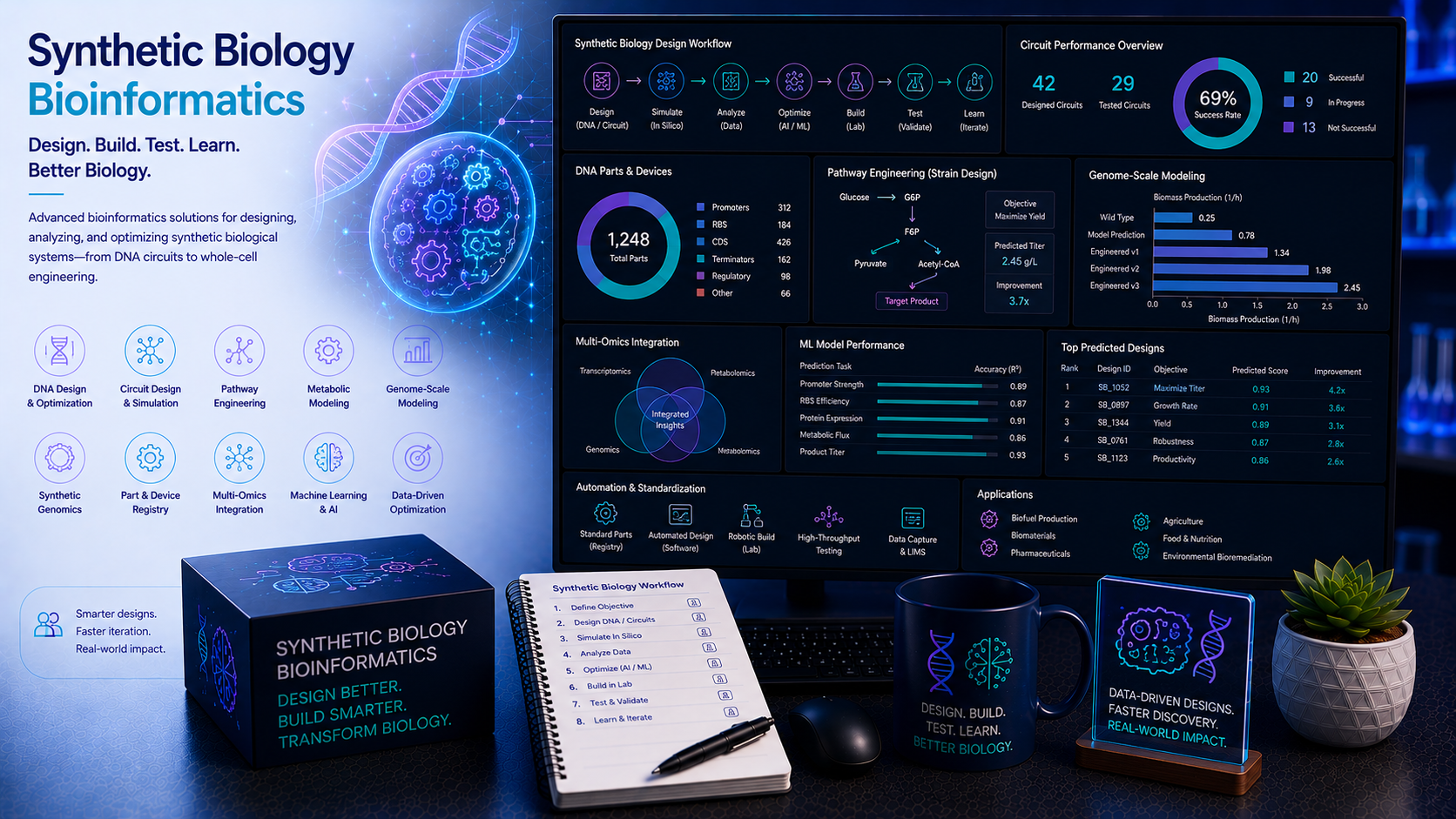
Synthetic biology is engineering biology with precision — designing, building, and optimising biological systems from the ground up to produce valuable compounds, sense environmental signals, execute programmable gene circuits, and deliver therapeutic payloads. From metabolic pathway design and codon optimisation to gene regulatory network modelling, CRISPR-based genome engineering design, and the computational characterisation of biosynthetic gene clusters, synthetic biology generates complex design and data challenges at the interface of molecular biology, engineering, and bioinformatics. At BioinformaticsNext, we provide specialist synthetic biology bioinformatics services — supporting academic synthetic biology groups, industrial biotechnology companies, metabolic engineering programmes, and therapeutic synthetic biology ventures with expert computational design, analysis, and optimisation across the synthetic biology development cycle.
Synthetic Biology Bioinformatics: Pathway Design, Gene Circuit Analysis & Metabolic Engineering
Expert computational biology for metabolic pathway design, codon optimisation, gene regulatory circuit modelling, biosynthetic gene cluster analysis, genome-scale metabolic modelling, and CRISPR-based genome engineering design in synthetic biology applications.
The vision of synthetic biology — the rational design of biological systems with predictable, programmable behaviour — depends critically on computational tools that can navigate the vast design space of genetic parts, regulatory elements, and metabolic pathways to identify optimal constructs before expensive and time-consuming wet-lab synthesis and testing. Bioinformatics underpins every stage of the design-build-test-learn (DBTL) cycle: from database mining for biosynthetic gene clusters and enzyme discovery through in silico pathway design, thermodynamic and kinetic modelling of gene circuits, genome-scale metabolic flux analysis, and machine learning-guided design optimisation. At BioinformaticsNext, we provide the full synthetic biology bioinformatics stack — from initial computational design through experimental data analysis and model-guided iteration — accelerating the DBTL cycle and reducing the experimental burden of synthetic biology development.
What We Support
Comprehensive synthetic biology bioinformatics across metabolic engineering, gene circuit design, biosynthetic pathway discovery, and genome-scale modelling.
- Metabolic pathway design and enzyme selection for heterologous biosynthetic pathway engineering
- Codon optimisation for heterologous gene expression in E. coli, S. cerevisiae, CHO, and other hosts
- Biosynthetic gene cluster (BGC) identification, annotation, and dereplication from genomic data
- Gene regulatory circuit modelling, simulation, and design optimisation
- Genome-scale metabolic model (GEM) construction, flux balance analysis, and strain optimisation
- CRISPR guide RNA design, off-target prediction, and multiplex genome engineering support
- Promoter, RBS, and terminator strength prediction and regulatory part selection
- Machine learning-guided design-build-test-learn cycle optimisation
- Proteomics and transcriptomics analysis of engineered cell characterisation data
- DNA assembly strategy design for complex genetic constructs and pathways
Our Synthetic Biology Bioinformatics Services
Specialist computational synthetic biology — from metabolic pathway design, codon optimisation, and BGC analysis through gene circuit modelling, genome-scale flux analysis, and ML-guided DBTL optimisation.
All analyses are tailored to your chassis organism, target product, genetic design objective, and synthetic biology development stage.
1. Metabolic Pathway Design & Enzyme Discovery RetroPath · KEGG · PathPred · Enzyme Mining · Host Selection
Designing a heterologous biosynthetic pathway requires identifying the enzymatic steps connecting a starting substrate to the target compound, selecting appropriate enzymes from natural or engineered sources, and evaluating pathway feasibility in the chosen production host. Computational pathway design accelerates this process — systematically exploring the space of possible routes and prioritising those most likely to succeed experimentally.
- Retrosynthetic pathway design — RetroPath2.0 and ASKCOS retrobiosynthetic pathway enumeration from target compound to available precursors; KEGG, MetaCyc, and Rhea reaction database mining for known enzymatic steps; novel reaction step prediction using reaction rule application and enzyme promiscuity databases; pathway ranking by predicted yield, cofactor balance, and enzymatic step count
- Enzyme selection and characterisation — BLAST, DIAMOND, and HMMer-based homologue mining for candidate enzymes from BRENDA, UniProt, and public genome databases; enzyme kinetic parameter (Km, kcat, kcat/Km) database mining from BRENDA and SABIO-RK; enzyme specificity prediction and substrate scope assessment from sequence and structure; thermostability and pH optima prediction for host compatibility
- Pathway feasibility and thermodynamic assessment — eQuilibrator-based thermodynamic feasibility analysis (ΔrG'° calculation) for each pathway step; identification of thermodynamically unfavourable reactions requiring enzyme engineering or pathway re-routing; cofactor (NAD+/NADH, ATP, CoA) and redox balance analysis; precursor availability assessment from host metabolism
- Host strain selection and compatibility analysis — E. coli, S. cerevisiae, B. subtilis, Corynebacterium, Pseudomonas, Streptomyces, and CHO cell metabolic compatibility assessment; codon usage bias comparison between enzyme source organism and target host; toxic intermediate accumulation risk assessment; competing endogenous pathway identification and knockout target suggestion
2. Codon Optimisation & Regulatory Part Design Codon Usage · RBS · Promoter Strength · Terminator · mRNA Stability
Translating a designed pathway into a working biological system requires optimisation of the DNA sequence encoding each heterologous enzyme and the regulatory elements controlling its expression. Codon usage, mRNA secondary structure, promoter strength, ribosome binding site context, and terminator efficiency all influence protein expression levels in ways that are predictable computationally and must be matched to the expression requirements of a balanced biosynthetic pathway.
- Codon optimisation for heterologous expression — IDT Codon Optimization Tool, OPTIMIZER, and custom codon harmonisation algorithms for E. coli, S. cerevisiae, mammalian, and plant expression systems; codon adaptation index (CAI) and tRNA adaptation index (tAI) calculation and optimisation; rare codon avoidance and codon pair bias correction; GC content and repeat sequence screening for synthesis compatibility
- mRNA stability and secondary structure optimisation — RNAfold and Mfold mRNA secondary structure prediction; 5′ UTR and start codon context optimisation for translation initiation; mRNA stability element avoidance; internal ribosome entry site (IRES) conflict screening; RNA-seq based mRNA stability estimation from experimental data
- Promoter and RBS strength prediction — De Bruijn sequence-based promoter strength prediction; RBS Calculator and Salis Lab RBS Design for E. coli translation initiation rate prediction; SynBioHub and iGEM Registry part database mining for characterised promoters and RBS sequences; sigma factor and transcription factor binding site prediction for inducible promoter design
- Regulatory part characterisation from experimental data — RNA-seq-based promoter strength quantification from transcriptomic data; ribosome profiling (Ribo-seq) analysis for translation efficiency measurement; fluorescence reporter data analysis for part characterisation; part-to-part variability and context dependence assessment from combinatorial library screening data
3. Gene Circuit Modelling & Dynamic Simulation ODE Modelling · SBML · Boolean Networks · Bistability · Oscillators
Gene regulatory circuits — from simple toggle switches and repressilators to complex multi-input biosensors and logic gates — exhibit dynamic behaviours that are difficult to predict from sequence or part characterisation data alone. Mathematical modelling and dynamic simulation of gene circuit behaviour enables in silico circuit design and optimisation before synthesis, dramatically reducing the experimental iteration required to achieve desired circuit properties.
- Ordinary differential equation (ODE) circuit modelling — Deterministic ODE-based modelling of gene circuit dynamics using Hill function transcription, first-order mRNA degradation, and Michaelis-Menten translation kinetics; parameter fitting from time-course fluorescence reporter data; steady-state analysis, nullcline plotting, and equilibrium point stability assessment; bifurcation analysis for bistable switch and oscillator circuit design
- Boolean and logical circuit analysis — Boolean network modelling of gene regulatory circuits with AND, OR, NOT, NAND, and NOR logic gate implementations; truth table verification for multi-input combinatorial logic circuits; attractor and basin of attraction analysis for Boolean network dynamics; conversion of Boolean to ODE representations for quantitative dynamics prediction
- Stochastic simulation for noise and variability analysis — Gillespie algorithm-based stochastic simulation of gene expression noise; cell-to-cell variability prediction from intrinsic and extrinsic noise sources; noise propagation through genetic circuit topologies; coefficient of variation (CV) and Fano factor analysis; stochastic bistability and switching time prediction for toggle switch designs
- SBML-based model construction and exchange — Systems Biology Markup Language (SBML) model construction using libSBML and COPASI; BioModels Database model retrieval and adaptation; SBML model validation and simulation in COPASI, BasiCO, and Tellurium; model sharing and documentation in SBML format for reproducibility and collaboration
4. Genome-Scale Metabolic Modelling & Flux Balance Analysis GEM · FBA · COBRApy · Optknock · Strain Optimisation
Genome-scale metabolic models (GEMs) represent the complete metabolic reaction network of an organism — enabling systems-level prediction of metabolic fluxes, growth rates, by-product formation, and the effects of genetic and environmental perturbations on production performance. Flux balance analysis and related constraint-based modelling methods provide actionable predictions for strain engineering to maximise product yield and titre.
- GEM construction and curation — COBRApy and memote-based GEM construction from genome annotation and BiGG, MetaNetX, and ModelSEED reaction databases; draft model reconstruction with ModelSEED and CarveMe; gap-filling and biomass composition curation; model quality assessment with memote scoring; integration of heterologous pathway reactions into host GEM
- Flux balance analysis and phenotype prediction — FBA for growth rate and product yield optimisation under defined nutrient conditions; parsimonious FBA (pFBA) for minimal flux solution identification; flux variability analysis (FVA) for reaction flux range determination; phenotype phase plane analysis for carbon and nitrogen source trade-off exploration; experimental growth rate and metabolite data validation of model predictions
- Strain optimisation and gene knockout prediction — OptKnock and FSEOF-based computational gene knockout and overexpression target identification for product yield improvement; RobustKnock for knockouts robust to environmental variability; MOMA and ROOM for gene knockout flux prediction; multi-objective optimisation of product yield vs. biomass formation trade-offs
- Omics data integration with GEM — RNA-seq transcriptomic data integration into GEM using iMAT and GIMME context-specific model generation; proteomics data-constrained flux modelling with MOMENT; metabolomics data-based flux constraint specification; 13C metabolic flux analysis (13C-MFA) experimental data integration for flux validation
5. BGC Mining, ML-Guided DBTL & Engineered Cell Characterisation antiSMASH · PRISM · Machine Learning · Multiomics · DBTL
Natural product discovery through biosynthetic gene cluster mining, machine learning-guided design-build-test-learn cycle acceleration, and multi-omics characterisation of engineered production strains represent three of the most computationally intensive and highest-value applications of synthetic biology bioinformatics — enabling both the discovery of new biosynthetic capabilities and the systematic optimisation of engineered production systems.
- Biosynthetic gene cluster (BGC) mining and analysis — antiSMASH 7, PRISM 4, and DeepBGC-based BGC identification and annotation from bacterial, fungal, and plant genome sequences; BiG-SCAPE and BiG-SLICE-based BGC family classification and dereplication across public genome databases; MIBiG reference BGC comparison and novelty assessment; GRAPE-based BGC expression analysis from metatranscriptomic data
- Machine learning-guided DBTL optimisation — Bayesian optimisation and Gaussian process-based experimental design for combinatorial genetic library screening; active learning-guided next round experimental design from screening data; random forest and gradient boosting models for genotype-to-phenotype mapping from high-throughput screening datasets; design space exploration with Latin hypercube sampling and design of experiments (DoE) for synthetic biology
- Engineered strain multi-omics characterisation — DESeq2 and edgeR transcriptomic analysis of wild-type vs. engineered strain comparisons; MaxQuant proteomics quantification of pathway enzyme expression levels; metabolomics LC-MS/GC-MS data processing and metabolite identification for product and by-product profiling; integrated multi-omics bottleneck identification for iterative strain improvement
- DNA assembly and construct design support — Golden Gate, Gibson Assembly, and USER cloning strategy design for complex multigene pathway constructs; repeat sequence and homology region screening for assembly fidelity; restriction site mapping and silent mutation insertion for cloning compatibility; synthetic DNA sequence ordering specification and vendor interface support
Key Applications
Synthetic biology bioinformatics across industrial biotechnology, natural product discovery, therapeutic synthetic biology, and academic research.
- Heterologous terpenoid, polyketide, and alkaloid biosynthetic pathway design
- Microbial production strain metabolic flux optimisation for biofuel and biochemical production
- Biosensor gene circuit design for environmental toxin and metabolite detection
- CRISPR-mediated multiplex genome engineering guide RNA design and validation
- Natural product BGC mining from actinomycete and fungal genome collections
- Synthetic gene circuit design for cell therapy regulated transgene expression
- Genome-scale metabolic model-guided knockout strategy for fermentation optimisation
- ML-guided combinatorial library design for enzyme engineering and pathway balancing
Tools, Technologies & Reference Databases
Validated synthetic biology bioinformatics tools and all major biological design and metabolic reference resources.
- Pathway Design: RetroPath2.0, ASKCOS, PathPred, KEGG, MetaCyc, Rhea, eQuilibrator
- Codon Optimisation: IDT Codon Tool, OPTIMIZER, Codon Harmony, RBS Calculator, RNAfold
- Circuit Modelling: COPASI, Tellurium, BasiCO, libSBML, SBML2Julia, BioNetGen
- GEM & FBA: COBRApy, memote, CarveMe, ModelSEED, OptKnock, FSEOF, BiGG Models
- BGC Mining: antiSMASH 7, PRISM 4, DeepBGC, BiG-SCAPE, BiG-SLICE, MIBiG
- ML-Guided Design: GPyOpt, BoTorch, scikit-learn, XGBoost, PyTorch, Design-Build-Test
- Omics Characterisation: DESeq2, MaxQuant, XCMS, MetaboAnalyst, WGCNA
- BRENDA / SABIO-RK — Enzyme kinetic parameter and substrate specificity databases for enzyme selection and pathway modelling
- BiGG Models / AGORA / VMH — Curated genome-scale metabolic model repositories for E. coli, S. cerevisiae, and human metabolism
- SynBioHub / iGEM Registry / JBEI-ICE — Standardised biological part registries and DNA design repositories
Project Deliverables
Structured, actionable synthetic biology bioinformatics outputs for every project.
- Metabolic pathway design report: ranked pathway options with thermodynamic feasibility and enzyme candidates
- Codon-optimised DNA sequences in FASTA/GenBank format with expression prediction metrics
- Gene circuit model: SBML file, ODE parameter set, and dynamic simulation outputs
- GEM analysis: flux balance solutions, gene knockout predictions, and product yield estimates
- BGC annotation report: cluster type, biosynthetic genes, MIBiG similarity, and novelty assessment
- ML-guided design recommendations: next experimental designs ranked by predicted performance
- Publication-ready figures (PDF/SVG/PNG at 300 dpi)
- Full written technical report with design rationale, computational results, and experimental recommendations
- DNA assembly strategy design for complex multigene constructs
- Stochastic circuit simulation and noise analysis for biosensor designs
- 13C-MFA flux data integration and validation against GEM predictions
- Multi-omics engineered strain characterisation and bottleneck identification
- Biosecurity screening of synthetic DNA sequences against select agent databases
- Manuscript methods section and supplementary figure legends
- Grant application synthetic biology bioinformatics sections and preliminary data
- Long-term DBTL cycle analytical support retainer
Frequently Asked Questions
Common questions from synthetic biology researchers, metabolic engineering companies, and industrial biotechnology teams.
The DBTL cycle is the iterative engineering workflow at the heart of synthetic biology — designing genetic constructs computationally, building them through DNA synthesis and cloning, testing their performance experimentally, and learning from the data to refine the next design iteration. Bioinformatics contributes at every stage: computational pathway design and part selection in the Design phase; DNA sequence optimisation and assembly strategy design in the Build phase; transcriptomics, proteomics, and metabolomics data analysis in the Test phase; and machine learning-guided interpretation and next-round design recommendation in the Learn phase. Our goal is to compress the DBTL cycle by maximising the information extracted from each experimental round and minimising the number of iterations required to reach the design objective.
Yes — for any compound with a defined chemical structure, we can perform retrobiosynthetic pathway enumeration to identify potential enzymatic routes from available cellular precursors. The completeness and reliability of the predicted pathway depends on the coverage of the reaction databases (KEGG, MetaCyc, Rhea) for the relevant chemistry and the availability of characterised enzymes for each step. For well-studied compound classes such as terpenoids, polyketides, alkaloids, and fatty acid derivatives, comprehensive pathway options are typically available. For entirely novel compounds requiring new-to-nature chemistry, we assess reaction rule applicability, enzyme promiscuity potential, and computational enzyme design feasibility as part of the pathway assessment.
Flux balance analysis (FBA) is a constraint-based modelling method that uses a genome-scale stoichiometric model of cellular metabolism — encoding all known metabolic reactions and their connectivity — to predict the distribution of metabolic fluxes under steady-state growth conditions. By maximising a defined objective function (typically biomass formation or product yield) subject to stoichiometric, thermodynamic, and capacity constraints, FBA predicts which reactions carry flux under given conditions and how much product can theoretically be produced from a given substrate. FBA can predict the effect of gene knockouts on growth rate and production, identify the metabolic bottlenecks limiting product yield, and suggest gene overexpression targets for improving productivity — all before any wet-lab experiment is performed.
Yes. Gene circuits with positive feedback loops — such as toggle switches and bistable memory elements — and negative feedback loops — such as oscillators and adaptation circuits — require nonlinear ODE modelling and bifurcation analysis to characterise their dynamic behaviour. We construct mechanistic ODE models of these circuits, parameterise them from available characterisation data, perform phase plane and nullcline analysis to identify steady states and stability, conduct bifurcation analysis to map the parameter regions exhibiting desired bistable or oscillatory behaviour, and run stochastic Gillespie simulations to assess how noise affects circuit reliability. We also perform sensitivity analysis to identify which parameters most critically determine circuit performance for experimental prioritisation.
Absolutely. We assist with the computational biology and bioinformatics sections of synthetic biology grant applications — including metabolic pathway design methodology, gene circuit modelling approaches, genome-scale metabolic modelling plans, BGC mining workflows, and preliminary computational results. We have experience supporting applications to BBSRC, EPSRC, Innovate UK, EU Horizon, DARPA, and NIH synthetic biology funding programmes. Please contact us as early as possible in the grant preparation process to allow time for any preliminary computational analyses needed.
Related Research Areas & Services
Synthetic biology bioinformatics connects to multiple complementary services we support.
- eDNA & Biodiversity Genomics (Metagenomics) — Environmental metagenomics BGC mining from soil and marine microbiome samples; novel enzyme discovery from uncultured microbial genomes for synthetic biology pathway design
- AlphaFold & Structural Bioinformatics — Enzyme structure prediction for active site analysis, substrate docking, and rational enzyme engineering to complement computational pathway design
- Drug Development & AI-Driven Discovery — Natural product drug discovery from BGC-mined biosynthetic pathways; ADMET prediction for synthetic biology-derived compounds; AI-guided lead optimisation for biologically produced small molecules
- Infectious Disease & Pandemic Genomics — Biosecurity screening of synthetic biology designs against select agent databases; gain-of-function assessment for engineered microbial sequences
- Long-Read Sequencing (ONT/PacBio) — Long-read sequencing verification of synthetic construct assemblies; full-length plasmid and BGC sequence confirmation from ONT or PacBio data
- Custom Software & Pipeline Development — Bespoke DBTL cycle automation platforms, automated construct design workflows, high-throughput screening data analysis pipelines, and metabolic modelling dashboards for synthetic biology programmes
Ready to Accelerate Your Synthetic Biology Programme?
Tell us about your target compound or biological function, your chassis organism, your available data, and your synthetic biology development objectives. Our synthetic biology bioinformatics team will design a tailored computational plan — typically within 48 hours of your enquiry. Whether you need metabolic pathway design and enzyme selection, codon optimisation, gene circuit modelling, genome-scale flux analysis, BGC mining for natural product discovery, or ML-guided DBTL cycle optimisation, we are here to deliver expert, reproducible synthetic biology bioinformatics from day one.