
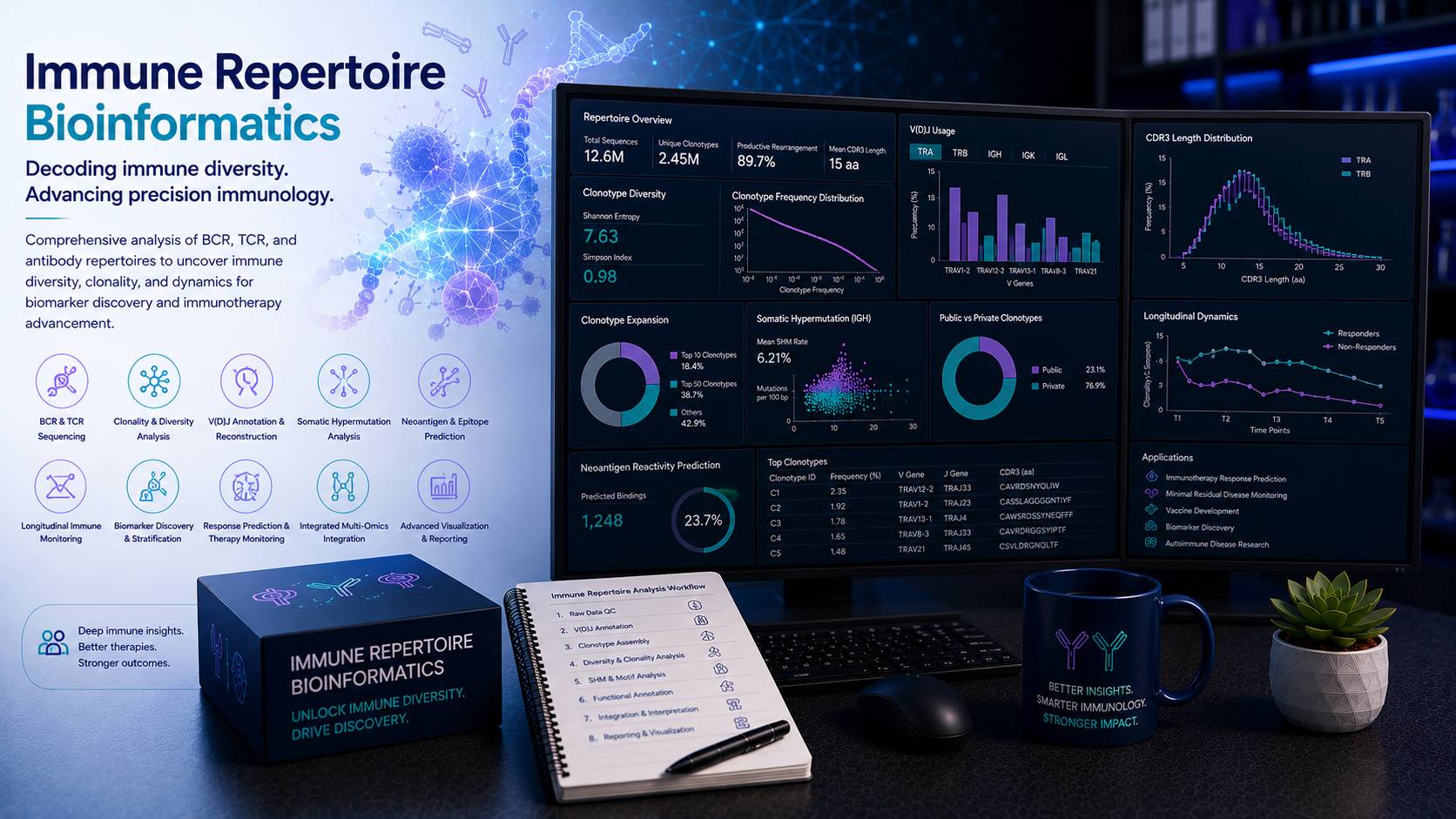
The T cell receptor (TCR) and B cell receptor (BCR) repertoire reflects the full diversity of adaptive immune recognition — encoding the history of an individual's immune responses to infection, cancer, autoimmunity, and therapeutic intervention. Immune repertoire sequencing (Rep-seq) and single-cell VDJ sequencing provide unprecedented resolution into clonal composition, antigen specificity, diversity, and dynamics of T and B cell populations. At BioinformaticsNext, we provide specialist TCR and BCR repertoire bioinformatics services — supporting adoptive cell therapy development, cancer immunotherapy trials, autoimmunity research, infectious disease studies, vaccine immunogenicity assessment, and antibody discovery programmes with expert immune repertoire analysis.
Immune Repertoire Bioinformatics: TCR & BCR Analysis for Immunotherapy, Infection & Discovery
Expert VDJ gene usage, clonotype analysis, diversity metrics, longitudinal tracking, and antigen specificity prediction across bulk and single-cell immune repertoire sequencing platforms.
The adaptive immune system generates a vast, diverse repertoire of antigen receptors through somatic VDJ recombination — creating a unique molecular fingerprint of each individual's immune history. High-throughput immune repertoire sequencing now enables deep profiling of TCR and BCR diversity, clonal expansion, convergent recombination, and antigen-driven selection across millions of cells in a single experiment. Extracting clinically and biologically meaningful insight from this data — from tracking CAR-T persistence to identifying cancer-reactive TCRs and characterising therapeutic antibody lineages — requires specialist bioinformatics expertise that goes far beyond standard genomics pipelines. At BioinformaticsNext, we provide validated, comprehensive immune repertoire bioinformatics across all major sequencing platforms and biological applications.
What We Support
Comprehensive TCR and BCR repertoire bioinformatics across bulk Rep-seq, single-cell VDJ, and spatial immune profiling platforms.
- Bulk TCR and BCR repertoire sequencing analysis from amplicon, 5′ RACE, and capture-based approaches
- Single-cell VDJ sequencing analysis with paired TCRα/β and IGH/IGL/IGK chain resolution
- Clonotype identification, abundance quantification, and diversity metric calculation
- Longitudinal clonal tracking across treatment timepoints, disease progression, and vaccination
- Antigen specificity and TCR-epitope binding prediction for tumour-reactive and pathogen-reactive clones
- BCR somatic hypermutation, clonal lineage, and affinity maturation analysis for antibody discovery
- Public clonotype identification and convergent recombination analysis across patient cohorts
- Integration of VDJ data with single-cell transcriptomics for clonotype-phenotype linking
Our Immune Repertoire Bioinformatics Services
End-to-end TCR and BCR repertoire analysis — from raw sequencing data to clonotype tables, diversity metrics, longitudinal tracking, and antigen specificity prediction.
All analyses are tailored to your sequencing platform, biological question, sample type, and clinical or research reporting requirements.
1. Bulk Immune Repertoire Sequencing Analysis MiXCR · IMGT · immunarch · VDJtools
Bulk TCR and BCR repertoire sequencing from peripheral blood, tumour-infiltrating lymphocytes, bone marrow, and tissue samples provides deep profiling of clonal composition and immune diversity. We apply validated pipelines for all major library preparation chemistries — including Adaptive Biotechnologies, Takara SMARTer, Archer Immunoverse, and in-house amplicon approaches.
- VDJ assembly and clonotype calling — MiXCR, IMGT/V-QUEST, and IgBLAST-based VDJ gene segment assignment, CDR3 sequence extraction, and clonotype identification; TCRα/β and TCRγ/δ analysis; IGH, IGK, and IGL clonotype calling with isotype classification
- Clonal abundance and frequency analysis — Clonotype frequency ranking and abundance distribution; top clone tracking; productive vs. non-productive rearrangement quantification; clonotype overlap between samples and conditions
- Diversity and repertoire metrics — Shannon entropy, Simpson diversity index, D50, Gini coefficient, and clonality score calculation; normalisation strategies for unequal sequencing depth; rarefaction curve analysis for sequencing depth adequacy assessment
- VDJ gene usage analysis — V, D, and J gene segment usage frequency profiling; CDR3 length distribution; N-nucleotide addition and P-nucleotide analysis; VJ pairing preference heatmaps and usage bias identification
2. Single-Cell VDJ Sequencing & Clonotype-Phenotype Integration 10x Genomics · scTCR-seq · scBCR-seq · Multiome
Single-cell VDJ sequencing resolves the paired receptor chains of individual T and B cells — enabling direct linkage of clonotype identity with transcriptomic phenotype, functional state, and surface protein expression. This clonotype-phenotype integration is transformative for understanding the relationship between antigen recognition and cellular function in cancer, infection, and autoimmunity.
- 10x Genomics VDJ paired chain assembly — Cell Ranger VDJ pipeline for TCRα/β and IGH/IGL/IGK paired chain assembly from 5′ gene expression libraries; clonotype assignment, expansion calling, and per-cell chain confidence filtering
- Clonotype-phenotype integration — Seurat and Scirpy-based integration of scVDJ clonotype data with scRNA-seq transcriptomic clusters; identification of expanded clones within specific functional cell states (exhausted, effector, memory, regulatory); clone-phenotype association testing
- CITE-seq and multimodal integration — Joint VDJ, transcriptomic, and surface protein (ADT) data integration; flow cytometry-level phenotyping of expanded clones; receptor expression and downstream signalling pathway correlation
- Clonal expansion and trajectory analysis — Identification of expanding, contracting, and stable clones across timepoints; RNA velocity and pseudotime analysis of clonotype-resolved T cell differentiation trajectories
3. Longitudinal Clonal Tracking & Immune Dynamics Adoptive Cell Therapy · Vaccination · Transplant · Cancer
Tracking how TCR and BCR clones expand, contract, and persist over time — across treatment, vaccination, disease progression, or immune reconstitution — provides critical biological insight into therapeutic mechanisms and immune memory formation. We provide robust longitudinal repertoire analysis with appropriate statistical frameworks for clinical and research datasets.
- Adoptive cell therapy clonal tracking — Longitudinal tracking of CAR-T, TIL, and TCR-T infusion product clones in peripheral blood from pre-infusion through peak expansion and memory phases; identification of persisting clones associated with durable clinical response
- Vaccine and infection immune response tracking — Antigen-driven clonal expansion detection after vaccination or infection; identification of responding clones and their phenotypic trajectory; convergent recombination as a marker of antigen-specific responses across individuals
- Immune reconstitution monitoring — TCR and BCR diversity recovery tracking after haematopoietic stem cell transplant (HSCT), chemotherapy, or immunosuppression; identification of oligoclonal outgrowth or repertoire skewing as safety signals
- Resistance and relapse clonal dynamics — Clonotype tracking in cancer patients at diagnosis, remission, and relapse; identification of treatment-resistant clone expansion; tumour-reactive TCR clone depletion as a resistance mechanism
4. Antigen Specificity & TCR-Epitope Prediction ERGO · TCRdist · NetTCR · pMHC Docking
Identifying which TCR clones recognise which antigens — and predicting the specificity of novel TCRs from sequence alone — is central to cancer immunotherapy target discovery, neoantigen vaccine design, autoimmunity research, and infectious disease immunology. We deploy validated deep learning and structural approaches for TCR-epitope specificity prediction.
- Deep learning TCR-epitope prediction — ERGO-II, NetTCR-2.1, and TCRMatch-based prediction of TCR-peptide-MHC binding specificity; CDR3 sequence-based epitope assignment for known antigen-TCR pairs from VDJdb and McPAS-TCR databases
- TCRdist clonotype similarity and clustering — TCRdist3-based repertoire-wide pairwise TCR similarity calculation; meta-clonotype identification and clustering of structurally related TCRs; convergent recombination detection across patient cohorts recognising shared antigens
- Neoantigen-reactive TCR identification — Integration of neoantigen predictions (NetMHCpan, pVACseq) with tumour-infiltrating lymphocyte scTCR-seq data; identification of neoantigen-reactive TCR clonotypes from expansion and phenotype signatures
- pMHC structural docking and interface analysis — AlphaFold-Multimer and HADDOCK-based TCR-pMHC complex modelling; CDR3 loop-epitope contact residue identification; cross-reactive epitope prediction from structural interface analysis
5. BCR Analysis, Somatic Hypermutation & Antibody Discovery Lineage Trees · SHM · Affinity Maturation · Discovery
BCR repertoire analysis reveals the clonal architecture and affinity maturation history of B cell responses — with direct applications in antibody discovery, vaccine immunogenicity assessment, and autoimmunity characterisation. We provide specialist B cell repertoire analysis from bulk and single-cell sequencing across all BCR loci and isotypes.
- Somatic hypermutation (SHM) analysis — Per-clonotype SHM frequency and hotspot analysis; mutation load comparison between naïve, memory, and plasma cell populations; SHM pattern analysis as a proxy for antigen exposure and affinity maturation history
- Clonal lineage tree reconstruction — Alakazam and ChangeO-based B cell clonal lineage inference and phylogenetic tree construction; identification of founder unmutated common ancestor (UCA) sequences; lineage convergence analysis across patients
- Isotype distribution and class switching analysis — IgM, IgG, IgA, IgE, and IgD isotype frequency profiling; class switch recombination pathway analysis; correlations between isotype distribution, SHM burden, and clinical outcome
- Antibody discovery support — Antigen-specific B cell clone identification from paired scBCR-seq data; variable region sequence extraction for recombinant antibody expression; germline reversion and humanisation analysis; developability and polyreactivity risk assessment from sequence features
Key Applications
TCR and BCR repertoire bioinformatics across immunotherapy, cancer, infection, autoimmunity, and antibody discovery.
- CAR-T, TIL, and TCR-T cell clonal persistence and expansion monitoring
- Tumour-reactive and neoantigen-specific TCR clone identification
- Vaccine immunogenicity and B cell response characterisation
- Antibody discovery and therapeutic antibody lineage analysis
- Immune reconstitution monitoring after HSCT and immunosuppression
- Autoimmunity-associated clonal expansion and autoreactive TCR profiling
- Infectious disease immune response and memory B cell tracking
- CDx and companion biomarker development for immunotherapy trials
Tools, Technologies & Reference Databases
Validated, clinically proven immune repertoire bioinformatics tools and all major TCR/BCR reference databases.
- Bulk Rep-seq: MiXCR, IMGT/V-QUEST, IgBLAST, immunarch, VDJtools, Change-O
- Single-Cell VDJ: Cell Ranger VDJ, Scirpy, Dandelion, Bracer, TraCeR
- BCR Analysis: Alakazam, ChangeO, SHazaM, IgPhyML, dowser
- TCR Specificity: ERGO-II, NetTCR-2.1, TCRdist3, TCRMatch, GLIPH2
- Workflow: Snakemake, Nextflow, Docker, Singularity, HPC/SLURM
- VDJdb — Curated database of TCR sequences with known antigen specificities for epitope prediction benchmarking
- McPAS-TCR — Manually curated pathology-associated TCR sequences across disease contexts
- IMGT — Reference sequences for immunoglobulin and TCR VDJ gene segments; essential for accurate repertoire analysis
- iReceptor / AIRR Community — AIRR-compliant adaptive immune receptor repertoire data standards and sharing portal
- OAS (Observed Antibody Space) — Large-scale curated antibody sequence database for humanness scoring and developability assessment
Project Deliverables
Structured, biologically interpretable immune repertoire outputs for every project.
- Annotated clonotype tables with VDJ gene usage, CDR3 sequences, and abundance frequencies
- Diversity metric report: Shannon entropy, clonality, D50, Simpson index per sample and timepoint
- VDJ gene usage frequency plots and CDR3 length distribution visualisations
- Longitudinal clonal tracking tables and expansion/contraction summary (time-series projects)
- Clonotype-phenotype integration outputs for single-cell VDJ projects (UMAP, cluster assignment)
- BCR lineage trees and SHM frequency plots (antibody discovery projects)
- Publication-ready figures (PDF/SVG/PNG at 300 dpi)
- Full written scientific report with methods, results, interpretation, and biological conclusions
- Regulatory submission immune repertoire analysis sections (IND, BLA, clinical study report)
- AIRR Community-compliant data formatting for public database deposition
- TCR-epitope specificity prediction and neoantigen-reactive clone shortlist
- Antibody variable region sequences formatted for recombinant expression
- Manuscript methods section and supplementary figure legends
- Grant application immune repertoire bioinformatics sections and preliminary data
- Long-term retainer for ongoing clinical trial sample monitoring and reporting
Frequently Asked Questions
Common questions from cell therapy developers, immunologists, and clinical research teams.
We support analysis from all major immune repertoire sequencing platforms — including Adaptive Biotechnologies immunoSEQ, Takara SMARTer TCR/BCR, Archer Immunoverse, 10x Genomics Chromium 5′ VDJ, BD Rhapsody, and custom in-house amplicon and RACE-based approaches. For single-cell VDJ, we primarily support 10x Genomics Chromium VDJ but can adapt pipelines for other platforms on request.
Yes. Single-cell VDJ sequencing with 10x Genomics Chromium 5′ VDJ libraries provides paired TCRα/β or IGH/IGL/IGK chain resolution for each individual cell. We use Cell Ranger VDJ and Scirpy to assemble and filter paired chain calls, assign clonotypes, and integrate receptor identity with single-cell transcriptomic phenotype — enabling direct clonotype-phenotype linkage at single-cell resolution.
Clonotype definition is harmonised with AIRR Community standards and can be configured to your biological question. By default, we define clonotypes by CDR3 nucleotide sequence identity with identical V and J gene segment usage — but we also support CDR3 amino acid-level clonotype grouping, which collapses convergently recombined sequences and is more appropriate for antigen specificity-focused analyses. We discuss and agree the clonotype definition strategy at project scoping.
Yes. We identify candidate tumour-reactive TCR clones using multiple convergent approaches — including clonal expansion signatures within tumour-infiltrating CD8+ T cell populations from scTCR-seq, integration with neoantigen prediction pipelines (NetMHCpan, pVACseq), TCRdist-based clustering with known tumour-reactive clones from VDJdb, and ERGO-II deep learning epitope prediction. Results are prioritised by expansion level, phenotypic state, and predicted antigen specificity.
Yes. We produce fully documented, reproducible immune repertoire analyses — including longitudinal CAR-T clonal tracking, TIL persistence monitoring, and immune reconstitution reports — formatted for inclusion in IND, BLA, and clinical study reports. All pipelines are version-controlled with complete software and parameter documentation for audit trail compliance.
Related Research Areas & Services
Immune repertoire bioinformatics connects to multiple complementary services we support.
- Cell & Gene Therapy Bioinformatics — CAR-T product profiling, TCR-T cell engineering, TIL characterisation, and adoptive cell therapy clonal persistence monitoring
- Immunology & Immuno-Oncology — Tumour microenvironment immune profiling, checkpoint biology, neoantigen identification, and immune cell deconvolution for immunotherapy programmes
- Cancer & Oncogenomics — Somatic variant calling, neoantigen prediction, TMB and MSI scoring, and tumour mutational profiling to complement immune repertoire analysis in oncology
- Clinical Genomics & Variant Interpretation — HLA typing, neoantigen-MHC binding prediction, and germline immune gene variant analysis for immunotherapy patient stratification
- Drug Development & AI-Driven Discovery — Biomarker discovery, patient stratification, and companion diagnostic development integrating immune repertoire data with multi-omics profiling
- Custom Software & Pipeline Development — Bespoke immune repertoire analysis platforms, automated clonotype tracking dashboards, and AIRR-compliant data management tools
Ready to Unlock the Full Value of Your Immune Repertoire Data?
Tell us about your sequencing platform, your sample types, and your biological or clinical objectives. Our immune repertoire bioinformatics team will design a tailored analytical plan — typically within 48 hours of your enquiry. Whether you need longitudinal CAR-T clonal tracking, tumour-reactive TCR identification, antibody discovery BCR analysis, or vaccine immunogenicity profiling, we are here to deliver expert, publication-ready immune repertoire results from day one.