
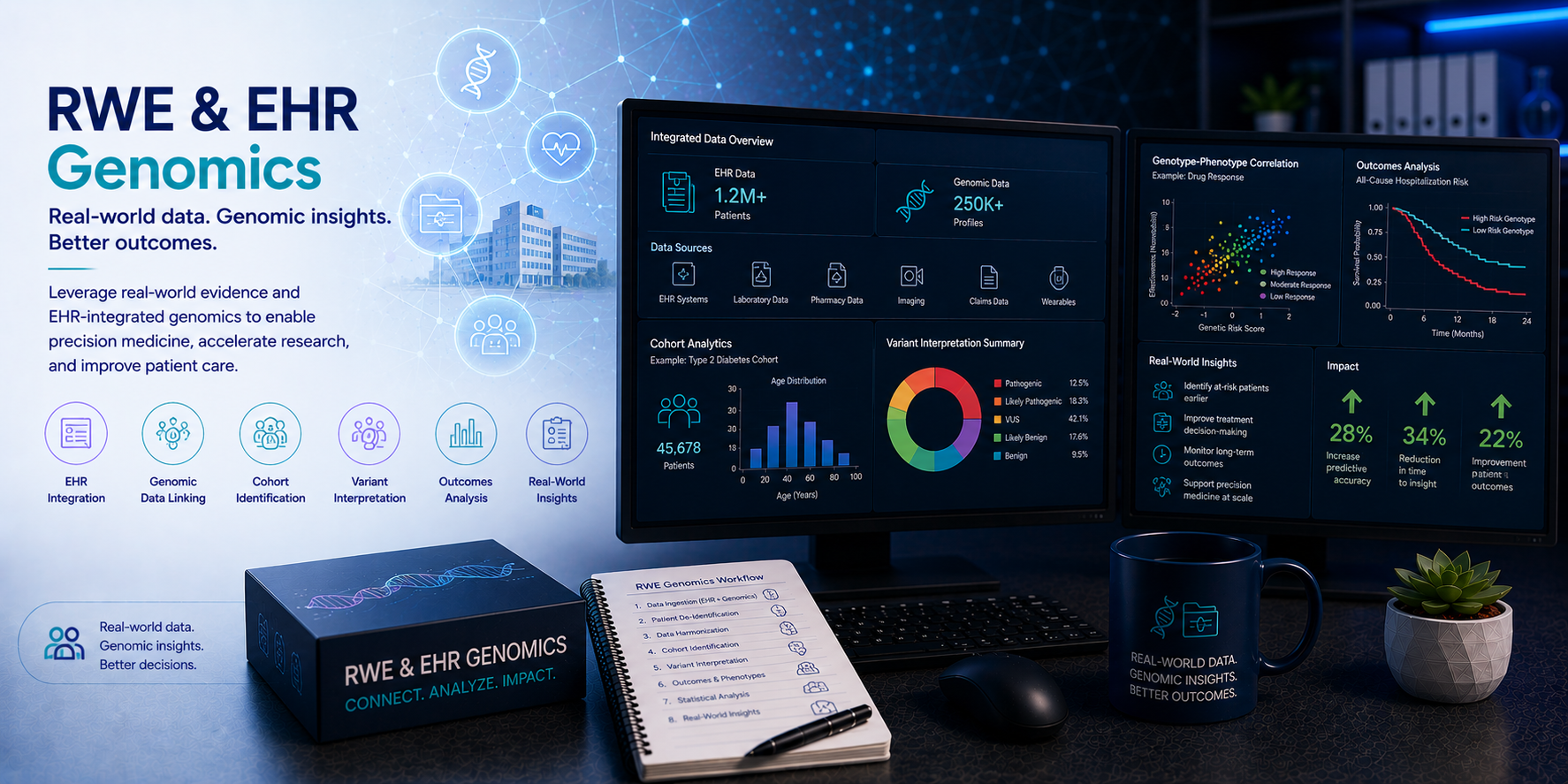
Real-world evidence (RWE) and electronic health record (EHR) genomics are transforming how we understand disease, validate drug targets, and develop precision medicine strategies at population scale. By linking genome-wide sequencing and genotyping data to rich longitudinal clinical phenotype information — from hospital diagnoses and primary care records to biomarker measurements, imaging, and wearable device data — biobank-scale genomic studies unlock biological insights and drug target opportunities that are simply not accessible from traditional clinical trial cohorts. UK Biobank, Genomics England, FinnGen, All of Us, and NHS-linked genomic datasets now provide the infrastructure for this research — but extracting meaningful, reproducible, and clinically actionable conclusions requires specialist bioinformatics, phenotyping expertise, and statistical genetics methodology. At BioinformaticsNext, we provide expert RWE and EHR genomics bioinformatics — supporting academic researchers, pharmaceutical companies, and NHS organisations in harnessing biobank-scale genomic data for disease biology, drug discovery, and precision medicine.
RWE & EHR Genomics Bioinformatics: UK Biobank, Clinical Genomics Integration & Population-Scale Analysis
Expert bioinformatics for UK Biobank, Genomics England, FinnGen, and NHS-linked genomic cohort analysis — including EHR phenotyping, GWAS, PheWAS, Mendelian randomisation, polygenic risk scores, and drug target validation from real-world genomic evidence.
The combination of large-scale genomic data with longitudinal electronic health records represents one of the most powerful resources in modern biomedical research. UK Biobank alone provides genome-wide genotyping, whole-exome sequencing, and whole-genome sequencing data linked to primary and secondary care records, hospital episode statistics, cancer registry data, death records, and a growing body of imaging and physical measurement data for approximately 500,000 participants followed over decades. This resource — and analogous biobanks globally — enables GWAS at unprecedented statistical power, phenome-wide association studies revealing the pleiotropic effects of genetic variants, Mendelian randomisation for causal inference on modifiable risk factors, and polygenic risk score development for clinical risk stratification. At BioinformaticsNext, we provide the specialist statistical genetics and bioinformatics expertise to navigate these complex, large-scale resources and deliver reproducible, peer-reviewed-quality genomic insights.
What We Support
Comprehensive RWE and EHR genomics bioinformatics across biobank-scale GWAS, phenotyping, drug target validation, and clinical genomics integration.
- UK Biobank, Genomics England, FinnGen, All of Us, and UKBB-PPP genomic data analysis
- EHR phenotype definition, ICD-10 code mapping, and clinical phenotyping from linked records
- Genome-wide association studies (GWAS) in biobank-scale cohorts with REGENIE and SAIGE
- Phenome-wide association studies (PheWAS) across all EHR-derived phenotypes
- Mendelian randomisation for causal inference and drug target validation
- Polygenic risk score (PRS) development, validation, and clinical deployment analysis
- Rare variant burden testing from biobank whole-exome and whole-genome sequencing
- Multi-ancestry GWAS and cross-biobank meta-analysis
- NHS Digital linked data analysis and secondary care record genomics integration
- Drug repurposing and target validation using biobank-scale genetic instruments
Our RWE & EHR Genomics Bioinformatics Services
Specialist biobank-scale genomics and EHR integration bioinformatics — from phenotype definition and GWAS through PheWAS, Mendelian randomisation, PRS development, and clinical genomics integration.
All analyses are tailored to your biobank resource, phenotype of interest, study design, and research, drug discovery, or clinical implementation objectives.
1. EHR Phenotyping & Clinical Cohort Definition ICD-10 · SNOMED · Phenotyping · PheCode · CALIBER
The quality of biobank genomic analysis depends fundamentally on the accuracy and reproducibility of the clinical phenotypes derived from linked EHR data. Defining cases and controls from hospital episode statistics, primary care records, cancer registries, and death records requires systematic phenotyping algorithms that are validated, transferable across data sources, and appropriately sensitive and specific for the clinical question.
- ICD-10, SNOMED CT, and Read code phenotyping — Systematic case definition from UK Biobank linked hospital episode statistics (HES), primary care data (CPRD, EMIS), cancer registry, and death record ICD-10 codes; SNOMED CT and Read code mapping for primary care phenotyping; PheCode mapping for PheWAS-compatible phenotype construction; self-reported phenotype validation against linked clinical records
- CALIBER and HDR UK phenotype library integration — Application of validated CALIBER and HDR UK phenotyping algorithms for over 300 common diseases; phenotype algorithm reproducibility assessment; incidence and prevalence validation against national disease registry benchmarks; time-to-event and longitudinal phenotype construction for survival analysis
- Quantitative trait phenotyping — Biomarker phenotype construction from UK Biobank biochemistry, haematology, and physical measurement data; repeated measurement harmonisation; phenotype transformation for GWAS (inverse normal transformation, log transformation); phenotype quality control and outlier handling
- Exclusion criteria and control definition — Control population definition with appropriate disease exclusions; prevalent vs. incident case distinction; time-varying covariate construction for longitudinal analyses; ancestry-stratified cohort definition for multi-ancestry studies
2. Biobank-Scale GWAS & Rare Variant Analysis REGENIE · SAIGE · BOLT-LMM · Meta-Analysis · WES
Genome-wide association studies in biobank-scale cohorts of hundreds of thousands of participants require computationally efficient mixed model association methods that control for population stratification and cryptic relatedness while maintaining statistical power. We apply validated GWAS pipelines optimised for the scale and complexity of UK Biobank and equivalent resources.
- Biobank-scale GWAS analysis — REGENIE and SAIGE-based whole-genome regression for quantitative and binary traits in large-scale biobanks; BOLT-LMM for quantitative trait GWAS; genomic inflation assessment and lambda GC calculation; population stratification correction with genetic principal components; genetic relatedness matrix construction and sparse GRM optimisation for computational efficiency
- GWAS quality control and imputation — Sample QC: call rate, heterozygosity, sex concordance, and ancestry outlier removal; variant QC: HWE, MAF, call rate, and imputation quality (INFO score) filtering; Michigan Imputation Server and TOPMed reference panel imputation; post-imputation QC and dosage conversion
- Multi-ancestry GWAS and cross-biobank meta-analysis — Ancestry-stratified GWAS in EUR, AFR, EAS, SAS, and AMR participants; METAL and MR-MEGA fixed and random effects cross-biobank meta-analysis; heterogeneity assessment and population-specific effect estimation; multi-ancestry fine-mapping with PAINTOR and MESuSiE
- Rare variant burden testing from biobank WES/WGS — SAIGE-GENE+ and REGENIE gene-level burden, SKAT, and SKAT-O rare variant association testing; functional variant annotation-informed collapsing tests; exome-wide significant gene identification; rare variant-common variant GWAS signal colocalisation
3. PheWAS, GWAS Downstream Analysis & Genetic Architecture PheWAS · Colocalisation · Fine-Mapping · Genetic Correlation · Heritability
Beyond the primary GWAS signal, a rich body of downstream analyses extracts the full biological and clinical value from biobank genomic data — revealing the pleiotropic consequences of associated variants, identifying causal genes, quantifying genetic overlap between traits, and linking GWAS signals to molecular phenotypes through QTL colocalisation.
- Phenome-wide association studies (PheWAS) — Genome-wide or variant-level PheWAS across all EHR-derived phenotypes; PheCode-based PheWAS in UK Biobank and FinnGen; identification of pleiotropic variants with effects across multiple disease categories; Bonferroni and FDR correction for thousands of simultaneous phenotype tests
- Fine-mapping and credible set construction — SuSiE and FINEMAP Bayesian fine-mapping for credible set construction at each GWAS locus; conditional analysis for multi-signal loci; posterior inclusion probability (PIP) calculation; 95% credible set variant annotation and functional scoring
- Genetic correlation and heritability analysis — LD score regression (LDSC) SNP-heritability estimation; cross-trait genetic correlation between disease pairs; partitioned heritability enrichment across functional annotations, cell types, and tissue types with S-LDSC; linkage disequilibrium adjusted kinship (LOAK) for biobank relatedness
- eQTL and pQTL colocalisation — COLOC Bayesian colocalisation of GWAS signals with GTEx, eQTLGen, deCODE, and UKBB-PPP pQTL datasets; causal gene and protein prioritisation; multi-tissue and multi-layer colocalisation for drug target evidence packages; SMR and HEIDI testing for causal vs. pleiotropic signal discrimination
4. Mendelian Randomisation & Drug Target Validation MR · Drug Targets · Causal Inference · Repurposing · Safety
Mendelian randomisation uses genetic variants as natural randomisation instruments to estimate the causal effect of modifiable exposures — including drug target gene expression or protein abundance — on disease outcomes. Applied to biobank-scale resources, MR provides population-level evidence for drug target prioritisation, indication selection, adverse effect prediction, and drug repurposing that complements clinical trial evidence.
- Two-sample Mendelian randomisation — TwoSampleMR and MendelianRandomization R-based two-sample MR using IEU Open GWAS and UK Biobank summary statistics; instrument variable selection with plink clumping and LD pruning; inverse variance weighted (IVW), MR-Egger, weighted median, and weighted mode sensitivity analyses; MR-PRESSO outlier detection and correction
- Drug target Mendelian randomisation — eQTL and pQTL instruments for drug target gene expression and protein level MR; cis-MR for on-target drug effect prediction; UKBB-PPP plasma proteomics pQTL instruments for protein-level drug target validation; comparison of MR effect estimates with clinical trial efficacy and adverse event data
- Multivariable MR and mediation analysis — MVMR for estimating independent causal effects of correlated exposures; MVMR mediation analysis for identifying causal mediators in multi-step biological pathways; network MR for causal pathway reconstruction; MR-Clust for heterogeneous instrument clustering
- Drug repurposing and adverse effect prediction — Systematic MR-based drug repurposing screening using eQTL instruments for approved drug target genes; drug-outcome MR for indication expansion; safety signal prediction from genetic proxy-outcome MR across PheWAS disease categories; comparison with pharmacovigilance adverse event databases
5. Polygenic Risk Scores & Clinical Genomics Integration PRS · LDpred2 · Multi-Ancestry · Clinical Utility · NHS
Polygenic risk scores aggregate the effects of thousands of common variants into a single individual-level genomic risk estimate that predicts lifetime disease risk, treatment response, and drug toxicity. We develop, validate, and analyse PRS for clinical implementation — including multi-ancestry PRS for diverse populations, PRS clinical utility assessment, and integration with NHS clinical pathway design.
- Polygenic risk score development and optimisation — PRSice-2, LDpred2, MegaPRS, and PRS-CS PRS construction from GWAS summary statistics; LD reference panel selection and ancestry matching; genome-wide vs. genome-wide significant variant PRS comparison; PRS R² and AUC-ROC prediction accuracy in held-out validation cohorts
- Multi-ancestry PRS development — PRS-CSx and CT-SLEB multi-ancestry PRS combining GWAS summary statistics from multiple ancestry populations; ancestry-specific LD reference panels; global PRS portability assessment across EUR, AFR, EAS, SAS, and admixed populations; PRS calibration and recalibration for non-European ancestry groups
- PRS clinical utility assessment — Absolute risk conversion from PRS percentile to lifetime risk using disease prevalence data; decision curve analysis (DCA) for clinical net benefit assessment; incremental risk discrimination of PRS over clinical risk factors; NRI and IDI for PRS added value above standard risk models; PRS integration into QRISK, Framingham, and other clinical risk scores
- NHS and clinical pathway integration support — PRS percentile cut-off selection for screening eligibility thresholds; NHS Genomics England PRS implementation evidence review; PRS pilot programme analytical support; NICE evidence framework-aligned clinical utility reporting; equitable PRS implementation assessment for diverse NHS patient populations
Key Applications
RWE and EHR genomics bioinformatics across drug discovery, precision medicine, NHS implementation, and population health research.
- UK Biobank GWAS for cardiovascular, metabolic, psychiatric, and cancer traits
- Mendelian randomisation-based drug target prioritisation and validation
- PheWAS for pleiotropic variant characterisation and drug safety profiling
- Multi-ancestry PRS development for diverse NHS patient populations
- Drug repurposing from genetic proxy MR across biobank disease phenotypes
- Rare variant exome-wide burden testing in UK Biobank WES data
- EHR-linked genomic cohort phenotyping for clinical research programmes
- NHS genomics pathway PRS clinical utility and implementation analysis
Tools, Technologies & Reference Resources
Validated, widely adopted statistical genetics and RWE bioinformatics tools and all major biobank and EHR reference resources.
- GWAS: REGENIE, SAIGE, BOLT-LMM, PLINK2, flashPCA, METAL, MR-MEGA
- Fine-Mapping: SuSiE, FINEMAP, PAINTOR, MESuSiE, PolyFun
- Heritability: LDSC, S-LDSC, LDSCORE, GCTB, GCTA, BayesRR-RC
- Mendelian Randomisation: TwoSampleMR, MendelianRandomization, MR-PRESSO, MVMR, MR-Clust
- PRS: PRSice-2, LDpred2, PRS-CS, PRS-CSx, MegaPRS, CT-SLEB
- UK Biobank / Genomics England / FinnGen / All of Us — Major biobank-scale genomic and EHR-linked research resources
- IEU Open GWAS / MR-Base — Curated GWAS summary statistics repository for two-sample MR and cross-trait colocalisation
- UKBB-PPP / deCODE / Olink GWAS — Plasma proteomics pQTL GWAS for protein-level drug target MR instruments
- GTEx / eQTLGen / MetaBrain — Tissue-specific eQTL resources for GWAS colocalisation and cis-MR drug target analysis
- CALIBER / HDR UK / PheCode — Validated EHR phenotyping algorithms and PheWAS-compatible phenotype libraries
Project Deliverables
Structured, publication-ready RWE and EHR genomics bioinformatics outputs for every project.
- EHR phenotype definition document with ICD-10/SNOMED code lists and validation metrics
- GWAS summary statistics in standard GWAS Catalog format with QQ and Manhattan plots
- Fine-mapping credible sets with PIPs and functional annotations per locus
- PheWAS results across all tested phenotypes with FDR-corrected significance and forest plots
- MR results table with IVW estimates, sensitivity analyses, and Egger intercept p-values
- PRS performance metrics: R², AUC-ROC, absolute risk by decile, and calibration plots
- Publication-ready figures (PDF/SVG/PNG at 300 dpi): Manhattan, QQ, forest, PRS distribution
- Full written scientific report with methods, results, biological interpretation, and clinical context
- Pipeline scripts and configuration files for complete analytical reproducibility
- Cross-biobank meta-analysis coordination and GWAS Catalog submission support
- Multi-ancestry PRS development and portability assessment
- NHS clinical pathway PRS implementation evidence report
- Drug repurposing MR systematic screen across biobank phenotypes
- eQTL/pQTL colocalisation drug target evidence package for pharmaceutical teams
- Manuscript methods section and supplementary figure legends
- Grant application RWE genomics sections and preliminary GWAS or MR data
- Long-term retainer for ongoing biobank programme analysis and database updates
Frequently Asked Questions
Common questions from academic researchers, pharmaceutical teams, and NHS genomics programmes.
UK Biobank is a large-scale biomedical database and research resource containing in-depth genetic, lifestyle, and health information from approximately 500,000 UK participants aged 40–69 at recruitment, with ongoing longitudinal follow-up through linked NHS records. It provides genome-wide genotyping (imputed to approximately 96 million variants), whole-exome sequencing (for 200,000+ participants), and whole-genome sequencing (for 200,000+ participants), linked to hospital episode statistics, primary care records, cancer registries, imaging data (brain, cardiac, abdominal MRI), and physical measurements. UK Biobank data is available to approved researchers worldwide through an application process and has generated thousands of published GWAS, MR, and PRS studies across virtually every common disease.
Mendelian randomisation (MR) uses genetic variants as natural randomisation instruments to estimate the causal effect of a modifiable exposure — such as a protein's circulating level or a gene's expression — on a disease outcome, free from confounding and reverse causation. For drug target validation, we use cis-eQTL or cis-pQTL variants for a target gene as instruments to estimate what happens to a disease phenotype when that gene's expression or protein level is genetically perturbed — mimicking the effect of a drug modulating that target. This provides real-world, population-level causal evidence for or against a target's therapeutic relevance before expensive clinical development, and can simultaneously assess safety by testing the genetic proxy against a comprehensive panel of EHR-derived disease phenotypes.
Yes. BioinformaticsNext holds or can obtain approved access to UK Biobank data through the standard application process, enabling us to run analyses on your behalf or in collaboration with your team. For pharmaceutical and commercial applications, we work within UK Biobank's commercial access framework. Alternatively, if your institution already has UK Biobank access, we can provide remote analytical support for your existing data environment. We also work with pre-computed GWAS summary statistics from UK Biobank and other biobanks available through the IEU Open GWAS platform and Neale Lab repositories for two-sample MR and colocalisation analyses without requiring direct data access.
PRS trained primarily on European-ancestry GWAS have reduced predictive accuracy in non-European populations due to differences in allele frequencies, LD patterns, and causal variant frequencies. We address this through multi-ancestry PRS methods (PRS-CSx, CT-SLEB) that combine GWAS summary statistics from multiple ancestry populations with population-specific LD reference panels; ancestry-specific PRS calibration using within-ancestry validation cohorts; and assessment of PRS portability across ancestry groups. For NHS implementation, we explicitly assess PRS performance in diverse patient populations and advise on equitable clinical deployment strategies that avoid exacerbating health inequalities from PRS based predominantly on European GWAS data.
Absolutely. We assist with the statistical genetics and bioinformatics sections of grant applications — including proposed GWAS methodology, MR study design, PRS development plans, EHR phenotyping approaches, and preliminary GWAS or MR results from publicly available summary statistics. We have experience supporting applications to BBSRC, MRC, NIHR, Wellcome Trust, BHF, CRUK, and pharmaceutical grant programmes. Please contact us as early as possible to allow time for any preliminary analyses that would strengthen the scientific case.
Related Research Areas & Services
RWE and EHR genomics connects to multiple complementary services we support.
- Genetics & Genomics — Population genetics, GWAS methodology, rare variant analysis, polygenic risk scores, and Mendelian randomisation providing the core statistical genetics toolkit for biobank-scale genomic research
- AI Drug Target Identification — Multi-omics AI target scoring integrating biobank GWAS, eQTL, pQTL, and MR evidence into composite drug target prioritisation frameworks for pharmaceutical programmes
- Drug Development & AI-Driven Discovery — Drug repurposing, companion biomarker development, patient stratification, and clinical trial design support using biobank-scale genomic real-world evidence
- Clinical Genomics & Variant Interpretation — Variant classification, rare disease genomics, and NHS diagnostic genomics integrating with population-scale biobank findings for clinical translation
- Biomarker Discovery & Validation — PRS and polygenic biomarker development, clinical outcome correlation, and companion diagnostic analysis using biobank-scale genomic data and linked clinical records
- Custom Software & Pipeline Development — Bespoke biobank GWAS pipelines, automated MR analysis workflows, PRS calculation tools, and EHR phenotyping platforms for research and NHS genomics programme deployment
Ready to Advance Your RWE or Biobank Genomics Programme?
Tell us about your biobank resource, your phenotype of interest, your research or drug discovery objectives, and any NHS or clinical implementation goals. Our RWE and EHR genomics bioinformatics team will design a tailored analytical plan — typically within 48 hours of your enquiry. Whether you need UK Biobank GWAS analysis, Mendelian randomisation for drug target validation, PheWAS pleiotropic variant profiling, multi-ancestry PRS development, rare variant burden testing, or NHS clinical pathway PRS implementation support, we are here to deliver expert, reproducible real-world genomics results from day one.