
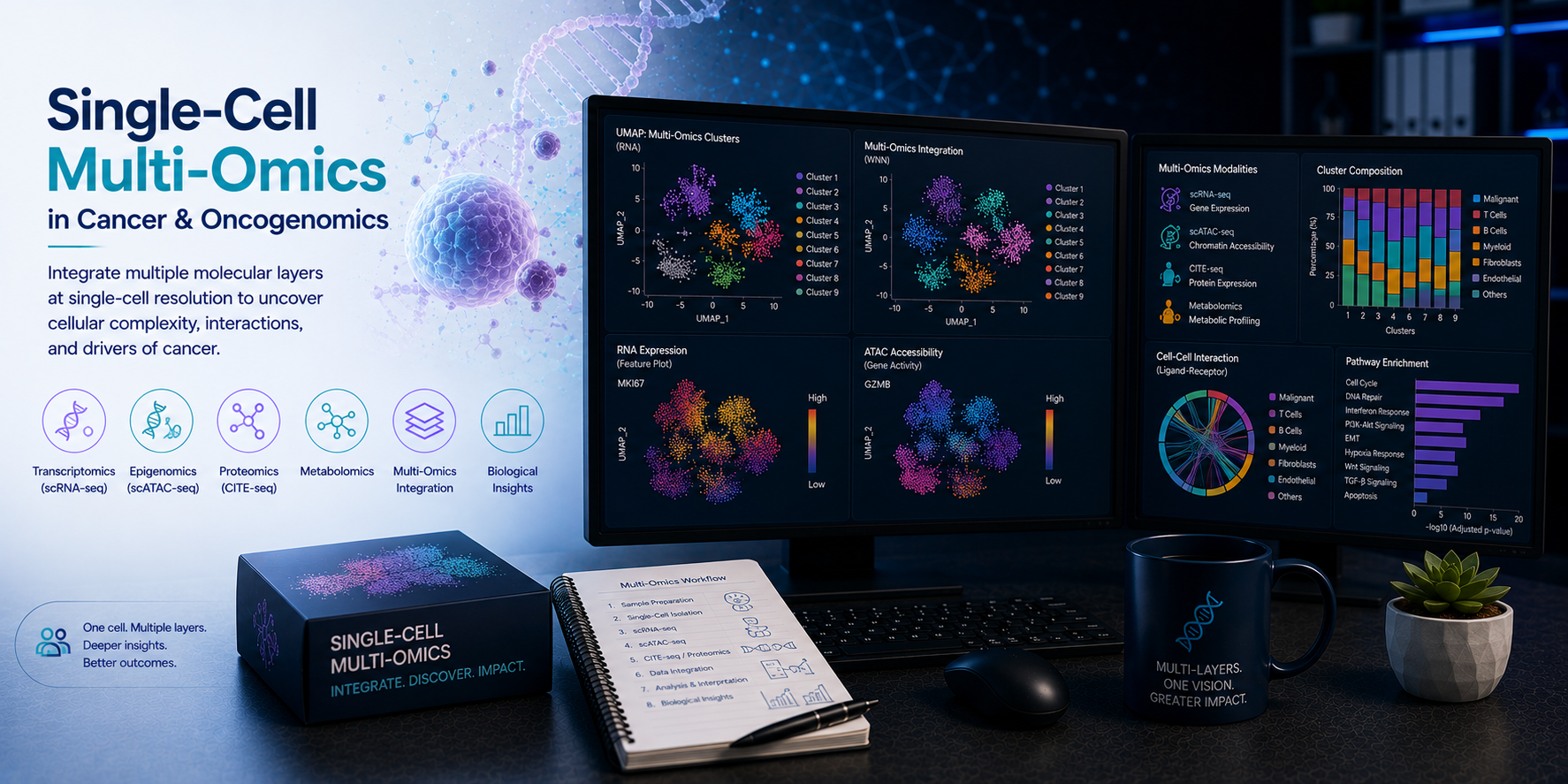
Single-cell multi-omics technologies have transformed our ability to characterise cellular biology — moving beyond transcriptomics alone to simultaneously measure protein expression, chromatin accessibility, DNA methylation, and immune receptor sequences in the same individual cells. CITE-seq, 10x Genomics Multiome, REAP-seq, TEA-seq, and related platforms now enable multimodal single-cell profiling that resolves cell identity, functional state, epigenetic regulation, and receptor specificity at unprecedented resolution. At BioinformaticsNext, we provide specialist single-cell multi-omics bioinformatics services — delivering expert CITE-seq, Multiome, and multimodal integration analysis for immunology, oncology, drug discovery, and translational research programmes.
Single-Cell Multi-Omics & CITE-seq Bioinformatics: Multimodal Cell Profiling for Research & Drug Discovery
Expert CITE-seq, 10x Multiome, and single-cell multi-omics bioinformatics — from antibody-derived tag processing and joint RNA-protein clustering to chromatin accessibility integration, gene regulatory network inference, and multimodal biomarker discovery.
Single-cell transcriptomics revolutionised our understanding of cellular heterogeneity — but transcriptome alone is an incomplete picture of cell identity and function. Proteins are the primary effectors of cellular activity, and surface protein expression determines cell-cell interactions, signalling competency, and therapeutic target accessibility. Chromatin accessibility defines the regulatory landscape that constrains and enables transcriptional programmes. DNA methylation encodes epigenetic memory that persists across cell divisions. Immune receptor sequences link clonal identity to transcriptional phenotype. Single-cell multi-omics integrates these dimensions in the same cells — providing the most complete molecular portrait of cellular biology currently achievable.
At BioinformaticsNext, we provide the full single-cell multi-omics bioinformatics stack — from platform-specific data processing and quality control through joint clustering, weighted nearest neighbour integration, gene regulatory network inference, and multimodal biomarker development — for all major single-cell multi-omics platforms and biological applications.
What We Support
Comprehensive single-cell multi-omics bioinformatics across CITE-seq, Multiome, TEA-seq, REAP-seq, and multimodal VDJ integration platforms.
- CITE-seq antibody-derived tag (ADT) processing, normalisation, and RNA-protein joint analysis
- 10x Genomics Multiome ATAC + Gene Expression joint chromatin and transcriptome analysis
- TEA-seq and REAP-seq trimodal RNA, ATAC, and protein co-profiling analysis
- Weighted nearest neighbour (WNN) multimodal integration and joint cell type clustering
- Gene regulatory network inference from joint RNA and ATAC data
- Transcription factor activity scoring and chromatin-transcriptome linkage analysis
- scVDJ integration with CITE-seq for clonotype-phenotype-protein co-profiling
- Multimodal differential analysis between conditions, timepoints, and patient groups
- Batch correction and multi-sample integration across multimodal datasets
- Multimodal biomarker discovery for immunotherapy, oncology, and drug development applications
Our Single-Cell Multi-Omics Bioinformatics Services
Specialist CITE-seq and multimodal single-cell bioinformatics — from platform-specific processing and QC through joint clustering, regulatory network inference, and multimodal biomarker development.
All analyses are tailored to your platform, antibody panel, biological question, sample types, and research or translational objectives.
1. CITE-seq ADT Processing, Normalisation & QC DSB · CLR · Isotype Control · Ambient ADT
CITE-seq antibody-derived tag (ADT) data presents unique processing challenges — including ambient ADT contamination from unbound antibodies, non-specific background binding, isotype control normalisation, and the bimodal distribution of ADT counts that differs fundamentally from RNA count distributions. Rigorous ADT processing is essential before any joint RNA-protein analysis can yield biologically accurate results.
- ADT count matrix generation and QC — Cell Ranger multi and CITE-seq-count-based ADT barcode demultiplexing and UMI count matrix generation; per-antibody library size, saturation, and detection rate QC; identification of poorly performing antibodies from isotype controls and background distributions
- Ambient ADT removal and background correction — DSBseq (denoised and scaled by background) normalisation using empty droplet ambient ADT profiles for protein-specific background subtraction; identification and removal of high-ambient ADT droplets; comparison of DSB vs. CLR normalisation for downstream analysis stability
- ADT normalisation strategies — Centred log-ratio (CLR) normalisation for panel-wide ADT scaling; isotype control-guided background threshold determination; per-cell protein detection rate assessment; bimodal distribution fitting for positive/negative population separation per antibody
- Multiplexing demultiplexing — HTODemux and GMM-based cell hashing antibody (HTO) demultiplexing for multi-sample CITE-seq experiments; doublet detection from HTO signal; per-sample cell yield and doublet rate reporting after demultiplexing
2. Joint RNA-Protein Clustering & Weighted Nearest Neighbour Integration WNN · Seurat · totalVI · MultiVI · Cell Identity
The defining analytical advantage of CITE-seq is the ability to cluster and annotate cells using both RNA and protein information simultaneously — leveraging the complementary resolution of surface protein expression for robust cell type discrimination and transcriptomic depth for functional state characterisation. We apply validated multimodal integration frameworks that optimally weight each modality's contribution to cell identity.
- Weighted nearest neighbour (WNN) joint clustering — Seurat WNN-based joint clustering that learns the informative weight of RNA and protein modalities per cell neighbourhood; modality weight visualisation; comparison of WNN vs. RNA-only vs. protein-only clustering for cell type discrimination accuracy
- totalVI probabilistic multimodal integration — scVI-tools totalVI deep generative model for joint RNA and ADT data integration; denoised protein expression estimation; batch-corrected joint latent space construction for multi-sample CITE-seq integration
- Multimodal cell type annotation — High-confidence immune and stromal cell type annotation using combined protein markers (CD3, CD4, CD8, CD19, CD56, CD14, CD16, HLA-DR) and transcriptomic gene signatures; resolution of ambiguous populations where RNA alone is insufficient; automated annotation with CellTypist and SingleR validated against protein expression
- Protein expression visualisation and interpretation — UMAP and violin plot visualisation of protein expression across clusters; ridge plots for bimodal protein distribution assessment; protein co-expression heatmaps; comparison of protein and RNA expression levels for surface receptor validation
3. 10x Multiome ATAC + Gene Expression Analysis ArchR · Signac · TF Footprinting · Peak-Gene Links
10x Genomics Multiome simultaneously profiles chromatin accessibility (ATAC-seq) and gene expression (RNA-seq) from the same individual nuclei — enabling direct linkage of the epigenetic regulatory landscape to the transcriptional programmes active in each cell. This joint profiling reveals how transcription factor binding and chromatin remodelling drive cell identity, differentiation, and disease-associated gene expression programmes.
- Joint ATAC and RNA processing — Cell Ranger ARC processing of Multiome data; per-nucleus RNA and ATAC QC including TSS enrichment score, nucleosomal signal, number of fragments in peaks, and RNA UMI count; nuclei filtering based on joint RNA-ATAC quality thresholds
- Chromatin accessibility analysis — ArchR and Signac-based peak calling with MACS2; per-cell-cluster differential peak accessibility analysis; iterative LSI dimensionality reduction for ATAC modality; gene activity score calculation from chromatin accessibility as a transcription factor binding proxy
- Transcription factor footprinting and motif enrichment — JASPAR and ENCODE motif database-based TF binding site enrichment in differentially accessible peaks; ChromVAR and ArchR-based per-cell TF activity deviation scoring; TF footprinting analysis for identification of TFs with active binding from Tn5 insertion bias patterns
- Peak-to-gene linkage and gene regulatory network inference — Correlation-based peak-to-gene linkage across cells using joint RNA-ATAC data; cis-regulatory element identification for disease-relevant genes; SCENIC+ and Pando-based gene regulatory network (GRN) construction integrating TF motifs, chromatin accessibility, and gene expression
4. Multimodal VDJ Integration & Clonotype-Phenotype-Protein Profiling scTCR · scBCR · CITE-seq · Clonotype · Epitope
Combining CITE-seq with paired VDJ sequencing creates the most comprehensive single-cell immune profiling dataset possible — simultaneously resolving each cell's receptor clonotype identity, surface protein phenotype, and transcriptomic state. This trimodal integration is transformative for adoptive cell therapy characterisation, vaccine immunogenicity assessment, and antibody discovery.
- Trimodal RNA-protein-VDJ integration — Scirpy and Dandelion-based integration of scTCR-seq or scBCR-seq clonotype data with CITE-seq RNA and ADT modalities; per-cell clonotype assignment with protein phenotype and transcriptomic state; expanded clone identification across cell type compartments
- Clonotype-phenotype-protein co-analysis — Identification of expanded TCR or BCR clones within specific protein-defined immune subsets (CD8+CD39+PD1+ exhausted T cells, CD4+CD25+FOXP3+ Tregs, CD19+IgD-CD27+ class-switched memory B cells); protein marker validation of transcriptomically-defined clonal populations
- Antigen-specific cell enrichment analysis — pMHC tetramer or dextramer ADT-based antigen-specific T cell identification from CITE-seq; tetramer-positive cell transcriptomic and phenotypic characterisation; integration with TCRdist for antigen-specific clonotype clustering
- Antibody discovery multimodal profiling — Antigen-specific B cell identification using antigen-bait ADT labelling; scBCR-seq paired chain extraction from antigen-specific cells; SHM burden and lineage tree construction from CITE-seq-identified antigen-specific B cell clones
5. Multimodal Differential Analysis & Biomarker Discovery Differential Abundance · Pseudobulk · Clinical Correlation
The analytical power of single-cell multi-omics is fully realised when multimodal data is integrated across biological conditions, treatment groups, and patient cohorts — enabling the discovery of multimodal biomarkers that combine protein, chromatin, and transcriptomic features for superior clinical prediction compared to any single modality alone.
- Multimodal differential expression and accessibility analysis — Pseudobulk DESeq2 and edgeR differential RNA expression between conditions; limma-voom differential ADT protein abundance analysis; DAseq and Milo differential cell abundance testing; MACS2-based differential chromatin accessibility between patient groups
- Multi-sample and multi-patient integration — Harmony, scVI, and totalVI-based batch correction across patients, timepoints, and tissue sites in CITE-seq datasets; patient-level pseudobulk aggregation for statistically appropriate cross-patient comparisons; mixed-effects models for longitudinal multi-timepoint CITE-seq studies
- Multimodal biomarker feature development — Combined RNA gene signature, protein surface marker panel, and chromatin accessibility feature integration for clinical outcome prediction; LASSO and elastic net multimodal feature selection; SHAP-based multimodal biomarker interpretability analysis
- Clinical correlation and outcome association — Correlation of multimodal cell state features with clinical response, progression-free survival, and overall survival; responder vs. non-responder multimodal signature development; treatment-induced multimodal changes as pharmacodynamic biomarkers for clinical trials
Key Applications
Single-cell multi-omics bioinformatics across immunology, oncology, drug development, and translational research.
- High-resolution immune cell phenotyping combining protein and RNA modalities
- CAR-T, TIL, and NK cell product multimodal characterisation for cell therapy QC
- Tumour-infiltrating lymphocyte exhaustion profiling with protein and epigenomic context
- Vaccine-induced B cell and T cell response multimodal characterisation
- Antigen-specific T cell and B cell identification using pMHC tetramer ADTs
- Chromatin accessibility and TF regulatory network analysis in disease cell types
- Multimodal biomarker discovery for immunotherapy response prediction
- Antibody discovery B cell antigen-specific enrichment and clone characterisation
Tools, Technologies & Reference Resources
Validated, cutting-edge single-cell multi-omics bioinformatics tools across all platforms and analysis workflows.
- CITE-seq Processing: Cell Ranger multi, CITE-seq-count, DSBseq, HTODemux
- RNA-Protein Integration: Seurat (WNN), totalVI, MultiVI, MOFA+, CiteFuse
- ATAC Processing: Cell Ranger ARC, ArchR, Signac, MACS2, ChromVAR
- GRN Inference: SCENIC+, Pando, FigR, decoupleR, DoRothEA
- VDJ Integration: Scirpy, Dandelion, Bracer, Cell Ranger VDJ, TCRdist
- Differential Analysis: DESeq2, edgeR, limma-voom, Milo, DAseq, nebula
- Batch Correction: Harmony, scVI, BBKNN, Seurat integration, Liger
- Annotation: SingleR, CellTypist, scType, Azimuth (Seurat reference)
- Human Cell Atlas / Azimuth — Multimodal reference atlases for CITE-seq cell type annotation
- JASPAR / ENCODE / Roadmap — TF motif and chromatin reference databases for ATAC analysis
Project Deliverables
Structured, publication-ready single-cell multi-omics bioinformatics outputs for every project.
- Processed multimodal single-cell object (Seurat/AnnData) with QC metrics and joint embeddings
- Joint RNA-protein UMAP with cell type annotations and modality weight visualisations
- ADT protein expression violin plots, ridge plots, and heatmaps across annotated cell types
- Differential RNA and protein abundance results between conditions with effect sizes and FDR
- Chromatin accessibility peak matrix, differential peak tables, and TF activity scores (Multiome)
- Peak-to-gene linkage tables and gene regulatory network figures (Multiome)
- Clonotype-phenotype-protein co-analysis outputs (VDJ integrated projects)
- Publication-ready figures (PDF/SVG/PNG at 300 dpi)
- Full written scientific report with methods, results, and biological interpretation
- GRN transcription factor regulon analysis and master regulator identification
- Multimodal biomarker feature development and clinical outcome correlation
- Antigen-specific cell enrichment analysis from pMHC tetramer ADT labelling
- Antibody discovery variable region sequence extraction from antigen-specific B cells
- Manuscript methods section and supplementary figure legends
- Grant application single-cell multi-omics sections and preliminary data
- Long-term retainer for ongoing cohort expansion and multimodal dataset integration
Frequently Asked Questions
Common questions from immunology, oncology, and drug discovery teams working with CITE-seq and single-cell multi-omics data.
CITE-seq panels typically include 20–200 antibodies, with current TotalSeq panels from BioLegend routinely covering 100–300 surface and intracellular targets. Panel design should balance biological coverage of the cell types of interest with practical considerations: each antibody adds sequencing library complexity, costs, and the need for appropriate titration and QC. We advise on panel selection based on your target cell types, biological questions, and sequencing budget — prioritising lineage markers for cell type annotation, functional markers for state characterisation, and therapeutic target markers for drug discovery applications.
Weighted nearest neighbour (WNN) integration learns the informative contribution of each modality to cell neighbourhood structure — up-weighting protein information when it is discriminatory and RNA information when protein signal is low. In practice, WNN clustering resolves immune cell subsets — particularly within the CD4+ T cell, CD14+ monocyte, and NK cell compartments — with substantially higher resolution and confidence than RNA alone, because surface protein markers (CD45RA, CD197/CCR7, CD16, CX3CR1) provide cleaner discrimination of memory, effector, and transitional states than their corresponding transcriptomes.
CITE-seq measures RNA and surface/intracellular protein simultaneously from single cells — ideal when the biological question centres on protein-level immune phenotyping, surface receptor expression, or pMHC tetramer-based antigen-specific cell enrichment. 10x Multiome measures RNA and chromatin accessibility (ATAC-seq) from the same nuclei — ideal when the question requires epigenetic regulatory information, TF binding analysis, or peak-to-gene regulatory linkage. TEA-seq measures all three modalities simultaneously. The choice depends on whether protein expression or epigenetic regulation is the critical missing dimension relative to RNA alone for your specific biological question.
Yes. CITE-seq-derived cell type signatures can be used to deconvolve matched bulk RNA-seq datasets using CIBERSORTx, MuSiC, or BayesPrism — enabling validation of single-cell findings in larger, clinically annotated patient cohorts. CITE-seq protein expression data can also be directly compared with matched flow cytometry or mass cytometry (CyTOF) datasets to validate single-cell antibody staining and assess concordance between platforms. We integrate multimodal single-cell and bulk data to maximise the biological and clinical insight from your complete dataset.
Absolutely. We assist with the single-cell multi-omics bioinformatics sections of grant applications — including proposed CITE-seq analysis workflows, Multiome ATAC integration methodology, antibody panel justification, WNN clustering rationale, and preliminary multimodal data. Please contact us as early as possible in the grant preparation process to allow time for any preliminary analyses that would strengthen the application.
Related Research Areas & Services
Single-cell multi-omics bioinformatics connects to multiple complementary services we support.
- Single-Cell RNA-seq: TME & Clonal Evolution — scRNA-seq tumour microenvironment profiling, cancer cell state mapping, and clonal evolution analysis providing the transcriptomic foundation for CITE-seq multimodal extension
- Immune Repertoire (TCR/BCR) — Paired scVDJ analysis integrated with CITE-seq for clonotype-phenotype-protein co-profiling in adoptive cell therapy and vaccine immunogenicity studies
- Cell & Gene Therapy Bioinformatics — CITE-seq multimodal profiling of CAR-T, TIL, and NK cell therapy products for comprehensive cell product quality characterisation
- Immunology & Immuno-Oncology — Immune cell profiling, checkpoint pathway analysis, and neoantigen identification complementing CITE-seq multimodal immune characterisation in oncology
- Spatial Transcriptomics — Spatial context integration with CITE-seq cell type signatures for deconvolution and spatially-resolved multimodal tumour profiling
- Custom Software & Pipeline Development — Bespoke CITE-seq and multimodal single-cell analysis platforms, automated multimodal QC reporting, and interactive multi-omics data exploration tools
Ready to Unlock the Full Power of Your Multi-Omics Single-Cell Data?
Tell us about your CITE-seq or Multiome platform, your antibody panel, your biological question, and your research or translational objectives. Our single-cell multi-omics bioinformatics team will design a tailored analytical plan — typically within 48 hours of your enquiry. Whether you need joint RNA-protein clustering, chromatin accessibility and TF network inference, multimodal VDJ integration, antigen-specific cell characterisation, or multimodal biomarker development, we are here to deliver expert, publication-ready multi-omics results from day one.