
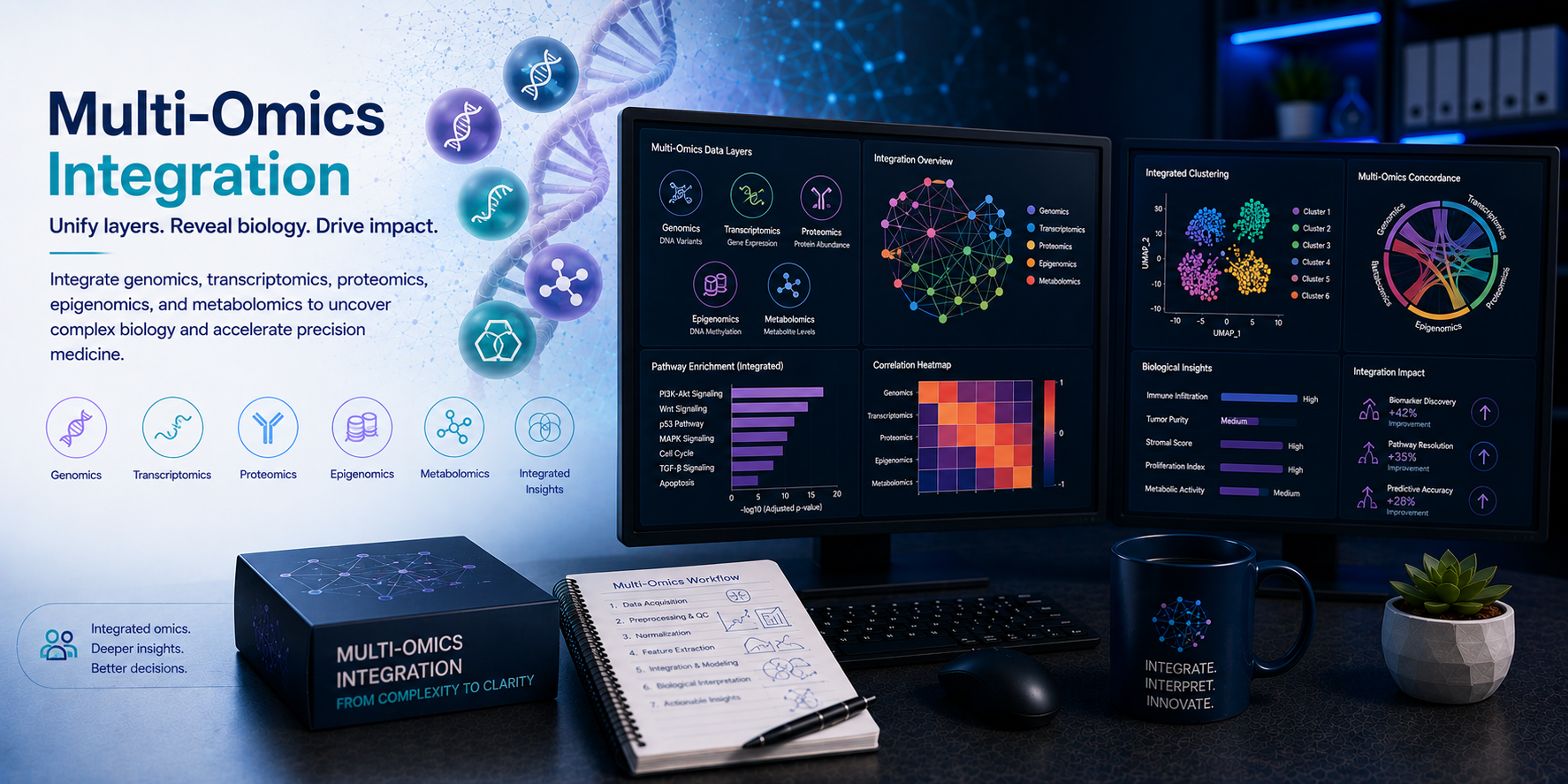
Multi-omics integration combines genome-wide sequencing, transcriptomics, proteomics, epigenomics, and metabolomics data from the same biological samples to reveal the mechanistic connections between molecular layers that no single experiment can uncover alone. A genomic variant explains a transcriptional change that drives a proteomic difference that manifests as a clinical phenotype — but only multi-omics integration can trace that causal chain. From unsupervised molecular subtype discovery and causal QTL-based inference to supervised multi-omics biomarker models and gene regulatory network construction, multi-omics integration has become an essential analytical capability for cancer research, drug discovery, and precision medicine. At BioinformaticsNext, we provide specialist multi-omics integration bioinformatics — delivering principled, statistically robust, and biologically interpretable cross-layer analysis for academic and pharmaceutical research programmes.
Multi-Omics Integration Bioinformatics: Connecting Genome, Transcriptome, Proteome & Beyond
Expert bioinformatics for multi-omics data harmonisation, unsupervised molecular subtyping, causal QTL and Mendelian randomisation integration, supervised biomarker model development, gene regulatory network construction, and pathway-level cross-layer analysis.
The central dogma of molecular biology — DNA to RNA to protein — is a starting framework, not a complete picture. Post-transcriptional regulation, protein degradation, post-translational modification, metabolic feedback, and epigenetic reprogramming mean that the relationships between genomic, transcriptomic, and proteomic layers are complex, nonlinear, and context-dependent. Multi-omics integration does not simply correlate gene expression with protein abundance — it builds statistical and mechanistic models of how information flows between layers, identifies which molecular features jointly predict clinical outcomes, and uses genetic instruments to distinguish causal from confounded cross-layer associations.
At BioinformaticsNext, we provide the full multi-omics integration bioinformatics stack — from data harmonisation, normalisation, and quality control across heterogeneous platforms through unsupervised factorisation, QTL mapping, Mendelian randomisation, supervised clinical outcome modelling, and systems-level network construction — for any combination of omics layers and any biological application.
What We Support
Comprehensive multi-omics integration bioinformatics across all combinations of molecular data layers, platforms, and biological applications.
- Cross-platform data harmonisation, normalisation, and batch correction across heterogeneous omics datasets
- Unsupervised multi-omics clustering and molecular subtype discovery with MOFA+, iCluster, and SNF
- eQTL, pQTL, sQTL, and mQTL mapping linking genetic variants to multi-layer molecular phenotypes
- GWAS colocalisation with QTL datasets for causal gene and protein prioritisation
- Mendelian randomisation for causal inference between omics layers and disease outcomes
- Transcriptomics–proteomics correlation and post-transcriptional regulation identification
- Supervised multi-omics biomarker development with DIABLO, LASSO Cox, and random survival forests
- Gene regulatory network inference from chromatin, transcriptomics, and TF binding data
- Weighted gene co-expression network analysis (WGCNA) across RNA and protein layers
- Metabolomics integration with transcriptomics and proteomics for pathway activity analysis
Our Multi-Omics Integration Bioinformatics Services
Specialist multi-omics integration — from data harmonisation and unsupervised molecular subtyping through causal inference, supervised biomarker development, and systems-level network construction.
All analyses are tailored to your specific omics layers, sample types, experimental design, clinical endpoints, and research or drug discovery objectives.
1. Multi-Omics Data Harmonisation, QC & Normalisation Batch Correction · Missing Data · Cross-Platform · QC
Integrating data from multiple omics platforms requires careful harmonisation — aligning samples across assays, correcting platform-specific batch effects, applying appropriate normalisation for each data type, and managing missing data before any cross-layer analysis can begin. Errors at this stage are the most common source of spurious multi-omics findings and propagate through all downstream analyses.
- Cross-assay sample identity verification — Genotype fingerprinting with VerifyBamID for RNA-seq and proteomics sample concordance against WGS; sex concordance checking across layers; identification and removal of sample swaps, mismatches, and duplicates; matched sample QC reporting across all omics layers before integration proceeds
- Layer-appropriate normalisation and scaling — DESeq2 VST or rlog for RNA-seq; quantile, VSN, or median normalisation for mass spectrometry proteomics; M-value transformation for methylation arrays; log-ratio and Pareto scaling for metabolomics; cross-layer feature scaling to comparable ranges without distorting biological variation
- Batch effect detection and correction — PCA-based batch effect visualisation per omics layer; ComBat and ComBat-seq for known batch variables in expression and methylation data; limma removeBatchEffect for proteomics; Harmony and RUVg for unknown confounders; batch correction validation preserving biological signal while removing technical variation
- Missing data handling across layers — Missing data pattern characterisation per omics layer; MNAR vs. MCAR classification per protein or feature; layer-appropriate imputation strategies (MinProb for proteomics, KNN for transcriptomics); minimum completeness threshold determination; complete-case vs. imputed analysis sensitivity comparison
2. Unsupervised Multi-Omics Integration & Molecular Subtype Discovery MOFA+ · iCluster · SNF · NMF · Consensus Clustering
Unsupervised multi-omics integration identifies molecularly coherent sample subgroups defined by patterns spanning multiple biological layers simultaneously — revealing cancer subtypes, drug response groups, or developmental states that are invisible when any single omics layer is examined alone. We apply validated multi-omics factorisation and clustering frameworks that balance discovery power with statistical robustness.
- Multi-omics factor analysis (MOFA+) — Latent factor decomposition of joint omics datasets into interpretable factors capturing shared and layer-specific variance; factor-phenotype association testing with clinical metadata; variance explained per factor per omics layer; sample subgroup identification from multi-omics latent space; group-MOFA for multi-group comparisons
- Integrative clustering (iCluster and iClusterBayes) — Latent variable model-based integrative clustering of genomic, transcriptomic, and proteomic data; penalised joint Gaussian latent variable optimisation; optimal cluster number selection with AIC/BIC and silhouette width; cross-layer feature weight extraction per molecular subtype
- Similarity network fusion (SNF) — Patient similarity network construction per omics layer; iterative cross-layer network fusion into consensus patient similarity matrix; spectral clustering of fused network; subtype robustness assessment and cluster stability testing with bootstrapping
- NMF and consensus clustering — Multi-omics non-negative matrix factorisation for metagene and metafeature extraction; consensus clustering across multiple random initialisations; cophenetic correlation and dispersion-based optimal rank selection; subtype survival analysis and clinical covariate association testing
3. Causal Multi-Omics Integration: QTL Mapping, Colocalisation & Mendelian Randomisation eQTL · pQTL · COLOC · SuSiE · MR · Causal Chains
The most biologically interpretable multi-omics integration is causal — using genetic variants as natural experiments to distinguish causal from confounded cross-layer associations. QTL mapping links genetic variants to molecular phenotypes across transcriptomic, proteomic, and metabolomic layers; Mendelian randomisation uses these instruments to test causal effects on disease outcomes and validate drug targets.
- Multi-layer QTL mapping — cis and trans eQTL mapping with tensorQTL and FastQTL from bulk and single-cell transcriptomics; pQTL mapping from plasma proteomics (SomaScan, Olink, mass spectrometry); sQTL splicing QTL mapping with LeafCutter and SQTLseekeR; mQTL and caQTL mapping from methylation arrays and ATAC-seq data
- QTL colocalisation with GWAS signals — COLOC Bayesian colocalisation testing between GWAS loci and eQTL, pQTL, and sQTL datasets; SuSiE fine-mapping for multi-signal colocalisation; causal gene and protein prioritisation from posterior probabilities; multi-tissue and multi-layer colocalisation for comprehensive drug target evidence packages
- Mendelian randomisation across omics layers — Two-sample MR using eQTL and pQTL instruments for causal effect estimation on disease outcomes; TwoSampleMR and MendelianRandomization R analysis with MR-Egger, weighted median, and MR-PRESSO sensitivity tests; bidirectional MR for causal direction testing between omics layers; multi-omics MR for causal chain reconstruction
- Multi-layer mediation and causal chain analysis — Mediation analysis testing whether transcriptomic or proteomic changes mediate genetic effects on disease; HIMA and mediation R package-based multi-step mediation; pathway-level mediation for mechanistic interpretation; causal chain mapping from genomic variant to transcript to protein to phenotype
4. Supervised Multi-Omics Biomarker Models & Patient Stratification DIABLO · LASSO Cox · Random Forest · Survival · CDx
When the goal is predicting clinical outcomes — treatment response, survival, toxicity, or progression — supervised multi-omics integration identifies the combination of features across genomic, transcriptomic, and proteomic layers that jointly predicts outcomes better than any single layer. We develop, validate, and benchmark multi-omics predictive models with rigorous cross-validation and clinical utility assessment.
- DIABLO multi-omics discriminant analysis — mixOmics DIABLO for supervised multi-omics classification; sparse canonical correlation analysis (sCCA) for cross-layer feature selection; latent component extraction maximising covariance between layers; multi-omics feature importance ranking per biological layer; AUROC performance evaluation and cross-validation
- Multi-omics survival model development — Block LASSO and elastic net Cox regression across combined omics feature matrices; layer-aware penalisation preserving within-layer sparsity; random survival forest with multi-omics features; multi-omics risk score calculation and high/low risk patient stratification; Kaplan-Meier and log-rank survival analysis
- Nested cross-validation and benchmarking — Nested CV for unbiased multi-omics model performance estimation; single-layer vs. multi-layer model C-index and AUC-ROC comparison; permutation-based significance testing; NRI and IDI incremental value quantification per additional omics layer; independent cohort validation in TCGA, GEO, and clinical trial datasets
- Clinical utility and regulatory support — Decision curve analysis (DCA) for net clinical benefit assessment; multi-omics biomarker panel size optimisation for clinical feasibility; SHAP-based feature interpretability and layer contribution quantification; analytical validation documentation for companion diagnostic IVD and CDx regulatory submissions
5. Gene Regulatory Networks, WGCNA & Pathway Crosstalk SCENIC+ · WGCNA · PROGENy · Pathway Integration · Metabolomics
Systems biology approaches translate multi-omics data into mechanistic models of gene regulatory networks, co-expression modules, and metabolic pathway activity — revealing the network-level logic connecting genetic variation to molecular phenotype. We construct and analyse multi-omics biological networks that provide the systems context for interpreting cross-layer associations and identifying master regulatory drivers.
- Gene regulatory network inference — SCENIC+ multi-omics GRN integrating ATAC-seq chromatin accessibility, RNA-seq expression, and TF motif databases; PANDA and LIONESS network construction from expression and regulatory priors; GRN comparison between disease and control states; master regulator and transcription factor activity scoring with decoupleR and VIPER
- Weighted gene co-expression network analysis (WGCNA) — WGCNA module construction from RNA-seq, proteomics, or combined expression matrices; module-trait association linking co-expression modules to clinical variables; hub gene and driver identification within modules; cross-omics module preservation analysis between transcriptomic and proteomic datasets
- Multi-layer pathway activity and crosstalk analysis — GSVA, PROGENy, and ssGSEA pathway activity scoring across all omics layers simultaneously; pathway-level cross-layer correlation analysis; identification of discordant pathway activity between mRNA and protein levels indicating post-transcriptional regulation; signalling network rewiring identification between drug-sensitive and -resistant conditions
- Metabolomics integration and joint pathway analysis — LC-MS and GC-MS metabolomics data processing and annotation against HMDB and KEGG; joint metabolomics, transcriptomics, and proteomics KEGG and Reactome pathway enrichment; mmvec microbiome-metabolome correlation; MOFA+-based metabolomics layer integration; fluxomics-informed metabolic network analysis from multi-omics data
Key Applications
Multi-omics integration bioinformatics across cancer, precision medicine, drug discovery, and fundamental systems biology.
- Cancer molecular subtyping from integrated genomic, transcriptomic, and proteomic data
- Drug target prioritisation from eQTL, pQTL, and GWAS colocalisation evidence
- Immunotherapy response multi-omics biomarker model development
- Transcriptome-proteome discordance and post-transcriptional regulation mapping
- Multi-omics survival signature development and clinical trial stratification
- Gene regulatory network construction in disease and normal tissue contexts
- Metabolomics-transcriptomics-proteomics joint pathway crosstalk analysis
- Multi-omics companion diagnostic analytical validation for regulatory submissions
Tools, Technologies & Reference Resources
Validated, widely adopted multi-omics integration tools and all major reference databases.
- Unsupervised Integration: MOFA+, iClusterBayes, SNF, NMF (R), ConsensusClusterPlus
- QTL & Causal: tensorQTL, FastQTL, COLOC, SuSiE, TwoSampleMR, LeafCutter, HIMA
- Supervised Models: DIABLO (mixOmics), glmnet (block LASSO), ranger (RSF), SHAP
- Network & GRN: SCENIC+, PANDA/LIONESS, WGCNA, Cytoscape, decoupleR, VIPER
- Pathway: GSVA, PROGENy, ssGSEA, fgsea, clusterProfiler, CARNIVAL
- TCGA / CPTAC / GTEx — Multi-omics cancer and normal tissue reference datasets for benchmarking and validation
- IEU Open GWAS / UK Biobank — GWAS summary statistics and eQTL/pQTL resources for colocalisation and MR analyses
- MSigDB / Reactome / KEGG / HMDB — Gene set, pathway, and metabolite reference databases for enrichment and integration
- PhosphoSitePlus / STRING / BioGRID — PTM, protein interaction, and regulatory prior databases for network construction
- ENCODE / Roadmap Epigenomics — Chromatin state and regulatory element references for epigenomics-transcriptomics integration
Project Deliverables
Structured, publication-ready multi-omics integration bioinformatics outputs for every project.
- Harmonised multi-omics data matrices with QC reports and batch correction documentation
- Unsupervised integration results: factor loadings, subtype assignments, and stability metrics
- QTL colocalisation results with posterior probabilities and prioritised causal gene list
- Supervised multi-omics model performance: C-index, AUC-ROC, and cross-validation results
- Multi-omics risk score formula and patient stratification with Kaplan-Meier survival curves
- Network and pathway figures: GRN, WGCNA module-trait heatmaps, and crosstalk diagrams
- Publication-ready figures (PDF/SVG/PNG at 300 dpi)
- Full written scientific report with methods, results, biological interpretation, and recommendations
- Pipeline scripts and configuration files for complete analytical reproducibility
- Independent TCGA and GEO multi-omics validation cohort analysis
- Multi-layer mediation and causal chain reconstruction analysis
- Metabolomics integration and joint pathway activity analysis
- Multi-omics CDx companion diagnostic analytical validation for regulatory submissions
- Interactive multi-omics data exploration dashboard and network viewer
- Manuscript methods section and supplementary figure legends
- Grant application multi-omics integration sections and preliminary data
- Long-term retainer for ongoing multi-omics programme analytical support
Frequently Asked Questions
Common questions from cancer researchers, pharmaceutical teams, and systems biology groups.
Early integration concatenates all omics matrices into a single feature space before analysis — simple but problematic because different layers have vastly different feature counts, scales, and distributions that distort results. Late integration runs each layer independently and combines results at the decision level — straightforward but misses cross-layer interactions. Intermediate integration — the approach we recommend for most applications — uses statistical frameworks (MOFA+, iCluster, SNF, DIABLO) that model cross-layer covariance explicitly, learning relationships between layers while controlling for their different technical characteristics. The optimal strategy depends on your sample size, layers, and biological question — we advise at project scoping.
Multi-omics integration is statistically demanding — combining high-dimensional data across layers dramatically increases the feature-to-sample ratio. For unsupervised clustering with MOFA+ or SNF, a minimum of 50–100 samples is needed for stable subtype identification, with 150–200+ preferred for clinical applications. Supervised multi-omics biomarker models typically require 200–500 samples with sufficient outcome events. QTL mapping requires population-scale cohorts of thousands. We provide realistic power calculations and performance expectations at project scoping based on your available sample size and the number of omics layers being integrated.
Most frameworks we use provide explicit layer contribution metrics. MOFA+ reports variance explained per latent factor per omics layer. DIABLO and sCCA provide per-layer feature loading matrices. For supervised models, we use SHAP values and block-level permutation importance to quantify each layer's predictive contribution independently. For clustering results, we perform single-omics silhouette scoring per layer and compare individual layer cluster assignments against the multi-omics consensus — providing a transparent picture of which layers drive the integrated signal and which add marginal information.
Yes — cross-study and cross-platform integration is one of the most common scenarios we address. It requires careful feature harmonisation (consistent gene IDs, protein identifiers, metabolite annotations across databases), cross-study batch correction (ComBat-seq for RNA-seq, reference sample anchoring for proteomics, BMIQ for methylation), and statistical models that include study as a random effect. We validate that correction removes technical while preserving biological variation before any cross-study integration analysis, and we advise on which omics layers are most reliably harmonised across platforms given your specific assays.
Absolutely. We assist with the bioinformatics and computational sections of multi-omics grant applications — including integration framework justification, QTL and colocalisation methodology, supervised biomarker development plans, network analysis approaches, and preliminary multi-omics data. We have experience supporting applications to BBSRC, UKRI, Wellcome Trust, NIH, and EU Horizon funding programmes. Please contact us as early as possible to allow time for any preliminary analyses that would strengthen the scientific case.
Related Research Areas & Services
Multi-omics integration connects to and draws on all the specialist omics services we support.
- AI Drug Target Identification — Multi-omics AI target scoring integrating GWAS, eQTL, pQTL, transcriptomics, and proteomics into composite drug target prioritisation frameworks
- Biomarker Discovery & Validation — Multi-omics cancer biomarker development, survival model construction, cross-cohort validation, and companion diagnostic regulatory support
- Proteomics & Phosphoproteomics — Quantitative mass spectrometry proteomics, phosphoproteomics, kinase inference, and protein network construction providing the protein layer for multi-omics integration
- Genetics & Genomics — GWAS, eQTL and pQTL mapping, Mendelian randomisation, and causal variant analysis providing the genetic layer and causal inference tools for multi-omics integration
- Single-Cell RNA-seq & TME Analysis — Single-cell transcriptomics providing cell-type-resolved expression data for single-cell multi-omics integration and deconvolution of bulk multi-omics signals
- Single-Cell Multi-Omics (CITE-seq) — CITE-seq, Multiome ATAC+RNA, and VDJ integration providing the single-cell multi-modal foundation extending bulk multi-omics to cellular resolution
- Custom Software & Pipeline Development — Bespoke multi-omics integration platforms, automated cross-layer analysis pipelines, and interactive multi-omics exploration dashboards for internal research and clinical teams
Ready to Integrate Your Multi-Omics Data?
Tell us about your omics data layers, your sample types, your biological or clinical question, and your research or drug discovery objectives. Our multi-omics integration bioinformatics team will design a tailored analytical plan — typically within 48 hours of your enquiry. Whether you need unsupervised multi-omics molecular subtyping, causal QTL colocalisation and Mendelian randomisation, supervised multi-omics biomarker model development, gene regulatory network construction, or metabolomics-transcriptomics-proteomics pathway analysis, we are here to deliver expert, reproducible multi-omics results from day one.