
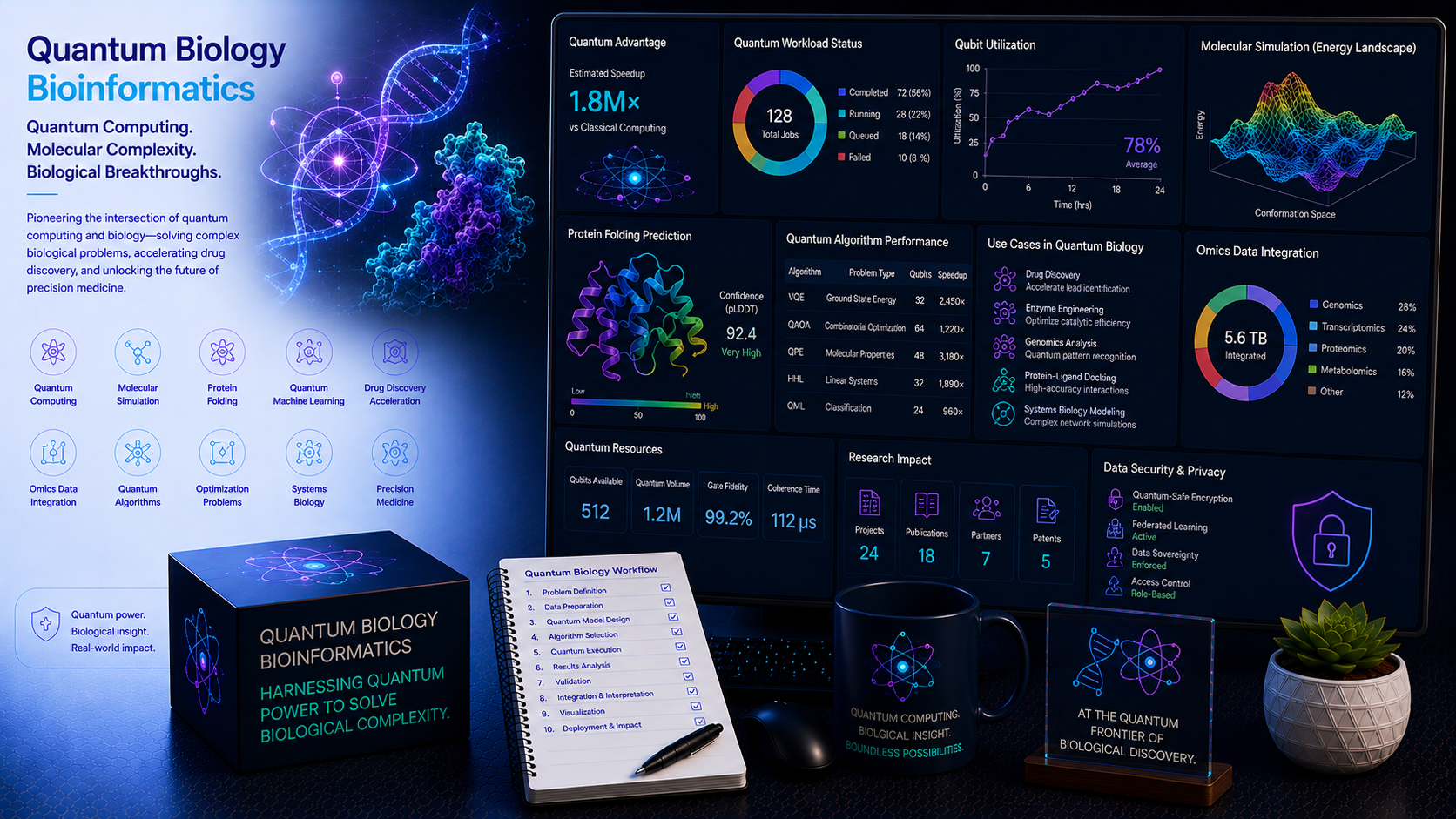
Quantum biology and quantum computing for life sciences represent one of the most exciting frontiers at the intersection of physics, computation, and biology. Quantum effects — superposition, entanglement, and tunnelling — play demonstrable roles in biological processes including photosynthesis, enzyme catalysis, avian magnetoreception, and olfaction. Simultaneously, quantum computing algorithms promise to transform computational biology by enabling the simulation of molecular quantum mechanics at a fidelity impossible for classical computers, accelerating drug discovery through quantum-enhanced molecular dynamics, and solving combinatorial optimisation problems in genomics and protein design that are intractable classically. At BioinformaticsNext, we provide specialist quantum biology bioinformatics services — supporting academic quantum biology groups, pharmaceutical quantum computing programmes, and computational biology teams exploring the quantum frontier in life sciences with expert analysis, classical simulation, and quantum algorithm design.
Quantum Biology & Quantum Computing for Life Sciences
Expert computational support for quantum biology research, quantum computing applications in drug discovery and genomics, variational quantum algorithms for molecular simulation, quantum machine learning for life sciences, and classical simulation of quantum biological phenomena.
The boundary between quantum and classical biology is not a clean line — quantum tunnelling of protons and electrons plays a role in enzyme catalysis that cannot be explained by classical transition state theory; quantum coherence has been proposed as a mechanism for energy transfer efficiency in photosynthetic light harvesting; and radical pair mechanisms involving quantum spin dynamics underpin the magnetic compass of migratory birds. Understanding these quantum biological phenomena requires computational tools that bridge quantum chemistry, biophysics, and systems biology. In parallel, the emergence of noisy intermediate-scale quantum (NISQ) devices and the advent of fault-tolerant quantum computing are opening genuine near-term opportunities in molecular simulation for drug discovery, quantum machine learning for genomics, and quantum optimisation for protein design. At BioinformaticsNext, we provide the computational expertise to navigate both dimensions of quantum biology — from the biophysics of quantum effects in living systems to the application of quantum algorithms to life science problems — with scientific rigour and practical impact.
What We Support
Comprehensive quantum biology and quantum computing for life sciences — from classical simulation of quantum biological processes and quantum chemistry for drug discovery through quantum machine learning, quantum algorithm design, and quantum bioinformatics.
- Classical and quantum chemistry simulation of enzyme active sites and biological electron transfer
- Quantum tunnelling analysis in enzyme-catalysed hydrogen transfer reactions
- Radical pair mechanism modelling for cryptochrome-based magnetoreception
- Variational quantum eigensolver (VQE) and QAOA for molecular simulation in drug discovery
- Quantum machine learning (QML) for genomic sequence classification and drug-target prediction
- Quantum optimisation for protein design, combinatorial genomics, and pathway analysis
- Quantum noise characterisation and error mitigation for NISQ device bioinformatics applications
- Quantum simulation of photosynthetic light harvesting and energy transfer dynamics
- Hybrid classical-quantum algorithm design for near-term quantum advantage in life sciences
- Quantum computing readiness assessment and quantum strategy consulting for pharmaceutical organisations
Our Quantum Biology & Quantum Computing Services
Specialist quantum biology bioinformatics — from quantum chemistry simulation of biological systems and radical pair mechanism modelling through variational quantum algorithms, quantum machine learning, and pharmaceutical quantum computing strategy.
All analyses are tailored to your biological system, computational infrastructure, quantum hardware access, and research or drug discovery objectives.
1. Quantum Effects in Biological Systems: Classical Simulation & Analysis Enzyme Catalysis · Tunnelling · QM/MM · Photosynthesis · Olfaction
Quantum effects in biology are real, measurable, and biologically significant — but understanding them requires sophisticated computational methods that accurately describe quantum mechanical behaviour in the complex, warm, wet environment of living cells. We apply state-of-the-art quantum chemistry and multiscale simulation methods to characterise quantum biological phenomena from the molecular level upward.
- Enzyme catalysis and proton/hydride tunnelling — QM/MM (quantum mechanics/molecular mechanics) simulation of enzyme active sites using ORCA, Gaussian, and NWChem quantum chemistry packages; kinetic isotope effect (KIE) calculation for proton and hydride transfer reactions; instanton theory and path integral molecular dynamics for tunnelling rate calculation; comparison of classical transition state theory vs. quantum tunnelling contributions to enzyme rate enhancement
- Photosynthetic energy transfer simulation — Frenkel exciton model construction for light-harvesting complex (LHC) chromophore networks; Redfield and HEOM (hierarchical equations of motion) quantum dynamics simulation of excitation energy transfer; quantum coherence lifetime estimation in FMO complex and LHCII; decoherence timescale analysis in biological environments; classical vs. quantum transport efficiency comparison
- Radical pair mechanism and magnetoreception — Spin dynamics simulation of cryptochrome radical pair reactions using quantum spin Hamiltonian; hyperfine coupling constant calculation from DFT for flavin-tryptophan radical pairs; singlet-triplet interconversion rate modelling; magnetic field effect sensitivity analysis; avian compass model evaluation against experimental behavioural data
- Olfactory quantum tunnelling hypothesis analysis — Inelastic electron tunnelling spectroscopy (IETS) modelling for odorant molecular vibration frequency discrimination; DFT vibrational frequency calculation for odorant molecules; Turin model quantum tunnelling rate estimation; comparison of shape-based and vibration-based olfaction discrimination predictions against psychophysical data
2. Quantum Chemistry for Drug Discovery & Molecular Simulation VQE · PySCF · ORCA · DFT · Binding Energy · NISQ
Quantum chemistry provides the most accurate description of molecular electronic structure — capturing the quantum mechanical effects that determine binding affinity, reaction rates, and electronic properties that classical force fields approximate only crudely. We apply classical quantum chemistry methods for current drug discovery applications and design hybrid quantum-classical algorithms targeting near-term quantum advantage in molecular simulation.
- Classical quantum chemistry for drug discovery — DFT (density functional theory) and post-Hartree-Fock (MP2, CCSD(T)) electronic structure calculations for drug-target binding energy estimation using ORCA and PySCF; fragment-based quantum chemistry for protein-ligand interaction energy decomposition; reaction mechanism elucidation for covalent drug-target bonds; transition metal and metalloenzyme active site electronic structure characterisation
- Variational quantum eigensolver (VQE) for molecular simulation — Jordan-Wigner and Bravyi-Kitaev fermion-to-qubit mapping for molecular Hamiltonians; UCCSD and hardware-efficient ansatz design for NISQ VQE; active space selection for tractable NISQ molecular simulation; VQE energy convergence and shot noise analysis; Qiskit Nature, PennyLane, and OpenFermion-based VQE implementation
- Quantum phase estimation and fault-tolerant molecular simulation — Qubitisation and quantum walk-based Hamiltonian simulation for fault-tolerant quantum computers; T-gate resource estimation for molecular simulation of drug-target complexes; Trotterisation error analysis; identification of drug discovery molecular targets where quantum advantage is achievable and scientifically impactful
- Quantum-enhanced free energy calculations — Classical quantum chemistry-informed force field parameterisation for MD simulations; quantum mechanical correction to classical binding free energy estimates; quantum tunnelling correction to proton transfer rates in enzyme drug targets; identification of systems where quantum effects most significantly affect calculated binding affinities
3. Quantum Machine Learning for Genomics & Drug Discovery QML · Quantum Kernels · PQC · Quantum Neural Networks · Genomic AI
Quantum machine learning (QML) explores whether quantum computing can provide computational advantages for machine learning tasks — through quantum kernel methods, parameterised quantum circuits as classifiers, and quantum-enhanced neural networks. Applied to genomics and drug discovery, QML may offer advantages for high-dimensional genomic data classification, molecular property prediction, and drug-target interaction modelling as quantum hardware matures.
- Quantum kernel methods for genomic classification — Quantum kernel estimation using parameterised quantum circuits for genomic sequence feature mapping; quantum support vector machine (QSVM) implementation with Qiskit Machine Learning and PennyLane; quantum vs. classical kernel comparison for genomic variant pathogenicity classification; quantum advantage analysis for high-dimensional genomic feature spaces
- Parameterised quantum circuit (PQC) classifiers — Variational quantum classifier design for drug-target interaction prediction; quantum convolutional neural network (QCNN) architecture for genomic sequence classification; data re-uploading and encoding strategy design for NISQ classifiers; gradient-based optimisation (parameter shift rule) and gradient-free (SPSA, COBYLA) training; barren plateau detection and mitigation strategies
- Quantum generative models for molecular design — Quantum Boltzmann machine and quantum GAN (QGAN) design for molecular structure generation; quantum variational autoencoder (QVAE) for latent chemical space representation; quantum-enhanced de novo molecule generation; comparison of quantum generative model sample quality against classical VAE and GAN baselines
- Near-term QML benchmarking and advantage assessment — Rigorous quantum vs. classical ML performance comparison on genomic and drug discovery datasets; quantum advantage regime identification for specific data geometries; practical quantum volume and circuit depth requirements for genomic QML tasks; dequantisation analysis to assess whether claimed quantum advantages can be replicated classically
4. Quantum Optimisation for Protein Design & Combinatorial Genomics QAOA · Annealing · Protein Folding · Combinatorial · D-Wave
Many problems in computational biology are inherently combinatorial optimisation problems — protein sequence design, phylogenetic tree reconstruction, metabolic flux optimisation, drug combination selection, and genomic variant prioritisation all involve searching vast discrete solution spaces. Quantum optimisation algorithms — including QAOA, quantum annealing, and variational hybrid approaches — offer potential advantages for specific instances of these problems.
- Quantum approximate optimisation algorithm (QAOA) for biology — QAOA circuit design for combinatorial biological optimisation problems; problem Hamiltonian encoding for sequence design, graph partitioning, and set cover biological applications; QAOA depth (p) and parameter optimisation; Qiskit Optimization and PennyLane-based QAOA implementation; comparison of QAOA solution quality against classical heuristics (simulated annealing, genetic algorithms)
- Quantum annealing for protein and genomic problems — QUBO (quadratic unconstrained binary optimisation) formulation of protein side-chain packing, sequence design, and genomic marker selection problems; D-Wave Advantage embedding and chain strength optimisation; hybrid classical-quantum annealing with D-Wave Leap for large-scale biological combinatorial problems; solution quality and time-to-solution comparison against classical solvers
- Protein design and folding quantum optimisation — Lattice protein model quantum annealing for hydrophobic-polar folding; amino acid sequence design QUBO formulation for target structure stability; quantum optimisation of rotamer selection in protein design; comparison with Rosetta and ProteinMPNN classical design performance
- Genomic combinatorial optimisation — Quantum optimisation for maximum clique and minimum vertex cover in genetic interaction networks; haplotype phasing as a combinatorial optimisation problem on quantum hardware; multi-omics feature selection as a QUBO problem; quantum-enhanced optimal experimental design for genomics studies
5. Quantum Computing Strategy & Readiness for Life Sciences NISQ · Fault-Tolerant · Roadmap · Use Case Assessment · Pharma
Most pharmaceutical, biotech, and life science organisations are at an early stage of understanding how quantum computing will affect their competitive landscape and which biological and computational problems represent genuine near-term or long-term quantum computing opportunities. We provide expert, scientifically grounded quantum computing strategy and readiness assessment for life science organisations — cutting through the hype to identify where quantum computing offers genuine value for biology.
- Quantum computing use case identification — Systematic assessment of an organisation's computational biology portfolio for quantum computing opportunity: molecular simulation, machine learning, combinatorial optimisation, and cryptography use cases; near-term NISQ advantage vs. long-term fault-tolerant advantage timeline mapping; competitive landscape analysis of quantum computing adoption across pharmaceutical peers
- Qubit resource and circuit depth estimation — Logical qubit and physical qubit requirement estimation for identified life science quantum use cases; T-gate and two-qubit gate count estimation for molecular simulation circuits; quantum error correction overhead estimation; timeline projection for fault-tolerant quantum hardware achieving scientifically relevant molecular simulation fidelity
- Quantum hardware platform assessment — IBM Quantum, Google Sycamore, IonQ, Quantinuum, Rigetti, and D-Wave platform comparison for life science applications; native gate set and connectivity constraint assessment; quantum volume and error rate benchmarking relevance for biological quantum algorithms; cloud quantum access strategy (IBM Quantum Network, AWS Braket, Azure Quantum) for pharmaceutical organisations
- Quantum computing talent and partnership strategy — Internal quantum computing capability development roadmap; academic and quantum technology company partnership identification for pharmaceutical quantum programmes; quantum software development environment selection (Qiskit, PennyLane, Cirq, Q#); quantum computing grant and innovation funding opportunity identification
Key Applications
Quantum biology and quantum computing for life sciences across academic research, pharmaceutical drug discovery, and computational biology.
- QM/MM simulation of enzyme active sites for mechanistic drug discovery
- Proton tunnelling kinetic isotope effect analysis in enzyme engineering
- VQE molecular simulation of drug-target binding for near-term quantum hardware
- Quantum machine learning for genomic variant pathogenicity classification
- Photosynthetic energy transfer quantum coherence computational modelling
- D-Wave quantum annealing for protein design combinatorial optimisation
- Pharmaceutical quantum computing use case identification and roadmapping
- Radical pair cryptochrome magnetoreception biophysical modelling
Tools, Technologies & Platforms
Classical quantum chemistry, quantum computing frameworks, and quantum biology simulation tools we work with.
- Quantum Chemistry: ORCA, PySCF, Gaussian, NWChem, Q-Chem, MOLPRO
- QM/MM: ORCA+AMBER, OpenMM-ML, ChemShell, GROMACS (QM/MM), NAMD
- Quantum Dynamics: QuTiP, HEOM (QuantumOptics.jl), Redfield toolkits, PyQME
- Quantum Computing SDK: Qiskit, PennyLane, Cirq, Q#, Amazon Braket SDK
- VQE/QAOA: Qiskit Nature, OpenFermion, PennyLane-QChem, Tangelo
- Quantum ML: Qiskit Machine Learning, PennyLane, TensorFlow Quantum, Torch Quantum
- Quantum Annealing: D-Wave Ocean SDK, PyQUBO, dimod, dwave-networkx
- Quantum Hardware: IBM Quantum, IonQ, Quantinuum H-series, Rigetti, D-Wave Advantage
- Spin Dynamics: EasySpin, SpinDynamica, Spinach, radical pair toolkits
- Molecular Design: RDKit, DeepChem, Pennylane-Lightning, CUDA-Q
Project Deliverables
Structured, scientifically rigorous quantum biology and quantum computing outputs for every project.
- QM/MM simulation results: energy profiles, tunnelling rates, and KIE predictions
- Quantum dynamics simulation outputs: energy transfer efficiencies and coherence timescales
- VQE molecular energy convergence plots and ground state energy estimates
- QML model performance benchmarks vs. classical ML baselines
- QAOA or quantum annealing optimisation solution quality and runtime analysis
- Quantum strategy report: use case prioritisation, timeline, and hardware recommendations
- Publication-ready figures (PDF/SVG/PNG at 300 dpi)
- Full written scientific or technical report with methods, results, and biological interpretation
- Fault-tolerant quantum resource estimation for life science applications
- Quantum computing partnership and talent strategy advisory report
- Hybrid quantum-classical algorithm implementation and benchmarking
- Quantum noise characterisation and error mitigation protocol design
- Manuscript methods section and supplementary data for quantum biology publications
- Grant application quantum biology and quantum computing sections
- Long-term quantum biology research programme computational support retainer
Frequently Asked Questions
Common questions from quantum biology researchers, pharmaceutical quantum computing teams, and computational biology groups.
Quantum biology studies the role of quantum mechanical phenomena — superposition, tunnelling, entanglement, and spin dynamics — in biological processes. The most robustly established quantum biological phenomena are: (1) proton and hydride tunnelling in enzyme catalysis, demonstrated through primary kinetic isotope effects (kH/kD > classical limit of ~7) in enzymes including aromatic amine dehydrogenase, alcohol dehydrogenase, and dihydrofolate reductase; (2) radical pair spin dynamics in cryptochrome proteins underlying avian magnetoreception, supported by behavioural, spectroscopic, and quantum chemical evidence; and (3) quantum coherence in photosynthetic light harvesting, initially controversial but now well-characterised as playing a role in energy transfer dynamics in FMO, LHCII, and reaction centre complexes. More speculative proposals — including quantum effects in consciousness, microtubule quantum computing, and olfactory quantum tunnelling — remain scientifically contested and require more rigorous experimental support.
Current NISQ devices can simulate very small molecules — hydrogen (H₂), lithium hydride (LiH), and beryllium hydride (BeH₂) have been demonstrated on gate-based quantum hardware using VQE. Molecules of direct drug discovery relevance — containing tens to hundreds of correlated electrons — are beyond current hardware capabilities due to qubit count, gate fidelity, and circuit depth limitations. The scientific consensus is that fault-tolerant quantum computers with thousands to millions of logical qubits (requiring millions of physical qubits with current error correction overhead) will be needed for quantum advantage in realistic drug-target binding energy calculations. Near-term quantum advantage for drug discovery is more plausible for specific quantum chemistry subproblems and for classical quantum chemistry-augmented workflows than for end-to-end quantum molecular simulation on NISQ devices.
Quantum biology studies naturally occurring quantum effects in biological systems — the physics of how quantum mechanics influences enzyme kinetics, photosynthetic energy transfer, and magnetic sensing in living organisms. Quantum computing applies engineered quantum mechanical systems — superconducting qubits, trapped ions, photonic circuits — to perform computation using quantum superposition and entanglement. The two fields intersect where quantum computing is applied to simulate or analyse quantum biological phenomena: using quantum chemistry calculations to model enzyme tunnelling, or VQE on quantum hardware to simulate the electronic structure of photosynthetic chromophores. We work across both dimensions — applying computational tools to understand natural quantum biology and designing quantum algorithms for life science computational problems.
This depends critically on your specific computational biology bottlenecks and timeline expectations. The honest answer is that most drug discovery workflows will not benefit from quantum computing within the next 3–5 years — current NISQ devices are too noisy and too small for real drug discovery molecular simulation. However, building quantum computing knowledge and capability now — through talent development, academic partnerships, and pilot projects on near-term accessible use cases (quantum optimisation for library design, QML benchmarking) — positions organisations to exploit fault-tolerant quantum advantage when it arrives, which most credible roadmaps place in the 10–15 year horizon for pharmaceutical-scale molecular simulation. We provide balanced, evidence-based quantum computing strategy advice calibrated to scientific reality rather than commercial hype.
Absolutely. We assist with the computational and quantum biology sections of grant applications — including QM/MM simulation methodology, quantum dynamics modelling approaches, quantum algorithm design, quantum computing strategy, and preliminary computational results. We have experience supporting applications to EPSRC, BBSRC, MRC, Wellcome Trust, EU Horizon Quantum Flagship, DARPA, and DOE quantum biology and quantum computing programmes. Please contact us as early as possible in the grant preparation process to allow time for any preliminary calculations or feasibility analyses needed.
Related Research Areas & Services
Quantum biology connects to multiple complementary services we support.
- AlphaFold & Structural Bioinformatics — Protein structure prediction and molecular docking complementing quantum chemistry active site simulation; AlphaFold2 structures as starting points for QM/MM enzyme modelling
- Drug Development & AI-Driven Discovery — AI-powered drug discovery, ADMET prediction, and molecular design providing the classical ML baseline context against which quantum machine learning approaches are benchmarked
- Synthetic Biology Bioinformatics — Metabolic pathway design and enzyme discovery complemented by quantum chemistry simulation of enzyme mechanism and quantum optimisation of metabolic flux design
- Clinical AI Validation (EU AI Act) — Regulatory validation of quantum machine learning models used in clinical settings; EU AI Act high-risk classification of quantum AI systems in healthcare applications
- Genomic Foundation Model Fine-Tuning — Classical and quantum machine learning for genomic sequence modelling; quantum kernel methods and PQC classifiers as alternatives to classical transformer-based genomic foundation models
- Custom Software & Pipeline Development — Bespoke quantum chemistry workflow automation, quantum circuit design and simulation platforms, and hybrid quantum-classical pipeline development for life science quantum computing programmes
Ready to Explore Quantum Biology for Your Research Programme?
Tell us about your biological system of interest, your computational objectives, your quantum hardware access, and your research or drug discovery goals. Our quantum biology and quantum computing team will design a tailored computational plan — typically within 48 hours of your enquiry. Whether you need QM/MM enzyme simulation, photosynthetic quantum dynamics modelling, VQE molecular simulation for drug discovery, quantum machine learning benchmarking, quantum annealing for protein design, or pharmaceutical quantum computing strategy consulting, we are here to deliver expert, scientifically rigorous quantum biology support from day one.