
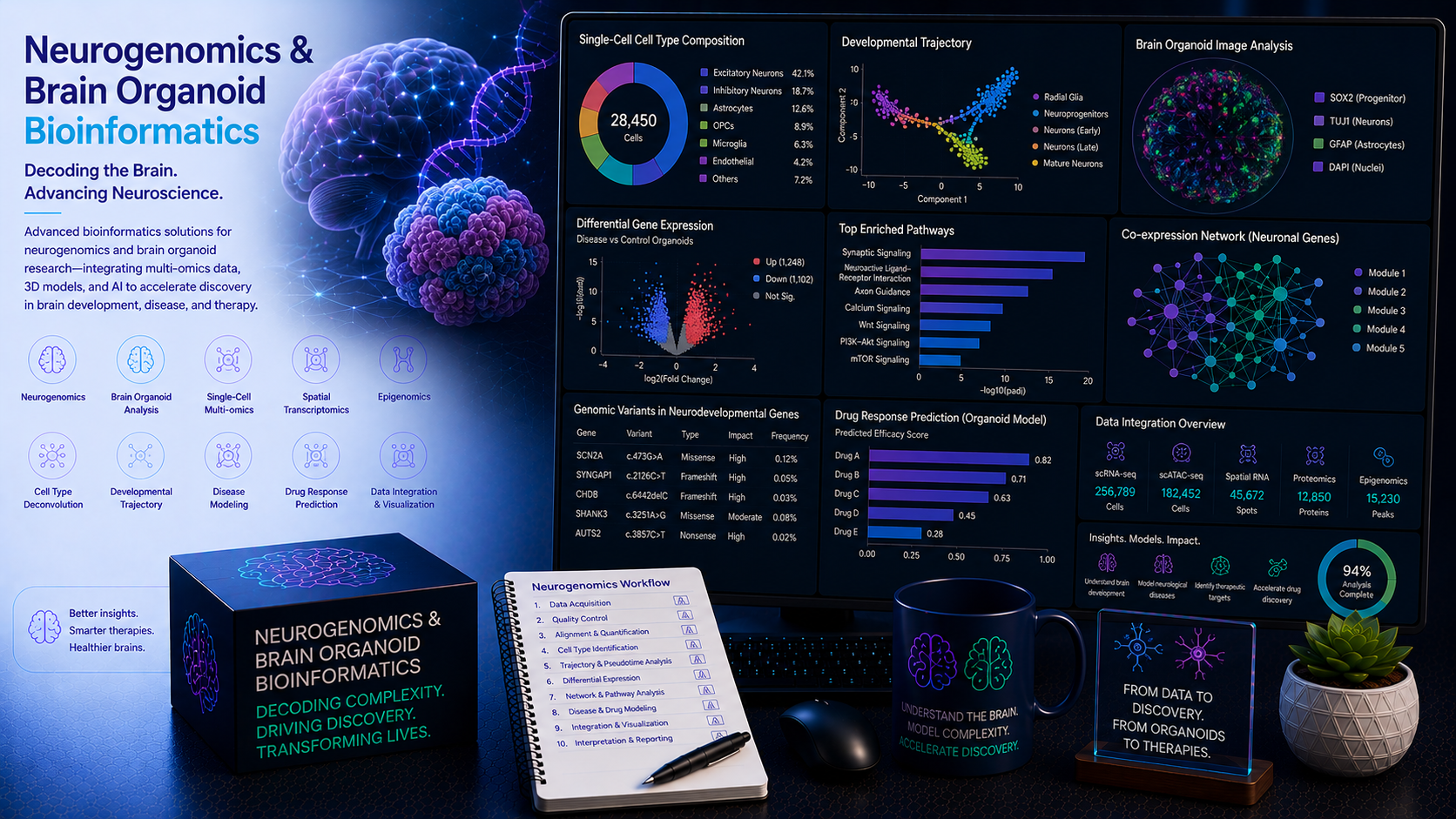
Neurogenomics and brain organoid bioinformatics sit at the frontier of neuroscience and precision medicine — combining whole-genome sequencing, single-cell multi-omics, spatial transcriptomics, and AI to decode the genetic architecture of neurological and psychiatric disease, characterise brain cell type diversity, and model human brain development in vitro. From GWAS-based risk gene identification and rare variant discovery in neurodevelopmental disorders to single-nucleus RNA-seq of post-mortem brain tissue and transcriptomic characterisation of patient-derived brain organoids, every application demands specialist bioinformatics expertise. At BioinformaticsNext, we provide expert neurogenomics and brain organoid bioinformatics services — supporting academic neuroscience groups, neurological disease biotech companies, and pharmaceutical CNS drug discovery programmes worldwide.
Neurogenomics & Brain Organoid Bioinformatics: From Brain Genetics to Single-Cell Disease Modelling
Specialist bioinformatics for neurological GWAS, rare variant discovery, single-nucleus brain transcriptomics, brain organoid characterisation, and CNS drug target identification.
The human brain is the most transcriptomically complex organ in the body — expressing more genes, in more cell-type-specific patterns, than any other tissue. Decoding the genetic and molecular basis of neurological and psychiatric diseases — including Alzheimer's disease, Parkinson's disease, schizophrenia, autism spectrum disorder, epilepsy, and ALS — requires bioinformatics approaches specifically adapted to the unique challenges of brain tissue: high cellular heterogeneity, neuronal vulnerability to isolation, post-mortem RNA degradation, and the lack of accessible living tissue for experimental study. Brain organoids derived from patient iPSCs now provide an unprecedented cellular model of human brain development and disease — but their transcriptomic characterisation requires sophisticated single-cell bioinformatics to interpret correctly.
At BioinformaticsNext, we provide the full neurogenomics and brain organoid bioinformatics stack — from GWAS and multi-omics CNS target identification through to snRNA-seq atlas construction, organoid developmental trajectory analysis, and neurological disease biomarker discovery.
What We Support
Comprehensive bioinformatics across neurological GWAS, brain single-cell omics, organoid transcriptomics, and CNS drug discovery applications.
- Neurological and psychiatric GWAS analysis, colocalisation, and causal gene prioritisation
- Rare variant and de novo mutation analysis in neurodevelopmental and neurodegenerative disorders
- Single-nucleus RNA-seq (snRNA-seq) of post-mortem brain tissue and brain organoids
- Brain cell type atlas construction and disease-associated cell state identification
- Brain organoid transcriptomic characterisation and developmental trajectory analysis
- Spatial transcriptomics for brain region-specific gene expression and cell type mapping
- Neurological disease multi-omics integration: genomics, transcriptomics, epigenomics, and proteomics
- CNS drug target identification and cell-type-specific druggability assessment
- Polygenic risk score (PRS) development for neurological and psychiatric traits
- Neuroimaging-genomics integration and brain phenotype GWAS analysis
Our Neurogenomics & Brain Organoid Bioinformatics Services
Specialist computational neuroscience services tailored to the unique analytical challenges of brain genomics and organoid biology.
All analyses are tailored to your disease area, tissue type, organoid protocol, sequencing platform, and research or drug discovery objectives.
1. Neurological GWAS & Genetic Risk Analysis GWAS · Colocalisation · MR · PRS · Brain eQTL
Human genetic evidence from neurological and psychiatric GWAS provides the most robust starting point for CNS target identification — linking common and rare genetic variants to disease risk and to the specific brain cell types, regions, and biological processes most relevant to therapeutic intervention.
- Neurological GWAS colocalisation and eQTL integration — Bayesian colocalisation of neurological GWAS signals (Alzheimer's, Parkinson's, schizophrenia, ASD, epilepsy, MS) with brain eQTL datasets (GTEx brain, PsychENCODE, BrainSeq, MetaBrain); causal gene prioritisation with SMR, MAGMA, and Mendelian randomisation
- Cell-type heritability enrichment — Partitioned LD score regression (S-LDSC) using snRNA-seq-derived brain cell type gene sets; identification of neurons, astrocytes, oligodendrocytes, microglia, and OPCs most enriched for neurological trait heritability
- Rare variant and de novo mutation analysis — Whole-genome and whole-exome sequencing analysis of neurodevelopmental disorder trios; de novo SNV, indel, and CNV identification; TADA, DeNovolyzeR, and denovoStats-based gene-level enrichment testing for ASD, intellectual disability, epilepsy, and schizophrenia
- Polygenic risk score (PRS) development — PRSice-2, LDpred2, and MegaPRS-based PRS construction for Alzheimer's, Parkinson's, schizophrenia, bipolar disorder, and MDD; PRS validation across independent cohorts; PRS-by-environment interaction analysis
2. Single-Nucleus RNA-seq of Brain Tissue & Organoids snRNA-seq · Cell Type Atlas · Disease States · Ambient RNA
Single-nucleus RNA-seq (snRNA-seq) has become the gold standard for transcriptomic profiling of post-mortem human brain tissue — bypassing the cell isolation challenges of fresh tissue and enabling cell-type-resolved gene expression analysis from frozen archival samples. We provide specialist snRNA-seq bioinformatics optimised for the unique technical challenges of neuronal and glial cell profiling.
- snRNA-seq processing and QC — STARsolo and Cell Ranger-based nucleus demultiplexing; ambient RNA removal with SoupX and CellBender; doublet detection with Scrublet and DoubletFinder; neuronal-specific QC thresholds accounting for the large transcriptomes of mature neurons
- Brain cell type annotation and atlas construction — Seurat and Scanpy-based clustering and annotation against reference brain atlases (Allen Brain Atlas, Human Cell Atlas brain, PsychENCODE single-cell); major cell class (neuron, astrocyte, oligodendrocyte, OPC, microglia, endothelial) and subtype annotation
- Disease-associated cell state identification — Differential abundance analysis with Milo and DAseq; disease-associated microglia (DAM), disease-associated astrocyte (DAA), and stressed neuron state identification; comparison of cell state composition between disease and control donors
- Cross-dataset integration and meta-analysis — Harmony, scVI, and LIGER-based integration of multiple snRNA-seq datasets across brain regions, disease stages, and cohorts; batch correction preserving biological variation; mega-atlas construction from publicly available and proprietary datasets
3. Brain Organoid Transcriptomic Characterisation iPSC · Developmental Trajectory · Cell Identity · Maturation
Brain organoids derived from patient-specific iPSCs provide a human cellular model of brain development and disease — but correctly interpreting their transcriptomes requires benchmarking against primary human brain references, assessing organoid maturation state, and identifying disease-relevant transcriptional differences between patient and control organoids. We provide specialist bioinformatics for all major organoid protocols including whole-brain, cortical, midbrain, hypothalamic, choroid plexus, and assembloid models.
- Organoid cell type characterisation and identity scoring — Automated cell type annotation against Allen Brain Atlas and primary fetal brain snRNA-seq references; identity scoring for neural stem cells, intermediate progenitors, excitatory and inhibitory neurons, astrocytes, and choroid plexus epithelium; batch and protocol variability assessment
- Developmental trajectory and pseudotime analysis — Monocle3, PAGA, and scVelo-based neurogenesis trajectory modelling; radial glia to neuron differentiation pseudotime; RNA velocity for progenitor and post-mitotic state transition directionality
- Patient vs. control organoid comparison — Differential gene expression and differential abundance analysis between patient and isogenic control organoids; disease-relevant gene module identification; correlation of transcriptional phenotypes with clinical genotype severity
- Organoid maturation benchmarking — Maturation scoring against primary human fetal and adult brain references; identification of immature transcriptional signatures limiting disease relevance; comparison of maturation across organoid time points and culture conditions
4. Spatial Transcriptomics of Brain Tissue Visium · Xenium · MERSCOPE · Region Mapping
Spatial transcriptomics preserves the anatomical context of gene expression — enabling mapping of brain cell types, disease-associated states, and gene regulatory programmes to specific brain regions, cortical layers, and histological niches that are lost in dissociated single-cell approaches. We provide specialist spatial transcriptomics analysis for human and rodent brain tissue sections.
- Visium and Visium HD spatial analysis — SpaceRanger processing and Seurat/Squidpy-based spatially-resolved clustering; brain region annotation aligned with Allen Brain Atlas parcellations; spatially variable gene expression identification and region-specific marker analysis
- High-resolution spatial platforms — Xenium, MERSCOPE, and CosMx single-molecule FISH data analysis; single-cell resolution spatial cell type mapping; cell-cell spatial co-localisation and neighbourhood analysis in disease-relevant brain regions
- Cell type deconvolution of spatial spots — cell2location, RCTD, and SPOTlight deconvolution of Visium spots into constituent cell types; layer-specific and region-specific cell type composition mapping; correlation with histological annotations
- Spatial ligand-receptor and niche analysis — CellChat and NicheNet spatial interaction analysis; identification of disease-relevant intercellular communication within specific brain anatomical niches; spatial co-expression of neurotrophic and neuroinflammatory signalling pathways
5. Neurological Multi-Omics Integration & CNS Target Discovery Epigenomics · Proteomics · AI Targets · Drug Discovery
Integrating neurological GWAS, snRNA-seq, epigenomics, and proteomics into a unified multi-omics framework provides the strongest biological foundation for CNS drug target identification — pinpointing targets with genetic evidence of causality, cell-type-specific disease relevance, and computational druggability.
- Brain epigenomics analysis — snATAC-seq chromatin accessibility profiling; brain cell-type-specific peak calling with ArchR and Signac; transcription factor motif enrichment in disease-associated open chromatin regions; GWAS variant overlap with brain regulatory elements for functional annotation
- CSF and brain proteomics integration — Cerebrospinal fluid (CSF) and post-mortem brain proteomics differential abundance analysis; pQTL colocalisation with neurological GWAS for protein-level target validation; CSF biomarker candidate identification for neurological disease monitoring
- CNS drug target prioritisation — Multi-evidence AI target scoring integrating GWAS, eQTL, snRNA-seq, epigenomics, and druggability; cell-type-specific target expression profiling for therapeutic window estimation; OpenTargets neurological disease target scoring and extension
- Gene regulatory network inference — SCENIC and pySCENIC transcription factor regulon analysis in brain cell types; disease-associated regulatory network disruption mapping; identification of master regulator transcription factors as potential CNS drug targets
Key Applications
Neurogenomics and brain organoid bioinformatics across neuroscience research, CNS drug discovery, and translational medicine.
- Alzheimer's, Parkinson's, and ALS GWAS target identification and validation
- Schizophrenia, ASD, and ADHD rare variant and de novo mutation analysis
- Post-mortem brain snRNA-seq atlas construction and disease cell state mapping
- Patient iPSC-derived brain organoid transcriptomic characterisation
- Spatial mapping of neurodegeneration-associated cell states in brain sections
- Microglia, astrocyte, and oligodendrocyte disease state characterisation
- CNS drug target cell-type-specific expression and druggability profiling
- Neurological biomarker discovery from CSF proteomics and brain transcriptomics
Tools, Technologies & Reference Databases
Specialist neurogenomics and brain organoid bioinformatics tools and all major brain reference databases.
- GWAS & Genetics: MAGMA, SMR, COLOC, TwoSampleMR, PRSice-2, LDpred2, S-LDSC
- snRNA-seq: Cell Ranger, STARsolo, SoupX, CellBender, Seurat, Scanpy, scVI, Harmony
- Trajectory Analysis: Monocle3, scVelo, PAGA, Dynamo, CellRank
- Spatial Transcriptomics: SpaceRanger, Squidpy, cell2location, RCTD, SPOTlight, Giotto
- Epigenomics: ArchR, Signac, MACS2, ChromVAR, deepTools, HOMER
- Allen Brain Atlas — Human and mouse brain gene expression reference atlas for cell type annotation and region mapping
- PsychENCODE / BrainSeq — Brain eQTL, gene expression, and epigenomic reference datasets for neurological GWAS colocalisation
- UK Biobank / iPSYCH / PGC — Neurological and psychiatric GWAS summary statistics for colocalisation and PRS development
- Human Cell Atlas Brain — Single-cell reference atlas of human brain cell types for snRNA-seq annotation
- OpenTargets Neurological — Multi-evidence CNS target-disease associations for drug target prioritisation
Project Deliverables
Structured, publication-ready neurogenomics and brain organoid bioinformatics outputs for every project.
- snRNA-seq cell type annotation report with UMAP visualisations and marker gene tables
- Differential expression and differential abundance results between disease and control conditions
- GWAS colocalisation and causal gene prioritisation report with locus plots and forest plots
- Brain organoid developmental trajectory and pseudotime analysis outputs
- Spatial transcriptomics cell type maps and region-specific expression visualisations
- CNS target prioritisation table with multi-evidence scores and cell-type expression profiles
- Publication-ready figures (PDF/SVG/PNG at 300 dpi)
- Full written scientific report with methods, results, and biological interpretation
- Grant application neurogenomics and computational neuroscience sections
- Manuscript methods section and supplementary figure legends
- Interactive brain cell atlas and spatial expression viewer
- Brain organoid benchmarking report against primary human fetal brain references
- CSF and brain proteomics integration and biomarker candidate report
- Long-term retainer for ongoing cohort expansion and database re-analysis
Frequently Asked Questions
Common questions from neuroscience researchers, CNS drug discovery teams, and clinical neurogenomics groups.
Single-nucleus RNA-seq (snRNA-seq) sequences RNA from isolated nuclei rather than whole cells — making it the method of choice for brain tissue, where mature neurons are fragile and do not survive standard cell dissociation protocols. snRNA-seq is compatible with frozen post-mortem tissue archival samples and captures all major brain cell types including neurons, astrocytes, oligodendrocytes, microglia, OPCs, and endothelial cells. We apply nucleus-specific QC parameters and ambient RNA correction methods (SoupX, CellBender) optimised for the snRNA-seq data characteristics of brain tissue.
Yes. We provide comprehensive transcriptomic characterisation of patient-derived brain organoids — including cell type annotation against primary human fetal brain references, developmental trajectory analysis, maturation benchmarking, and differential gene expression between patient and isogenic control organoids. We work with all major organoid protocols including whole-brain, cortical, midbrain, hypothalamic, choroid plexus, and assembloid models, and adapt our bioinformatics approach to the specific cell types and developmental stages relevant to your organoid system.
We have bioinformatics experience across a broad spectrum of neurological and psychiatric conditions — including Alzheimer's disease, Parkinson's disease, ALS, frontotemporal dementia (FTD), multiple sclerosis, epilepsy, schizophrenia, bipolar disorder, major depressive disorder, autism spectrum disorder (ASD), ADHD, and rare neurodevelopmental disorders. Our analytical approaches are adaptable to any neurological indication with appropriate genomic, transcriptomic, or clinical data.
Yes. Integrating patient genetic data with brain organoid transcriptomics is one of the most powerful approaches for understanding disease mechanisms. We map GWAS risk variants and rare disease mutations onto cell-type-specific expression profiles from organoid snRNA-seq, identify the organoid cell types most relevant to genetic risk, and use eQTL colocalisation with organoid-derived gene expression data to link genetic variants to transcriptional targets in disease-relevant cell populations.
Absolutely. We assist with the bioinformatics and computational neuroscience sections of grant applications — including proposed snRNA-seq analysis workflows, GWAS integration methodology, brain organoid transcriptomic characterisation approaches, and preliminary computational data. Please contact us as early as possible in the grant preparation process to allow sufficient time for preliminary analyses.
Related Research Areas & Services
Neurogenomics and brain organoid bioinformatics connects to multiple complementary services we support.
- Genetics & Genomics — GWAS analysis, Mendelian randomisation, polygenic risk score development, and rare variant analysis for neurological and psychiatric disease genetics
- AI Drug Target Identification — Multi-evidence AI target scoring integrating neurological GWAS, brain eQTL, snRNA-seq, and druggability assessment for CNS drug discovery programmes
- Drug Development & AI-Driven Discovery — CNS biomarker discovery, patient stratification, and computational support for neurological disease drug development programmes
- Clinical Genomics & Variant Interpretation — Germline variant calling, ACMG classification, and rare neurodevelopmental disorder trio genomic analysis
- Structural & Functional Genomics — Brain epigenomics, snATAC-seq analysis, and chromatin accessibility profiling in neurological disease and brain organoid models
- Custom Software & Pipeline Development — Bespoke brain atlas construction platforms, organoid transcriptomic analysis pipelines, and interactive neurogenomics data visualisation tools
Ready to Advance Your Neurogenomics or Brain Organoid Research?
Tell us about your neurological disease area, your data type, and your research or drug discovery objectives. Our neurogenomics and brain organoid bioinformatics team will design a tailored analytical plan — typically within 48 hours of your enquiry. Whether you need snRNA-seq analysis of post-mortem brain tissue, transcriptomic characterisation of patient-derived organoids, neurological GWAS target identification, or spatial transcriptomics of brain sections, we are here to deliver expert, publication-ready results from day one.