
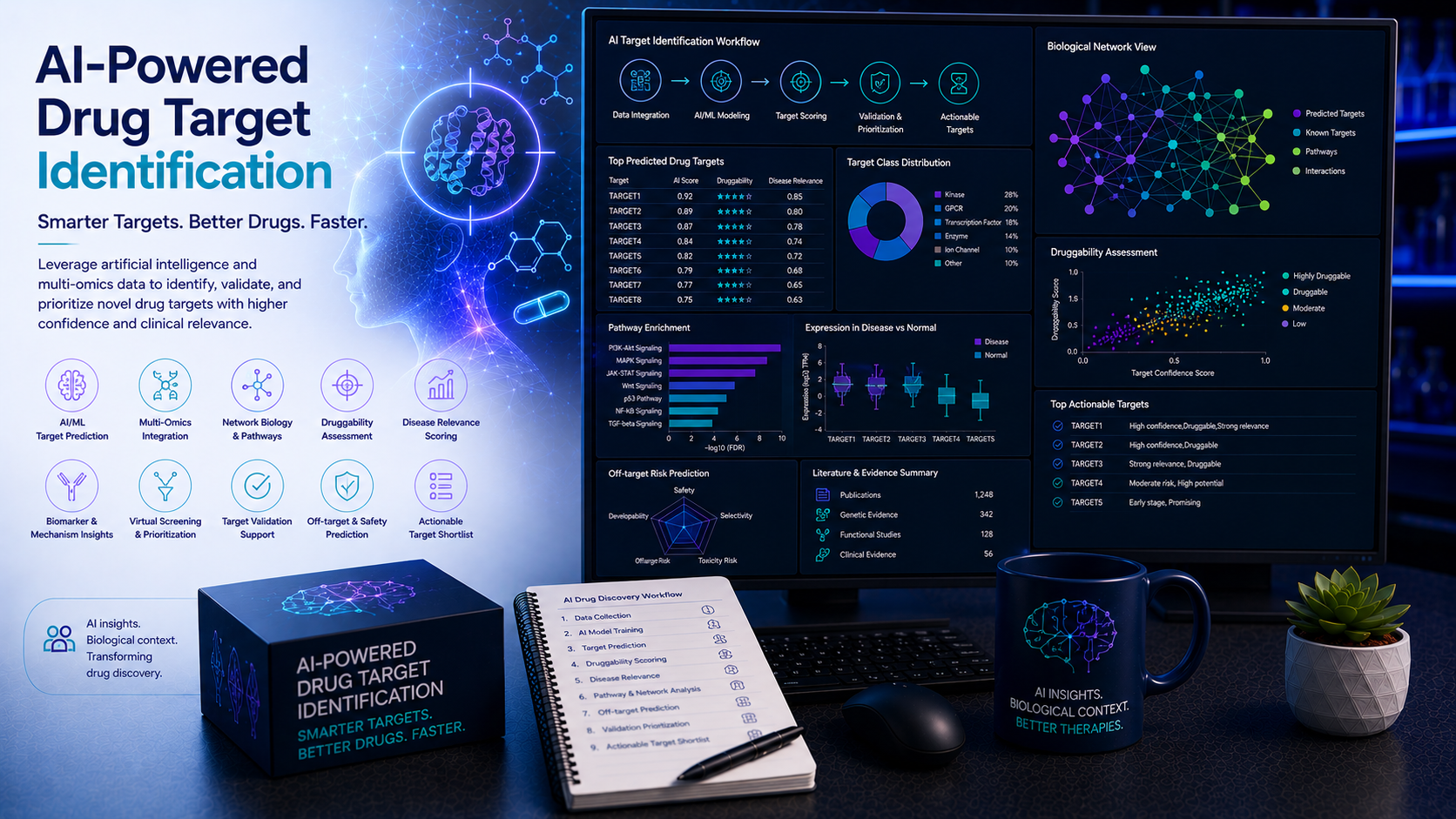
Selecting the right therapeutic target is the single most consequential decision in drug development — and the one most predictive of clinical success or failure. Genome-wide association studies (GWAS), multi-omics data integration, knowledge graph AI, and deep learning are transforming how targets are identified, scored, and validated. At BioinformaticsNext, we provide expert AI-powered drug target identification services — combining human genetic evidence, transcriptomics, proteomics, single-cell profiling, and graph neural networks to prioritise the most biologically credible and druggable therapeutic targets for pharmaceutical, biotech, and academic drug discovery programmes.
AI Drug Target Identification: From Genetic Evidence to Therapeutic Hypothesis
Integrating machine learning, GWAS, multi-omics, and knowledge graphs to prioritise targets with the highest probability of clinical success.
The failure rate of drug candidates in clinical trials remains stubbornly high — largely because targets selected without strong biological validation fail to demonstrate the expected efficacy in patients. Landmark analyses have demonstrated that targets with human genetic evidence supporting their causal role in disease have approximately twice the success rate in clinical development compared to targets without genetic validation. Yet manually integrating the volume, variety, and velocity of genomic, transcriptomic, proteomic, and chemical data now available is beyond the capacity of any single research team.
AI-powered drug target identification changes this equation. Machine learning models can simultaneously interrogate GWAS summary statistics, expression quantitative trait loci (eQTL) datasets, single-cell transcriptomic atlases, protein interaction networks, and chemical databases — producing a ranked, multi-evidence target prioritisation list with explicit confidence scores. At BioinformaticsNext, we deploy validated AI and bioinformatics pipelines to identify, score, and prioritise drug targets with strong biological rationale and high probability of clinical success.
What We Support
Comprehensive AI-driven computational support across every stage of the target identification and validation pipeline.
- AI-powered integration of GWAS, eQTL, pQTL, and sQTL evidence for causal gene prioritisation
- Deep learning-based drug-target interaction prediction and target deorphanisation
- Knowledge graph construction and graph neural network (GNN)-based target scoring
- Multi-omics target prioritisation combining genetic, transcriptomic, and proteomic evidence
- Single-cell and spatial transcriptomics profiling for cell-type-specific target expression and tissue selectivity
- Network pharmacology and protein-protein interaction (PPI) analysis for hub target identification
- Druggability prediction and cross-referencing against ChEMBL, OpenTargets, DrugBank, and DGIdb
- Mendelian randomisation for causal inference between target gene expression and disease outcome
- CRISPR screen integration and functional genomics validation of AI-nominated targets
- NLP-powered literature mining and patent landscape analysis for target hypothesis generation
Our AI Drug Target Identification Services
Modular, fully customisable AI and bioinformatics analyses tailored to your disease, data type, and stage of programme.
All analyses are tailored to your therapeutic area, data type, and stage of development.
1. GWAS-Based Causal Gene Prioritisation GWAS · eQTL · Mendelian Randomisation
Human genetic evidence from genome-wide association studies (GWAS) is the strongest available predictor of clinical success for drug targets. We apply state-of-the-art computational methods to extract causal gene candidates from GWAS summary statistics and link them to mechanistic target hypotheses with explicit evidence scoring.
- GWAS colocalisation — Bayesian colocalisation of GWAS signals with eQTL, pQTL, and sQTL datasets (GTEx, eQTLGen, deCODE) to identify the most likely causal genes at each locus; fine-mapping with SuSiE and FINEMAP for credible set resolution
- Mendelian randomisation (MR) — Two-sample MR using drug target genes as genetic instruments (TwoSampleMR, MendelianRandomization R); causal effect estimation of target expression or protein level on disease outcome; sensitivity analyses including MR-Egger, weighted median, and MR-PRESSO
- MAGMA gene-level analysis — Aggregation of SNP-level GWAS signals to gene-level p-values; gene-set and pathway enrichment from GWAS data to identify biological context for prioritised targets
- SMR and HEIDI testing — Summary Mendelian Randomisation to test whether GWAS and eQTL signals share a causal variant; distinguishing causal pleiotropy from linkage disequilibrium-driven co-localisation
- Rare variant burden analysis — Exome-wide collapsing and burden tests (SAIGE-GENE, REGENIE) using UK Biobank whole-exome sequencing data for rare variant-based target prioritisation
- Polygenic signal enrichment — Partitioned LD score regression (S-LDSC) and cell-type-specific heritability enrichment to identify biological processes, tissue types, and cell populations enriched for disease heritability
2. Multi-Omics AI Target Scoring & Prioritisation OpenTargets · Custom ML · Integration
No single data source tells the full story of a drug target. Our AI-powered multi-omics integration simultaneously combines genetic, transcriptomic, proteomic, and chemical evidence into a composite target priority score that reflects the totality of available biological evidence — far exceeding what any single dataset can reveal.
- OpenTargets integration and extension — Automated ingestion and extension of OpenTargets Platform target-disease associations; augmentation with proprietary or unpublished datasets using the same multi-evidence framework
- Differential expression meta-analysis — DESeq2 and edgeR analysis across multiple disease vs. control transcriptomic datasets; identification of consistently dysregulated target genes across tissues, cell lines, and patient cohorts with reproducibility scoring
- Proteomic evidence integration — Plasma proteomics (SomaScan, Olink) and tissue proteomics data integration; pQTL colocalisation with disease GWAS for protein-level genetic target validation
- Custom composite target scoring — Machine learning-based evidence aggregation models; configurable weighting of genetic, expression, pathway, druggability, and clinical evidence layers into a single interpretable priority score
- Cross-species conservation and essentiality scoring — Evolutionary constraint (gnomAD pLI/LOEUF) and cancer dependency scoring (DepMap CRISPR) to assess target tractability, therapeutic window, and on-target safety risk
- Pathway and network context enrichment — Positioning of candidate targets within disease-relevant biological pathways; identification of upstream regulators and downstream effectors for broader programme context
3. Knowledge Graph & Deep Learning Target Discovery GNN · Hetionet · PrimeKG · PyKEEN
Biological knowledge is inherently relational — genes connect to proteins, proteins to diseases, diseases to phenotypes, phenotypes to drugs. Knowledge graph AI captures these multi-hop relationships to surface non-obvious target candidates and repurposing hypotheses that are invisible to single-dataset analyses.
- Heterogeneous knowledge graph construction — Integration of Hetionet, PrimeKG, STRING, DrugBank, and OMIM into a unified biological knowledge graph; custom node and edge type addition for proprietary data assets
- Graph neural network (GNN) target scoring — Node classification and link prediction with Graph Convolutional Networks (GCN), Graph Attention Networks (GAT), and relational GNNs (R-GCN) using DGL and PyTorch Geometric; interpretable target-disease association scoring
- Knowledge graph embedding models — TransE, RotatE, and ComplEx embedding models (PyKEEN, DGL-KE) for drug-disease-gene triple completion; multi-hop target-disease pathway inference and repurposing candidate generation
- Target deorphanisation — Prediction of disease-gene associations for understudied proteins and dark genome genes; linking genes of unknown function to disease biology via graph-based inference and functional annotation propagation
- Network medicine and disease module mapping — Target-disease network module identification; random walk and network diffusion algorithms for target centrality scoring within disease-relevant biological networks
4. Single-Cell AI Target Profiling scRNA-seq · Spatial · Cell2location
Drug targets do not act uniformly across all cell types. Understanding where a target is expressed, in which cell populations it is most active, and how its expression changes in disease is critical for assessing therapeutic window, tissue selectivity, and on-target safety. We use single-cell and spatial transcriptomics to generate cell-type-resolved target profiles at unprecedented resolution.
- Cell-type-specific target expression profiling — Analysis of Human Cell Atlas, Tabula Sapiens, and disease-specific scRNA-seq datasets; UMAP-based visualisation of target expression and co-expression patterns across all major cell populations
- Disease-context single-cell atlases — Integration of patient scRNA-seq data (tumour, inflamed tissue, diseased organ) with healthy reference atlases; identification of disease-specific cell states with differential target expression
- Spatial target localisation — Visium, MERFISH, and Xenium spatial transcriptomics analysis for anatomical target localisation; cell2location and BayesSpace deconvolution for cell-type density mapping
- Ligand-receptor and cell-cell communication analysis — CellChat and NicheNet-based intercellular signalling pathway analysis involving target genes; relevance to paracrine, autocrine, and juxtacrine drug mechanisms
- Cell-type safety and off-tissue expression profiling — Identification of off-target cell populations expressing the therapeutic target; assessment of potential on-target, off-tissue toxicity risks to guide therapeutic window estimation
5. Druggability & Chemical Matter Assessment ChEMBL · DGIdb · AlphaFold2 · fpocket
A target with compelling genetic and expression evidence is only valuable if it can be pharmacologically modulated. We assess both the structural druggability of the target protein and the availability of existing chemical matter — combining computational structural biology with systematic database mining and intellectual property review.
- Structural druggability prediction — AlphaFold2-predicted structures submitted to fpocket, SiteMap, and DoGSiteScorer for binding pocket identification and druggability scoring; pocket volume, depth, hydrophobicity, and aromaticity assessment
- Existing chemical matter survey — Systematic ChEMBL, DrugBank, DGIdb, and BindingDB cross-referencing for known inhibitors, activators, and tool compounds; compound potency, selectivity, and chemical series profiling
- Antibody and biologic tractability assessment — Extracellular domain availability scoring for antibody therapeutics; signal peptide and transmembrane topology prediction for cell-surface and secreted target suitability
- PPI interface druggability — Hot-spot residue prediction for protein-protein interfaces; tractability assessment for peptide, macrocycle, or small molecule disruption of difficult-to-drug protein complexes
- Allosteric site identification — Molecular dynamics-based cryptic pocket detection; identification of allosteric modulation potential for targets with challenging or occupied orthosteric sites
6. CRISPR Screen & Functional Genomics Integration MAGeCK · BAGEL2 · DepMap · Cancer Dependency
Genetic perturbation data from CRISPR screens provides orthogonal, functional validation of target essentiality in disease-relevant cell models — complementing and strengthening AI-nominated target hypotheses with experimental evidence. We analyse genome-wide CRISPR screen data and integrate publicly available functional genomics resources to validate and refine target lists.
- Genome-wide CRISPR screen analysis — MAGeCK and BAGEL2 analysis of pooled CRISPR knockout screen data; essential and context-dependent essential gene identification, hit calling, and quality control across replicate conditions
- DepMap cancer dependency integration — Correlation of target dependency scores with genomic, expression, and proteomic features across 1,000+ cancer cell lines; identification of target-selective cancer lineages and companion biomarker hypotheses
- CRISPRa/i perturbation transcriptomics — Analysis of CRISPR activation and interference perturbation transcriptomics to define target gain- and loss-of-function transcriptional signatures for MoA inference and drug signature comparison
- Synthetic lethality target mapping — Identification of synthetic lethal gene pairs for nominated targets; combination target hypothesis generation from genetic interaction data in disease-relevant models
- Drug-CRISPR signature comparison — Cross-referencing CRISPR knockout transcriptional signatures with drug perturbation profiles (LINCS L1000, CMap) to validate compound mechanism and nominate next-generation combination targets
7. AI-Powered Literature Mining & Target Hypothesis Generation NLP · BioBERT · PubMed · Patents
The biomedical literature contains decades of experimental evidence not yet captured in structured databases. Natural language processing and transformer-based models extract target-disease relationships, protein function annotations, and mechanistic hypotheses from millions of publications and patents at a scale and comprehensiveness not achievable by manual review.
- Named entity recognition (NER) and relation extraction — SciSpacy, BioBERT, and PubMedBERT transformer models for extraction of gene-disease, protein-phenotype, and compound-target relationships from PubMed, bioRxiv, and PMC full texts
- Target-disease co-occurrence analysis — Large-scale text mining across 35M+ PubMed abstracts; scoring of gene-disease association strength from literature co-occurrence with entity disambiguation and negation detection
- Biological mechanism summarisation — LLM-assisted synthesis of mechanism-of-action evidence for prioritised targets; structured evidence summaries for scientific and regulatory review
- Patent landscape analysis — NLP-based patent mining for freedom-to-operate (FTO) assessment and identification of competitor target programmes and IP-protected chemical series
- Clinical trial target mapping — ClinicalTrials.gov integration to identify targets currently in clinical development, approved indications, failed programme learnings, and competitive intelligence
Key Applications
AI drug target identification supports research and development across the full therapeutic pipeline and drug modality spectrum.
- Novel first-in-class target discovery from disease GWAS and rare variant studies
- Target validation using human genetic causal evidence and Mendelian randomisation
- Knowledge graph AI for dark genome and deorphaned target identification
- Oncology precision medicine target discovery and synthetic lethality mapping
- Immunotherapy and neoantigen target identification from multi-omics profiling
- CNS and neurological disease target prioritisation from single-nucleus atlases
- Rare disease target identification where GWAS power is limited
- Drug repurposing target discovery for new indication expansion
- Combination target identification and resistance bypass target mapping
- Metabolic and cardiovascular disease target discovery from phenotype GWAS
- Antibody and biologic target tractability assessment
- Regulatory and IND-supporting computational target validation packages
Our Analytical Workflow
A structured, reproducible AI target identification process designed to integrate seamlessly with your internal drug discovery pipeline.
Step 1 — Project Scoping Free
We discuss your disease area, available data, existing target hypotheses, therapeutic modality, and programme objectives. We define the analytical approach, evidence sources, data requirements, and deliverables before any work begins — at no cost.
Step 2 — Data Audit & Public Resource Mapping
Inventory of your proprietary data assets alongside relevant public resources — GWAS summary statistics, expression datasets, protein data, and chemical databases — specific to your target indication, tissue, and therapeutic modality.
Step 3 — Secure Data Transfer & QC
Encrypted receipt of proprietary datasets under NDA; comprehensive quality control of all omics, sequencing, and assay data before integration into the analytical pipeline.
Step 4 — AI Pipeline Configuration & Execution
Version-controlled pipeline deployment (Snakemake/Nextflow); GWAS colocalisation, multi-omics integration, knowledge graph construction, and AI model training as appropriate to the agreed analytical plan.
Step 5 — Target Scoring & Prioritisation
Composite AI target scoring across genetic, transcriptomic, proteomic, network, druggability, and safety evidence layers; ranked target list with per-evidence-source confidence metrics and interpretable scoring breakdowns.
Step 6 — Druggability & Chemical Assessment
Structural binding site analysis, existing chemical matter survey, biologic tractability assessment, and intellectual property landscape review for shortlisted candidate targets.
Step 7 — Visualisation & Scientific Reporting
Publication-ready figures — target priority heatmaps, network visualisations, GWAS locus plots, MR forest plots, volcano plots, and single-cell UMAPs — with a comprehensive written scientific report and experimental validation recommendations.
Step 8 — Report & Regulatory Support Optional
Fully documented, reproducible analyses with version-controlled pipelines suitable for IND, CTA, and NDA regulatory submissions; optional manuscript preparation, grant application sections, and patent application bioinformatics content.
Tools & Technologies
Validated, industry-standard, and cutting-edge AI tools across all target identification and functional validation workflows.
- Genetic Evidence & GWAS: TwoSampleMR, MendelianRandomization, MAGMA, SMR, SuSiE, FINEMAP, COLOC, S-LDSC, SAIGE-GENE, REGENIE
- Multi-Omics Integration: OpenTargets, DESeq2, edgeR, MOFA+, mixOmics, clusterProfiler, GSEA, MaxQuant, Perseus
- Knowledge Graphs & GNNs: PyKEEN, DGL-KE, PyTorch Geometric, DGL, Hetionet, PrimeKG, NetworkX, igraph
- Single-Cell & Spatial: Seurat, Scanpy, cell2location, BayesSpace, CellChat, NicheNet, scVI, Harmony, LIGER
- Structural & Druggability: AlphaFold2, RoseTTAFold, ESMFold, fpocket, SiteMap, DoGSiteScorer, AutoDock Vina, GROMACS
- CRISPR & Functional Genomics: MAGeCK, BAGEL2, CRISPResso2, DepMap portal, LINCS L1000, CMap
- NLP & Literature Mining: SciSpacy, BioBERT, PubMedBERT, Gilda, Entrez API, spaCy
- Workflow & Infrastructure: Snakemake, Nextflow, Docker, Singularity, AWS, HPC/SLURM, Git/GitHub
Reference Databases We Use
All major genomic, chemical, and biological databases to support AI-powered target identification, validation, and druggability assessment.
- OpenTargets Platform — Multi-evidence target-disease association scoring integrating GWAS, expression, somatic mutations, and literature; primary framework for target prioritisation score benchmarking and extension
- IEU Open GWAS / UK Biobank — GWAS summary statistics for thousands of complex traits and diseases; primary resource for Mendelian randomisation, GWAS colocalisation, and polygenic heritability enrichment analyses
- GTEx / eQTLGen / deCODE — Tissue- and cell-type-specific eQTL, pQTL, and sQTL datasets for GWAS colocalisation and causal gene mapping across 54+ tissues and whole blood
- ChEMBL & BindingDB — Bioactivity data for drug-like compounds; target-activity data for druggability assessment and existing chemical matter survey
- DrugBank & DGIdb — Comprehensive drug-target information; approved drug mechanisms and indications for druggability assessment and repurposing candidate identification
- Human Cell Atlas / Tabula Sapiens — Single-cell reference atlases across human tissues for cell-type-resolved target expression profiling and therapeutic window assessment
- DepMap Cancer Dependency Map — CRISPR and RNAi essentiality data across 1,000+ cancer cell lines; correlation with genomic features for oncology target validation and biomarker discovery
- Protein Data Bank (PDB) — Experimental protein structures for docking template selection and structural analysis; complemented by AlphaFold2 structure predictions for novel targets without experimental structures
- Hetionet / PrimeKG — Heterogeneous biological knowledge graphs for multi-hop target-disease inference and knowledge graph embedding-based repurposing
- LINCS L1000 / CMap — Drug and genetic perturbation transcriptomic signatures for CRISPR-drug signature comparison, MoA inference, and connectivity mapping
Project Deliverables
A complete, structured set of outputs designed to advance your target identification programme and support internal and external reporting.
- Ranked AI target prioritisation report with per-target evidence summary and composite priority score
- GWAS colocalisation, Mendelian randomisation, and eQTL analysis outputs with locus plots and forest plots
- Multi-omics integration results: differential expression tables, pathway reports, and network visualisations
- Knowledge graph target scores and GNN-based target-disease inference results
- Single-cell target expression profiles across disease-relevant cell types with UMAP visualisations
- Structural druggability report with predicted binding pockets and tractability scores
- Chemical matter landscape summary: known compounds, tool compounds, and IP overview
- Publication-ready figures (PDF, SVG, PNG at 300 dpi): heatmaps, locus plots, network diagrams, UMAPs
- Full written scientific report: methods, results, interpretation, and experimental validation roadmap
- Pipeline scripts and configuration files for complete analytical reproducibility
- Regulatory submission bioinformatics sections (IND, CTA, NDA support)
- Patent application computational biology sections and freedom-to-operate landscape report
- Manuscript methods section and supplementary figure legends (journal-formatted)
- Interactive target prioritisation dashboard and knowledge graph explorer
- Experimental validation roadmap with prioritised assays and disease-relevant model systems
- Grant application computational biology sections and preliminary data package
- Long-term retainer support for ongoing target surveillance and programme evolution
Why Choose BioinformaticsNext?
Deep pharmaceutical biology expertise combined with state-of-the-art AI tools — scientifically rigorous, reproducible, and directly applicable to your drug discovery programme.
Drug Discovery Expertise
Our analysts understand the full drug development pipeline — from disease genetics to clinical biomarkers — ensuring every AI analysis is framed in its translational context and delivers actionable, experimentally testable target recommendations.
End-to-End AI Target Identification Stack
From GWAS and eQTL colocalisation through knowledge graph GNNs and single-cell profiling to structural druggability assessment — we cover every step of AI-powered target identification in a single engagement.
Cutting-Edge AI & Machine Learning
We deploy the latest graph neural networks, transformer-based NLP models, and multi-omics integration frameworks for target identification — keeping your programme at the scientific and technological frontier.
Fast Turnaround
Most AI drug target identification projects are delivered within 2–4 weeks of data receipt. Accelerated timelines are available for milestone-driven or board-facing programmes.
Flexible Engagement
Project-based, milestone-driven, or long-term retainer arrangements. We integrate with your internal teams as a seamless computational extension of your drug discovery and target identification group.
IP & Data Security
Strict confidentiality agreements, encrypted data transfer, and IP protection protocols as standard. NDAs are signed before any data or target information is shared.
Regulatory Awareness
We produce fully documented, reproducible analyses with version-controlled pipelines and comprehensive methods sections suitable for IND, CTA, and NDA regulatory submission contexts.
Global Reach
UK-headquartered with clients across Europe, North America, the Middle East, and Asia-Pacific. Full remote collaboration with encrypted communication and data transfer as standard.
Frequently Asked Questions
Common questions from pharmaceutical, biotech, and academic drug discovery clients about AI drug target identification.
AI drug target identification uses machine learning, deep learning, and large-scale data integration — including GWAS, multi-omics, knowledge graphs, and natural language processing — to identify and prioritise genes or proteins that are causally involved in disease and represent tractable therapeutic targets. AI approaches enable simultaneous interrogation of heterogeneous evidence sources at a scale and speed not achievable by conventional bioinformatics or manual review.
AI enables integration of 10–20+ heterogeneous data sources simultaneously — combining genetic evidence, expression data, protein interactions, chemical databases, and 35M+ publications — producing a probabilistic, multi-evidence target ranking with explicit confidence scores. Traditional methods typically rely on one or two datasets and cannot exploit the relational structure of biological knowledge that graph neural networks are specifically designed to capture.
Yes. When genetic evidence is limited — as is often the case in rare diseases — we use complementary approaches: Mendelian disease database mining (OMIM, ClinVar), rare variant burden testing from exome sequencing, transcriptomic meta-analysis across available disease models, protein interaction network analysis, and knowledge graph-based target inference. We combine multiple lines of evidence into a composite scoring framework to rank candidates by biological plausibility and druggability even in data-sparse settings.
We can work with whatever proprietary data you have — GWAS summary statistics, RNA-seq transcriptomics, proteomics, single-cell data, or compound activity data. We supplement this with relevant public resources including OpenTargets, GTEx, UK Biobank, Human Cell Atlas, DepMap, and ChEMBL. If you have no proprietary data, we can perform a comprehensive AI target identification analysis using only public resources for your disease of interest.
Yes. We routinely work with proprietary compound activity data, unpublished omics datasets, and confidential target information. All data is handled under strict NDA and confidentiality agreements. We never share, publish, or retain client data beyond the agreed project scope.
We have experience across oncology, immunology, metabolic disease, neurology, infectious disease, rare genetic disorders, and cardiovascular disease. Our AI target identification approaches are adaptable to any therapeutic area with appropriate omics, genetic, and clinical data — including indications with limited public genetic resources.
Yes. We produce fully documented, reproducible analyses with version-controlled pipelines and comprehensive methods sections suitable for inclusion in IND, CTA, and NDA regulatory submissions. We can also produce standalone computational biology target validation reports formatted for regulatory review.
Absolutely. We assist with the computational biology and AI sections of grant applications — including target rationale, proposed AI analytical workflows, methodology descriptions (GWAS, Mendelian randomisation, GNN, multi-omics integration), and preliminary computational data. Please get in touch as early as possible in the grant preparation process.
Related Research Areas & Services
AI drug target identification draws on and feeds into multiple complementary research domains and services we support.
- Drug Development & AI-Driven Discovery — Full-pipeline computational drug discovery support: protein structure prediction, molecular docking, ADMET modelling, MoA profiling, biomarker discovery, and drug repurposing
- Genetics & Genomics — GWAS analysis, Mendelian randomisation, polygenic risk score development, rare variant burden testing, and population genetics for drug target validation
- Cancer & Oncogenomics — Somatic variant calling, TMB and MSI scoring, neoantigen prediction, and tumour microenvironment profiling for oncology drug target identification
- Immunology & Immuno-Oncology — Immune target profiling, TCR/BCR repertoire analysis, and neoantigen-MHC binding prediction for immunotherapy target discovery
- Structural & Functional Genomics — Epigenomic target characterisation, chromatin accessibility, ATAC-seq, and enhancer hijacking analysis for epigenetic drug target programmes
- Custom Software & Pipeline Development — Bespoke AI target identification platforms, interactive knowledge graph explorers, and automated pipeline deployment for internal drug discovery operations
Ready to Identify Your Next Drug Target with AI?
Tell us about your disease area, your available data, and your programme objectives. Our AI drug target identification team will design a tailored computational plan — typically within 48 hours of your enquiry. Whether you are starting from a disease of interest, a GWAS dataset, or an existing target hypothesis requiring multi-omics validation, we are here to accelerate your discovery programme from day one.