
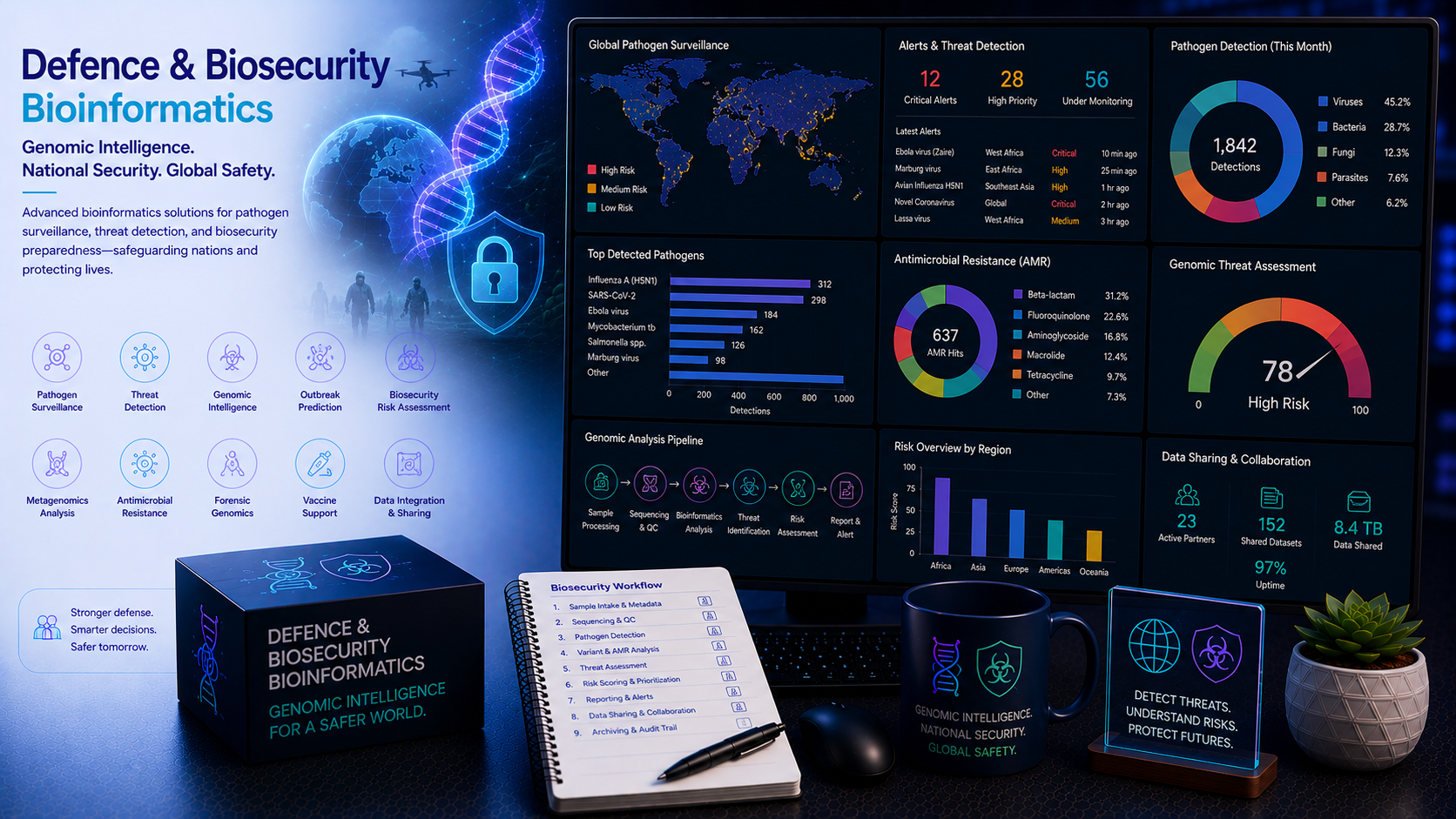
Defence and biosecurity bioinformatics sits at the intersection of genomics, microbiology, and national security — applying the most advanced sequencing and computational biology tools to detect, characterise, and counter biological threats. From rapid pathogen identification and genomic forensics of select agents to environmental biosurveillance pipeline development, biodefence metagenomics, and CBRN threat intelligence integration, defence bioinformatics demands the highest standards of analytical rigour, data security, and operational reliability. At BioinformaticsNext, we provide specialist defence and biosecurity bioinformatics services — supporting defence science organisations, government agencies, biosecurity contractors, and academic research groups working at the interface of genomics and national biosecurity with expert, security-conscious computational biology expertise.
Defence & Biosecurity Bioinformatics: Biodefence Pathogen Analysis & Biosurveillance Pipelines
Expert bioinformatics for biodefence pathogen characterisation, environmental biosurveillance pipeline development, bioforensic genomics, metagenomics-based threat detection, and CBRN-relevant genomic analysis for defence science and national security applications.
The genomic revolution has fundamentally transformed both the threat landscape and the defensive toolkit in biosecurity. Advances in synthetic biology, whole-genome sequencing, and metagenomics have simultaneously lowered the barrier to engineering biological agents and dramatically increased our ability to detect, characterise, and attribute biological threats with speed and precision previously impossible. Next-generation sequencing can identify an unknown pathogen from a complex environmental sample within hours. Genomic epidemiology can reconstruct the provenance and release point of a biological agent. Metagenomics can distinguish an intentional release from a natural outbreak by detecting anomalous community signatures. Capitalising on these capabilities for national security requires specialist bioinformatics expertise that combines deep microbiology and genomics knowledge with the operational awareness, data security standards, and analytical reliability demanded by defence and government environments.
At BioinformaticsNext, we provide the full defence and biosecurity bioinformatics capability — from validated environmental biosurveillance pipelines and pathogen characterisation workflows through bioforensic analysis, threat agent genomic databases, and bespoke DSTL-aligned analytical pipeline development — with appropriate security-consciousness and operational documentation at every stage.
What We Support
Comprehensive defence and biosecurity bioinformatics across environmental threat detection, pathogen characterisation, bioforensics, and biosurveillance pipeline development.
- Rapid metagenomic pathogen identification from environmental, clinical, and forensic samples
- Select agent and biological threat genomic characterisation and database development
- Environmental biosurveillance pipeline design, validation, and operational deployment
- Bioforensic genomics: provenance attribution and source reconstruction from genomic data
- Wastewater and environmental sentinel sampling metagenomics for threat detection
- Antimicrobial resistance gene surveillance in defence-relevant environmental contexts
- Synthetic biology threat detection and engineered sequence identification
- Dual-use research of concern (DURC) genomic risk assessment support
- CBRN-relevant genomic database construction and threat intelligence integration
- Bespoke secure pipeline development aligned with DSTL and MOD analytical requirements
Our Defence & Biosecurity Bioinformatics Services
Specialist biodefence and biosecurity bioinformatics — from rapid pathogen identification and environmental threat detection through bioforensic attribution, synthetic biology threat assessment, and bespoke DSTL-aligned pipeline development.
All analyses and pipeline developments are conducted with appropriate data security protocols, version control, audit trail documentation, and operational reliability standards required for defence and government applications.
1. Rapid Pathogen Identification & Metagenomics-Based Threat Detection mNGS · Kraken2 · DIAMOND · Unknown Agent · Clinical
The ability to identify an unknown biological agent rapidly and accurately from a complex environmental or clinical sample — without prior knowledge of the pathogen — is one of the most operationally critical capabilities in biodefence. Metagenomics-based pathogen identification provides this capability, distinguishing threat agents from background environmental and commensal sequences with validated sensitivity and specificity.
- Culture-independent pathogen identification — Kraken2, DIAMOND, and Kaiju-based taxonomic classification of metagenomic reads against comprehensive pathogen and background community reference databases; confidence-scored pathogen shortlist generation; discrimination of threat-relevant organisms from closely related environmental background taxa
- Unknown agent identification pipeline — De novo assembly of unclassified metagenomic contigs; BLASTx and HMM-based protein domain annotation against characterised pathogen gene families; phylogenetic placement of novel sequences; genome completeness assessment for novel bacterial and viral agents
- Clinical and environmental sample metagenomics — Matrix-specific processing pipelines for environmental swabs, air filter samples, water concentrates, soil, and clinical materials; host and background DNA depletion strategies; sensitivity threshold determination from spiked reference standards and blank controls
- Real-time and field-deployable analysis support — Oxford Nanopore real-time adaptive sampling pipeline support (ReadFish, BOSS-RUNS) for targeted pathogen enrichment during sequencing; MinION-compatible rapid classification workflows for field-forward and point-of-need deployment contexts
2. Select Agent & Biological Threat Genomic Characterisation Tier 1 Agents · Genome Analysis · Virulence · Phylogenomics
Comprehensive genomic characterisation of biological threat agents — including Tier 1 select agents and other CBRN-relevant pathogens — provides the reference knowledge base essential for detection assay design, forensic attribution, and threat intelligence. We provide specialist genomic analysis of threat-relevant organisms with appropriate regulatory awareness and containment-aligned analytical support.
- Threat agent whole-genome analysis — Reference genome assembly, annotation, and comparative genomics of biosecurity-relevant bacterial, viral, and fungal agents; virulence gene and toxin gene catalogue construction; antimicrobial resistance gene profiling; genome completeness and quality assessment against established reference sequences
- Virulence factor and pathogenicity island analysis — Comprehensive virulence gene identification using VFDB, PathogenFinder, and curated threat agent virulence databases; pathogenicity island detection and comparative analysis; toxin gene cluster characterisation and expression context analysis from transcriptomic data where available
- Comparative genomics and phylogenomics — Core genome SNP-based phylogenetic analysis of threat agent isolate collections; whole-genome MLST and cgMLST typing; pairwise ANI and genome distance calculation; identification of genomic features distinguishing high-consequence variants from reference strains
- Threat agent reference database construction — Curated, version-controlled genomic reference databases for biosecurity-relevant organisms; regular update protocols aligned with emerging sequence data; database quality validation against established reference sequences; integration with detection pipeline reference libraries
3. Bioforensic Genomics & Attribution Analysis SNP Forensics · Provenance · Release Point · Attribution
Bioforensic genomics applies phylogenetic, population genomic, and comparative genomic methods to determine the origin, provenance, and attribution of a biological agent recovered from an incident or investigation. Genomic evidence can distinguish natural outbreaks from deliberate releases, identify likely source populations or production systems, and support legal and intelligence attribution processes.
- Genomic attribution and provenance analysis — High-resolution core genome SNP phylogeny of incident isolates against global reference collections; Bayesian phylogeographic analysis for geographic provenance inference; population structure analysis to identify source population; molecular clock analysis for release timing estimation
- Natural vs. deliberate release discrimination — Epidemiological curve modelling combined with genomic diversity analysis; detection of anomalously low diversity consistent with single-source release; comparison of observed genomic signatures against expected natural outbreak diversity; analysis of geographic clustering inconsistent with natural transmission routes
- Passage history and production system inference — Genome-wide analysis of laboratory passage signatures; identification of mutations consistent with in vitro serial passage; comparison of isolate genomic signatures against reference passage series; detection of attenuating or enhancing mutations relative to wild-type references
- Forensic-grade analytical documentation — Chain of custody-aligned analytical workflows; comprehensive methods documentation suitable for legal and intelligence reporting; reproducible pipeline deployment with version control and full audit trail; uncertainty quantification and confidence interval reporting for all forensic conclusions
4. Environmental Biosurveillance Pipeline Development Sentinel Networks · Anomaly Detection · WBE · Automated
Effective biosurveillance requires not just the ability to perform individual analyses but the deployment of automated, validated, and operationally resilient pipelines that can process sentinel environmental samples continuously — detecting anomalous biological signals against a well-characterised baseline before a threat escalates. We design, validate, and deploy bespoke environmental biosurveillance bioinformatics pipelines for defence and government applications.
- Automated sentinel sample processing pipelines — Snakemake and Nextflow-based automated metagenomics pipelines for high-throughput sentinel environmental sample processing; real-time quality control and alert flagging; automated report generation with configurable threat threshold parameters; pipeline performance monitoring and failure alerting
- Baseline community characterisation and anomaly detection — Longitudinal environmental community baseline profiling across sentinel sampling networks; statistical process control and anomaly detection algorithms for identification of significant departures from baseline community composition; species-level and functional-level anomaly scoring
- Wastewater biosurveillance pipeline development — SARS-CoV-2, influenza, and select agent-relevant wastewater surveillance pipeline design and validation; Freyja and custom deconvolution tool integration for variant mixture analysis; automated trend reporting and early warning dashboard development; integration with national public health surveillance data streams
- DSTL and MOD-aligned pipeline documentation — Pipeline qualification documentation aligned with DSTL analytical requirements; software validation reports; operational user guides and standard operating procedures (SOPs); training support for in-house pipeline operation and maintenance
5. Synthetic Biology Threat Assessment & Engineered Sequence Detection DURC · Gain-of-Function · Engineered Sequences · Risk Assessment
Advances in synthetic biology have created new biosecurity challenges — including the potential for engineering enhanced pathogen characteristics, assembling select agent genomes from commercially synthesised oligonucleotides, and creating novel biological agents with no natural precedent. Computational approaches now provide the first line of screening for engineered biological sequences with threat potential.
- Engineered sequence detection and analysis — Identification of non-natural sequence features inconsistent with natural evolution: codon optimisation signatures, synthetic regulatory elements, restriction site-free sequence design patterns, and unusual recombination junctions; comparison of recovered sequences against natural variant databases to detect artificial modifications
- Gain-of-function and enhanced pathogen risk assessment — Computational assessment of mutations conferring enhanced transmissibility, virulence, immune evasion, or antibiotic resistance relative to wild-type reference sequences; structural modelling of mutation effects on key surface proteins; comparison against published experimental gain-of-function mutation catalogues
- Dual-use research of concern (DURC) genomic support — Computational biology sections for DURC institutional review submissions; risk assessment documentation for research involving potential pandemic pathogens (PPP); gain-of-function research of concern (GOFROC) genomic analysis and reporting support
- Synthetic gene screening support — Bioinformatics support for commercial gene synthesis screening programmes; analysis of flagged sequences for threat agent similarity, virulence gene content, and biosecurity-relevant functional domain identification; false positive reduction and contextual risk assessment for screening alert triage
Key Applications
Defence and biosecurity bioinformatics across government, military, public health, and academic security research contexts.
- DSTL and MOD biosurveillance pipeline development and validation
- Rapid unknown pathogen identification from environmental and clinical samples
- Bioforensic genomic attribution for biological incident investigation
- Select agent genomic characterisation and reference database construction
- Wastewater and environmental sentinel network biosurveillance
- Synthetic biology threat and engineered sequence detection
- DURC and gain-of-function research genomic risk assessment
- CBRN threat intelligence genomic database development
Tools, Technologies & Reference Resources
Validated, operationally proven biosecurity bioinformatics tools and reference resources for defence and government applications.
- Pathogen ID: Kraken2, Bracken, DIAMOND, Kaiju, MetaPhlAn4, CLARK
- Assembly: SPAdes, MEGAHIT, Flye, metaSPAdes, Minimap2, Medaka
- Phylogenomics: IQ-TREE2, BEAST2, RAxML-NG, Snippy, Gubbins, PopPUNK
- Annotation: PROKKA, Bakta, RAST, VFDB, PathogenFinder, antiSMASH
- AMR: AMRFinderPlus, ResFinder, CARD RGI, PlasmidFinder, MOB-suite
- Surveillance Pipelines: Snakemake, Nextflow, Docker, Singularity, Freyja, iVar
- ONT Real-Time: ReadFish, BOSS-RUNS, Guppy, MinKNOW, EPI2ME
- NCBI RefSeq / GenBank — Reference pathogen genome sequences for identification and comparative analysis
- VFDB / PathogenFinder / PHASTER — Virulence factor, pathogenicity island, and phage reference databases
- GISAID / PubMLST / Enterobase — Curated pathogen genomic surveillance databases for attribution and typing
Security, Data Handling & Compliance
Defence and biosecurity bioinformatics requires the highest standards of data security, confidentiality, and operational reliability — applied at every stage of our engagement.
Data Security
All data transfers conducted via encrypted channels; secure data processing environments with access control; no data retention beyond agreed project scope; NDAs and data processing agreements signed before any data or sequence information is shared.
Audit Trail & Reproducibility
Full version-controlled pipeline documentation with complete audit trails; software version records and parameter logs for every analysis; reproducible workflows deployable in isolated secure computing environments; chain of custody-aligned analytical documentation.
Regulatory Awareness
Familiarity with select agent regulations (CDC/USDA FSAP, Schedule 5 Pathogens UK), DURC institutional review requirements, GOFROC policy frameworks, and synthetic gene screening guidelines; all analyses conducted with appropriate regulatory context and containment-aligned protocols.
Operational Reliability
Pipeline validation against reference standards before operational deployment; defined performance metrics (sensitivity, specificity, false positive rate); documented failure modes and contingency procedures; ongoing pipeline performance monitoring and update protocols.
Project Deliverables
Structured, operationally relevant defence and biosecurity bioinformatics outputs with full documentation for government and defence applications.
- Pathogen identification report with confidence scores, read evidence, and background discrimination
- Genomic characterisation report: assembly statistics, virulence genes, AMR profile, and phylogenetic placement
- Bioforensic attribution analysis with phylogenetic evidence, confidence intervals, and uncertainty quantification
- Biosurveillance pipeline: validated Snakemake/Nextflow workflow with configuration files and SOPs
- Baseline community characterisation report and anomaly detection threshold documentation
- Synthetic biology threat assessment report with engineered feature analysis and risk scoring
- Full written technical report with methods, results, confidence assessment, and operational recommendations
- Complete pipeline scripts, version records, and audit trail documentation
- Bespoke DSTL and MOD-formatted analytical reports and pipeline qualification documents
- Real-time field-deployable ONT analysis pipeline development and validation
- Threat agent genomic reference database construction and maintenance
- Interactive biosurveillance dashboard and automated alerting system development
- Training and knowledge transfer for in-house pipeline operation
- DURC institutional review and GOFROC risk assessment computational biology sections
- Long-term retainer for ongoing biosurveillance programme support and pipeline updates
Frequently Asked Questions
Common questions from defence science organisations, government agencies, and biosecurity research groups.
Detection sensitivity depends on sequencing depth, sample matrix, background community complexity, and the proportion of threat agent DNA relative to total environmental DNA. For environmental samples with high background microbial content (soil, water), threat agent detection at very low concentrations requires deep sequencing (50–100M+ reads), host and background DNA depletion strategies, and targeted enrichment approaches such as capture hybridisation or real-time adaptive sampling with Oxford Nanopore. We characterise the limit of detection (LoD) for each pipeline against spiked reference standards and provide explicit sensitivity specifications with each validated pipeline deployment. Sensitivity can be substantially improved by combining metagenomics with targeted amplicon or qPCR-based confirmation for high-priority threat agents.
Genomic evidence can make important contributions to this determination — but no single line of evidence is definitive. Key genomic indicators suggesting a deliberate release include: anomalously low genomic diversity inconsistent with the expected within-host and between-host mutation rate over the observed epidemic timeframe; geographic clustering of cases inconsistent with natural transmission dynamics; the presence of engineered sequence features absent from natural variant databases; and phylogenetic placement inconsistent with the geographic location of reported cases. We integrate these genomic signals with epidemiological, intelligence, and environmental evidence to provide a structured probabilistic assessment rather than a binary conclusion — with explicit uncertainty quantification at every step.
We have experience working on biosecurity-relevant genomics projects aligned with DSTL analytical frameworks and UK government biosecurity requirements — including environmental metagenomics pipeline development, pathogen genomic characterisation, and biosurveillance analytical support. We are familiar with the documentation standards, data handling requirements, and operational reliability expectations of defence science contexts, and produce pipeline qualification documents, analytical SOPs, and technical reports formatted for government review. We operate under NDAs for all defence-relevant engagements and are available to discuss specific security requirements at initial consultation.
Yes. We develop bioinformatics pipelines using containerised, dependency-complete workflows (Docker, Singularity) that can be deployed in secure or air-gapped computing environments without requiring internet access during execution. All reference databases, software dependencies, and configuration files are packaged for offline deployment. We provide complete deployment documentation, installation guides, and validation test datasets so that pipelines can be independently verified in the target secure computing environment before operational use.
Yes. We assist with the bioinformatics and computational biology sections of grant applications to DSTL, DARPA, BARDA, Innovate UK, and other defence and biosecurity funding bodies — including proposed metagenomics pipeline architecture, pathogen detection methodology, bioforensic analysis approaches, biosurveillance system design, and preliminary computational data. Please contact us as early as possible in the application preparation process to allow time for any preliminary analyses or pipeline demonstrations required.
Related Research Areas & Services
Defence and biosecurity bioinformatics connects to multiple complementary services we support.
- Infectious Disease & Pandemic Genomics — Pathogen whole-genome sequencing, outbreak phylogenetics, AMR surveillance, and clinical metagenomics sharing core methodology with defence pathogen characterisation and bioforensics
- eDNA & Biodiversity Genomics — Environmental metagenomics, One Health biosurveillance, wastewater epidemiology, and novel pathogen discovery from environmental matrices directly applicable to defence biosurveillance
- Metagenomics & Microbiome — Shotgun metagenomics, MAG recovery, functional annotation, and resistome profiling providing the technical foundation for environmental biosurveillance metagenomics
- Genetics & Genomics — Population genomics, phylogenetic analysis, and demographic history inference underpinning bioforensic attribution and pathogen provenance analysis
- AlphaFold & Structural Bioinformatics — Structural characterisation of threat agent proteins, toxin structure prediction, and computational assessment of mutation effects on pathogen surface proteins relevant to biosecurity
- Custom Software & Pipeline Development — Bespoke biosurveillance platform development, secure containerised pipeline deployment, automated threat detection dashboards, and air-gapped environment pipeline configuration for defence applications
Ready to Advance Your Defence Bioinformatics or Biosurveillance Capability?
Tell us about your biosecurity programme, your analytical requirements, your data environment, and your operational objectives. Our defence and biosecurity bioinformatics team will design a tailored analytical or pipeline development plan — typically within 48 hours of your initial enquiry. All initial consultations are conducted under strict confidentiality. Whether you need rapid pathogen identification pipelines, bioforensic genomic attribution analysis, environmental biosurveillance pipeline development, synthetic biology threat assessment, or DSTL-aligned pipeline documentation, we are here to deliver expert, reliable, and security-conscious bioinformatics support from day one.