
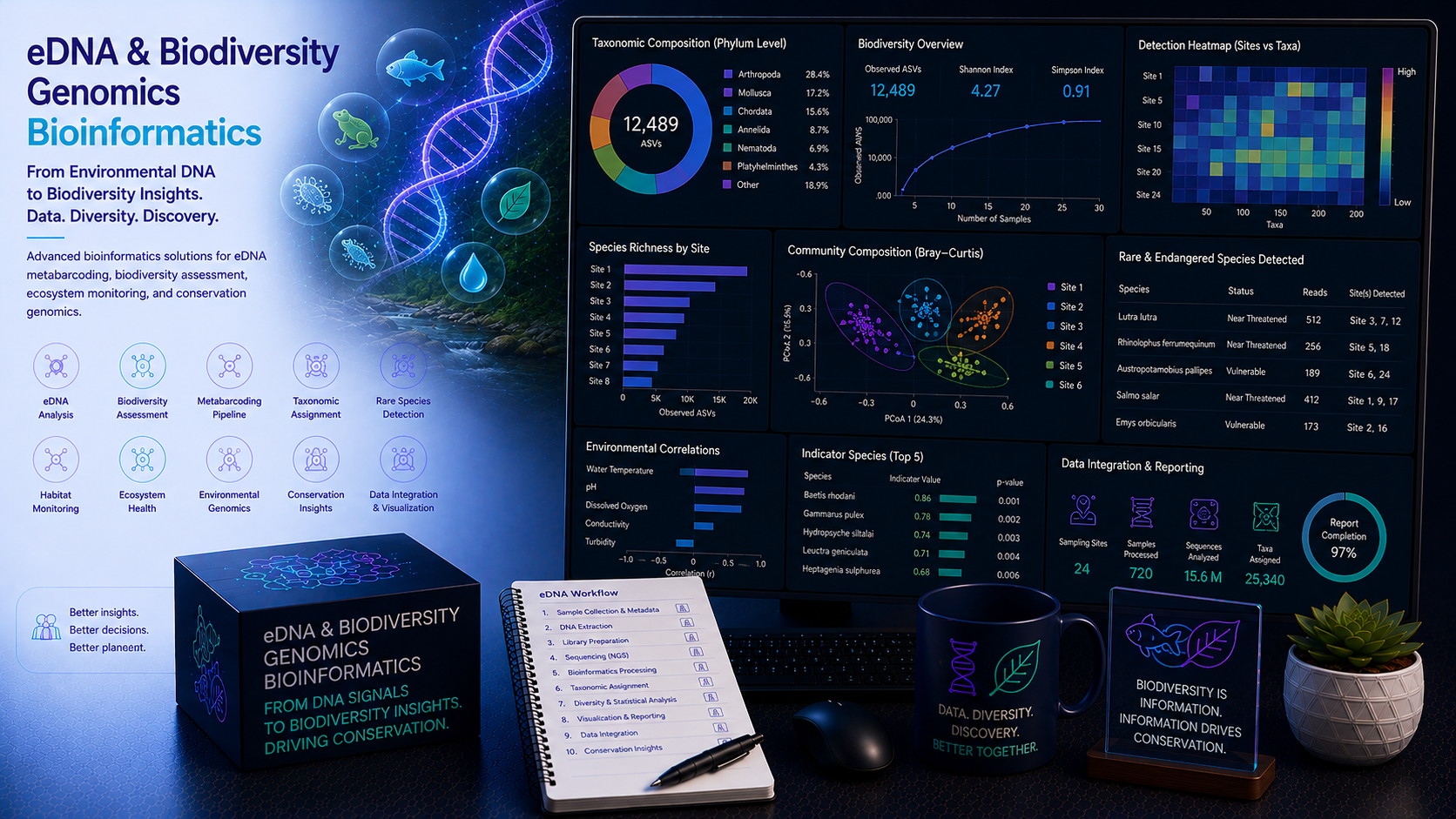
Environmental DNA (eDNA) and biodiversity genomics are revolutionising how we detect, monitor, and conserve species — enabling non-invasive, high-throughput assessment of biodiversity from water, soil, air, and sediment samples without the need to physically observe or capture organisms. From eDNA metabarcoding for aquatic species detection and bulk arthropod metagenomics to whole-genome population genomics for conservation management and phylogeographic analysis of endangered species, biodiversity genomics generates rich, complex datasets that demand expert bioinformatics analysis. At BioinformaticsNext, we provide specialist eDNA and biodiversity genomics bioinformatics services — supporting environmental consultancies, conservation organisations, academic ecology groups, regulatory agencies, and natural history institutions in extracting accurate, scientifically robust, and actionable biodiversity insights from genomic data.
eDNA & Biodiversity Genomics Bioinformatics: Species Detection, Diversity Analysis & Conservation Genomics
Expert bioinformatics for eDNA metabarcoding, species diversity assessment, population genomics, phylogeography, and conservation genomics across aquatic, terrestrial, and marine environments.
Traditional biodiversity survey methods — trapping, netting, visual transects, acoustic monitoring — are time-consuming, expensive, observer-dependent, and often miss rare, cryptic, or nocturnal species. Environmental DNA has transformed ecological monitoring: a single water or soil sample can now reveal the presence of hundreds of species simultaneously, including rare, invasive, and threatened taxa that would be impossible to detect cost-effectively by conventional means. Combined with metabarcoding across standardised gene markers (COI, 12S, 16S, ITS, rbcL, trnL), population-level whole-genome sequencing, and landscape genomics, eDNA and biodiversity genomics now underpin ecological impact assessments, invasive species surveillance, conservation breeding programme management, and biodiversity net gain reporting.
At BioinformaticsNext, we provide the full eDNA and biodiversity genomics bioinformatics stack — from amplicon quality filtering and taxonomic classification through diversity analysis, species distribution modelling, population structure analysis, and conservation genomics reporting — with outputs tailored to regulatory, scientific, and conservation management requirements.
What We Support
Comprehensive eDNA and biodiversity genomics bioinformatics across metabarcoding, metagenomics, population genomics, and conservation applications.
- eDNA metabarcoding amplicon processing and taxonomic classification across all major gene markers
- Alpha and beta diversity analysis with ecological community composition statistics
- Invasive, threatened, and rare species detection and occupancy modelling from eDNA data
- Shotgun metagenomics for bulk biodiversity assessment and functional community profiling
- Population genomics, genetic diversity, and inbreeding assessment for conservation management
- Phylogeographic analysis and landscape genomics for species range and connectivity studies
- Environmental DNA detection sensitivity and false negative rate assessment
- Biodiversity net gain and ecological baseline assessment bioinformatics support
- Reference database construction and curation for custom taxonomic groups
- Regulatory reporting support for EIA, HRA, and biodiversity net gain frameworks
Our eDNA & Biodiversity Genomics Bioinformatics Services
Specialist eDNA and biodiversity genomics bioinformatics across metabarcoding, diversity analysis, population genomics, and conservation applications.
All analyses are tailored to your target taxa, gene marker, sequencing platform, ecological context, and regulatory or conservation reporting requirements.
1. eDNA Metabarcoding: Amplicon Processing & Taxonomic Classification DADA2 · QIIME2 · COI · 12S · ITS · BLAST
eDNA metabarcoding amplicon data processing requires careful quality filtering, denoising, chimera removal, and taxonomic assignment against curated reference databases — with appropriate handling of sequencing errors, PCR bias, and cross-contamination that are endemic to highly multiplexed environmental sequencing. We apply validated, marker-specific pipelines that maximise taxonomic resolution while controlling false positive species detections.
- Amplicon QC and denoising — DADA2 and QIIME2-based paired-end read merging, quality filtering, chimera removal, and amplicon sequence variant (ASV) generation; primer trimming with Cutadapt; per-sample read depth and ASV richness QC reporting; sequencing negative control and field blank assessment for contamination screening
- Marker-specific processing pipelines — Optimised processing parameters for COI (metazoan), 12S rRNA (vertebrates, fish eDNA), 16S rRNA (bacteria, diet analysis), 18S rRNA (eukaryotes), ITS1/ITS2 (fungi, plants), rbcL and trnL (plants); marker-specific denoising error model training and ASV length filtering
- Taxonomic classification and reference database assignment — BLAST, RDP classifier, SINTAX, and DADA2 species-level assignment against BOLD, SILVA, UNITE, PR2, MitoFish, and custom curated reference databases; confidence score thresholding and ambiguous classification handling; taxonomic assignment validation against regional species checklists
- Contamination and false positive control — Negative extraction control and PCR blank subtraction; occupancy modelling-based false positive filtering (LULU, decontam); cross-contamination detection from index-hopping in highly multiplexed runs; conservative detection threshold application for regulatory-grade species reporting
2. Biodiversity & Ecological Community Analysis Alpha Diversity · Beta Diversity · Ordination · Turnover
Transforming eDNA species detection tables into ecologically meaningful diversity metrics, community composition summaries, and environmental driver analyses requires specialist ecological statistics — going beyond simple species lists to reveal the structure, turnover, and environmental determinants of biodiversity across sites, seasons, and habitats.
- Alpha diversity metrics — Species richness, Shannon entropy, Simpson diversity, Faith's phylogenetic diversity, and Chao1 and ACE richness estimators; rarefaction curve analysis for sequencing depth adequacy; comparison of diversity indices across sites, habitats, seasons, and treatment conditions with appropriate statistical testing
- Beta diversity and community ordination — Bray-Curtis, Jaccard, UniFrac (weighted and unweighted), and Aitchison distance-based beta diversity calculation; PCoA, NMDS, and RDA ordination visualisation; PERMANOVA and ANOSIM community composition significance testing; betadisper homogeneity of dispersion assessment
- Species turnover and nestedness decomposition — Baselga-based beta diversity partitioning into spatial turnover and nestedness components; identification of replacement vs. loss-driven community differences across environmental gradients; temporal community dynamics and seasonal turnover analysis
- Environmental driver analysis — Constrained ordination (RDA, CCA) linking community composition to environmental covariates (temperature, pH, conductivity, land use, water chemistry); distance-based redundancy analysis (dbRDA); indicator species analysis with IndVal; environmental threshold detection using gradient forest
3. Target Species Detection, Occupancy Modelling & Invasive Species Surveillance Rare Species · Great Crested Newt · Invasive · Occupancy
eDNA-based detection of specific target species — including legally protected, invasive, commercially important, or ecologically indicator species — requires specialised bioinformatics that accounts for detection probability, false positive and false negative rates, and occupancy across replicated samples to produce defensible presence/absence conclusions for regulatory and conservation reporting.
- Single-species eDNA detection analysis — Validated bioinformatics pipelines for target species detection from assay-specific qPCR and ddPCR data; occupancy model-based probability of presence estimation accounting for imperfect detection; detection threshold determination from negative controls and field blanks
- Multi-species eDNA panel analysis — Metabarcoding-based simultaneous detection of multiple target species from a single sample; species-specific read count thresholding; sensitivity and specificity assessment against conventional survey data for panel validation
- Invasive species early warning analysis — Ultra-sensitive invasive species detection from low eDNA concentration samples; site-specific invasion risk scoring from eDNA read abundance; spatial spread trajectory mapping from time-series eDNA data; signal discrimination between invasive target and native congeners
- Occupancy modelling and detection probability estimation — Site-occupancy models (unmarked, occu R) incorporating multi-replicate eDNA sample data; estimation of detection probability given presence; minimum sample number recommendations for target detection confidence; integration of eDNA data with conventional survey records for combined occupancy inference
4. Population Genomics & Conservation Genetics RADseq · WGS · FST · Inbreeding · Connectivity
Conservation genomics harnesses whole-genome and reduced-representation sequencing to characterise genetic diversity, population structure, inbreeding, and connectivity in threatened and managed species — providing the genetic information needed to guide conservation breeding, translocation, and habitat management decisions with precision and scientific rigour.
- RADseq and ddRAD processing and SNP calling — Stacks and dDocent-based RADseq processing; de novo and reference-guided locus assembly; SNP filtering for depth, missingness, minor allele frequency, and Hardy-Weinberg equilibrium; population-level genotype matrix generation
- Genetic diversity and inbreeding assessment — Per-population nucleotide diversity (π), expected and observed heterozygosity (He/Ho), and allelic richness calculation; inbreeding coefficient (FIS) and runs of homozygosity (ROH)-based individual inbreeding estimation; effective population size (Ne) inference from linkage disequilibrium decay
- Population structure and connectivity analysis — FST and GST differentiation statistics; STRUCTURE, ADMIXTURE, and fastSTRUCTURE-based ancestry proportion estimation; principal component analysis (PCA) of genomic variation; isolation by distance (IBD) and isolation by resistance (IBR) landscape genomics analysis
- Phylogeographic and demographic history analysis — Maximum likelihood and Bayesian phylogenetic reconstruction from whole-genome or RADseq data; PSMC and SMC++ effective population size history inference; demographic model comparison with fastsimcoal2 and momi2; divergence time estimation and colonisation history reconstruction
5. Regulatory Reporting & Biodiversity Net Gain Bioinformatics EIA · HRA · BNG · Baseline Assessment · Reporting
eDNA and biodiversity genomics data increasingly underpins statutory environmental impact assessments, habitat regulations appraisals, and biodiversity net gain (BNG) baseline reporting — requiring bioinformatics outputs that are not only scientifically accurate but also formatted for regulatory scrutiny, legally defensible, and interpretable by non-specialist ecologists and planners.
- Regulatory-grade species detection reporting — Formatted species presence/absence tables with detection confidence levels, read count evidence, negative control data, and methodological quality documentation; eDNA survey report sections aligned with Natural England, JNCC, and EA eDNA guidance frameworks
- Biodiversity net gain baseline bioinformatics — eDNA-derived biodiversity metrics formatted for BNG habitat condition and distinctiveness assessment; species richness and community composition baseline characterisation for pre-development survey reports; temporal monitoring data integration for BNG trajectory reporting
- Environmental impact assessment bioinformatics support — EIA biodiversity chapter bioinformatics data preparation; eDNA survey data interpretation and significance assessment relative to protected species and designated sites; receptor sensitivity and impact magnitude assessment from eDNA community data
- Reference database development and curation — Custom COI, 12S, ITS, and marker-specific reference database construction for regional or taxonomically specific target groups lacking adequate representation in public databases; sequence curation, taxonomic validation, and version-controlled database maintenance
Key Applications
eDNA and biodiversity genomics bioinformatics across environmental monitoring, conservation, and regulatory contexts.
- Great crested newt, white-clawed crayfish, and water vole eDNA detection surveys
- Fish community eDNA metabarcoding for river and lake bioassessment
- Invasive non-native species early detection and spread monitoring
- Marine and coastal biodiversity monitoring from seawater eDNA
- Conservation breeding programme genetic diversity and kinship management
- Threatened species population structure and translocation genetic assessment
- Biodiversity net gain baseline and post-development monitoring surveys
- EIA and HRA eDNA biodiversity data interpretation and regulatory reporting
Tools, Technologies & Reference Databases
Validated, ecologically proven bioinformatics tools and all major biodiversity genomics reference databases.
- Amplicon Processing: DADA2, QIIME2, OBITools3, Cutadapt, VSEARCH, LULU
- Taxonomic Classification: BLAST, SINTAX, RDP classifier, Kraken2 (eDNA), MIDORI2
- Diversity Analysis: vegan, phyloseq, iNEXT, betapart, microbiome (R)
- Occupancy Modelling: unmarked, occu (R), RPresence, PRESENCE
- Population Genomics: Stacks, dDocent, PLINK, ADMIXTURE, STRUCTURE, fastsimcoal2
- BOLD (Barcode of Life Database) — COI barcode reference library for metazoan species identification
- SILVA — Curated 16S and 18S rRNA reference database for microbial and eukaryotic eDNA classification
- UNITE — ITS fungal reference database for fungal eDNA metabarcoding
- MitoFish / MIDORI2 — Vertebrate mitochondrial reference databases for 12S fish and vertebrate eDNA
- NCBI GenBank / PR2 / RDP — General-purpose sequence and taxonomic reference resources for custom taxonomic group analysis
Project Deliverables
Structured, scientifically rigorous eDNA and biodiversity genomics outputs formatted for research, conservation, and regulatory use.
- ASV or OTU table with taxonomic assignments, confidence scores, and read counts per sample
- Species detection report with presence/absence classification and detection evidence
- Alpha and beta diversity metric summary tables with statistical test results
- Ordination plots (PCoA, NMDS) with environmental covariate overlays
- Population genomics outputs: FST tables, ADMIXTURE plots, PCA, and diversity statistics
- Occupancy model results with detection probability and site occupancy estimates
- Publication-ready figures (PDF/SVG/PNG at 300 dpi)
- Full written scientific or regulatory report with methods, results, and ecological interpretation
- Pipeline scripts and configuration files for complete analytical reproducibility
- Regulatory-formatted eDNA survey report sections for EIA, HRA, and BNG submissions
- Custom reference database construction and curation for target taxonomic groups
- Landscape genomics and isolation-by-resistance connectivity analysis
- Temporal monitoring data integration and biodiversity trend analysis
- Manuscript methods section and supplementary figure legends
- Grant application eDNA and conservation genomics sections with preliminary data
- Long-term retainer for ongoing monitoring programme data management and reporting
Frequently Asked Questions
Common questions from environmental consultancies, conservation organisations, and academic ecology and genomics groups.
Marker choice depends on your target taxa. For fish and vertebrate community detection, 12S rRNA (MiFish, Riaz primers) provides excellent species-level resolution with well-curated reference databases. For invertebrate communities, COI (Leray, BF3/BR2 primers) is the standard metazoan barcode with BOLD as the primary reference. For aquatic macroinvertebrates and bioassessment, COI is preferred. For fungal eDNA, ITS1 or ITS2 with UNITE is standard. For phytoplankton and micro-eukaryotes, 18S rRNA V4 with PR2 is appropriate. We advise on marker selection, primer design, and reference database availability at project scoping based on your specific target taxa, geographic region, and detection objectives.
False positive control is one of the most critical aspects of regulatory-grade eDNA bioinformatics. We apply multiple layers of false positive control: field extraction blanks and PCR negative controls processed identically to samples for contamination detection; LULU post-clustering curation to remove likely erroneous ASVs based on co-occurrence patterns; decontam R package-based statistical identification of contaminant ASVs; minimum read count and minimum sample occurrence thresholds calibrated to the target application; and cross-reference of detections against regional species checklists to flag biogeographically implausible records for expert review.
Yes — with appropriate caveats about method validation. For legally protected species surveys (great crested newt, white-clawed crayfish, water vole), eDNA-based detection is now accepted by Natural England and the Environment Agency as a primary survey method, provided it follows published protocol guidance (Natural England TIN069, EA eDNA protocols) and is reported with appropriate methodological documentation. Our bioinformatics outputs are formatted to meet these documentation requirements, and we produce detection confidence assessments that clearly distinguish confirmed detections from inconclusive results based on read count evidence and negative control data.
Recommended sequencing depth depends on the target community complexity and the minimum detection requirement. For vertebrate community surveys (fish, amphibians), 50,000–100,000 reads per sample is typically sufficient. For invertebrate communities with higher alpha diversity, 100,000–500,000 reads per sample is advisable. For single-species detection assays, depth requirements depend on the expected eDNA concentration rather than community diversity. We perform rarefaction curve analysis on each dataset to assess whether sequencing depth is adequate for the ecological conclusions being drawn, and flag samples where depth is insufficient for robust diversity estimation.
Absolutely. We assist with the bioinformatics and computational ecology sections of grant applications — including proposed eDNA metabarcoding workflows, marker and reference database justification, diversity analysis methodology, population genomics approaches, and preliminary eDNA or conservation genomics data. Please contact us as early as possible in the grant preparation process to allow time for any preliminary analyses that would strengthen the scientific case.
Related Research Areas & Services
eDNA and biodiversity genomics bioinformatics connects to multiple complementary services we support.
- Metagenomics & Microbiome Analysis — Shotgun metagenomics for microbial community profiling, functional annotation, and resistome analysis in environmental and clinical samples alongside eDNA eukaryotic diversity surveys
- Infectious Disease & Pandemic Genomics — Pathogen metagenomic surveillance in environmental samples; zoonotic disease One Health monitoring integrating wildlife eDNA and pathogen genomics
- Genetics & Genomics — Population genetics, phylogenetic analysis, whole-genome sequencing, and demographic history inference methods underpinning conservation population genomics
- Custom Software & Pipeline Development — Bespoke eDNA analysis platforms, automated metabarcoding reporting pipelines, and custom reference database management tools for environmental monitoring programmes
- Clinical Genomics & Variant Interpretation — Bioinformatics methodology and variant analysis approaches shared between conservation genomics and clinical population genomics applications
Ready to Advance Your eDNA or Biodiversity Genomics Programme?
Tell us about your target taxa, your eDNA or genomic data, your ecological or conservation objectives, and any regulatory reporting requirements. Our eDNA and biodiversity genomics bioinformatics team will design a tailored analytical plan — typically within 48 hours of your enquiry. Whether you need metabarcoding amplicon processing and taxonomic classification, species occupancy modelling, conservation population genomics, phylogeographic analysis, or regulatory-formatted eDNA survey reporting, we are here to deliver expert, scientifically rigorous biodiversity results from day one.