
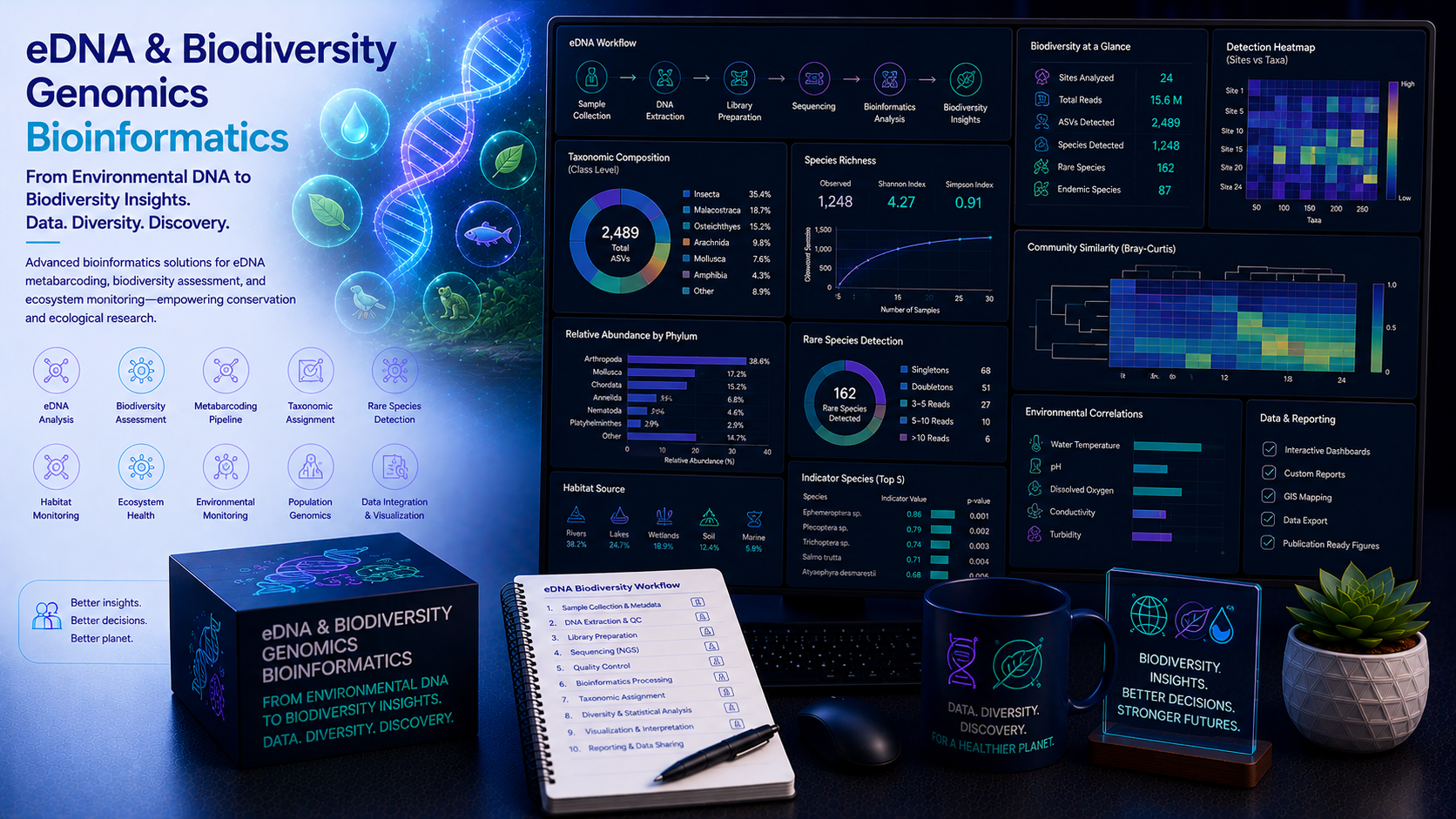
Environmental DNA (eDNA) sits at the intersection of metagenomics and ecology — enabling comprehensive, culture-independent profiling of entire microbial and eukaryotic communities directly from water, soil, sediment, air, and food samples. Where the metagenomics toolkit characterises who is present, what genes they carry, and what metabolic functions they perform, eDNA approaches extend this power to the full tree of life — from soil bacteria and marine archaea through fungi, protists, invertebrates, fish, and vertebrates — in a single sequencing experiment. At BioinformaticsNext, we provide specialist environmental metagenomics and eDNA bioinformatics from a microbiology and community genomics perspective — supporting environmental microbiologists, aquatic ecologists, One Health researchers, food safety scientists, and biosecurity agencies in profiling the full genomic complexity of environmental communities.
eDNA & Biodiversity Genomics: Environmental Metagenomics & Whole-Community Genomic Profiling
Expert bioinformatics for environmental shotgun metagenomics, multi-kingdom eDNA community profiling, microbial dark matter discovery, functional environmental genomics, and One Health biosurveillance from water, soil, sediment, and air samples.
Environmental DNA metagenomics differs fundamentally from clinical and gut microbiome metagenomics — the communities are vastly more phylogenetically diverse, spanning all three domains of life and encompassing organisms ranging from viruses and prokaryotes to macro-eukaryotes; the environmental matrices are highly variable in DNA yield, inhibitor content, and community complexity; and the biological questions span microbial ecology, biogeochemistry, ecosystem function, pathogen surveillance, and biodiversity monitoring simultaneously. A single litre of seawater or gram of soil contains thousands of microbial species, hundreds of protist lineages, fungal networks, nematodes, and traces of every macroorganism that has passed through — and metagenomics can characterise all of them.
At BioinformaticsNext, we provide the full environmental metagenomics and eDNA bioinformatics stack — from multi-kingdom amplicon profiling and shotgun environmental metagenomics through functional community annotation, novel genome discovery, pathogen surveillance, and longitudinal environmental monitoring — with outputs tailored to ecological, microbiological, regulatory, and biosecurity applications.
What We Support
Comprehensive environmental metagenomics and eDNA bioinformatics across aquatic, terrestrial, atmospheric, and food environments.
- Multi-kingdom eDNA amplicon profiling: bacteria (16S), fungi (ITS), protists (18S), and metazoans (COI, 12S)
- Shotgun environmental metagenomics for whole-community taxonomic and functional profiling
- Metagenome-assembled genome (MAG) recovery and novel microbial lineage discovery
- Environmental virome characterisation from shotgun metagenomics data
- Functional gene and metabolic pathway annotation from environmental metagenomes
- AMR gene and mobile genetic element profiling in environmental and agricultural samples
- One Health biosurveillance: zoonotic pathogen detection from wildlife, water, and soil eDNA
- Longitudinal environmental monitoring and ecosystem perturbation response analysis
- Food safety and fermentation microbiome quality control metagenomics
- Biogeochemical cycling gene profiling: nitrogen, carbon, sulphur, and phosphorus pathways
Our Environmental Metagenomics & eDNA Bioinformatics Services
Specialist environmental metagenomics — from multi-kingdom amplicon profiling and shotgun community genomics through functional annotation, novel lineage discovery, and One Health biosurveillance.
All analyses are tailored to your environmental matrix, sequencing platform, target community, study design, and ecological, microbiological, or regulatory objectives.
1. Multi-Kingdom eDNA Amplicon Profiling 16S · ITS · 18S · COI · 12S · Cross-Kingdom
Environmental communities span all domains of life — and understanding ecosystem function, biodiversity, and health requires profiling across bacteria, archaea, fungi, protists, and metazoans simultaneously. We design and analyse multi-marker eDNA surveys that capture the full cross-kingdom diversity of environmental communities from a single sampling campaign.
- Cross-kingdom amplicon survey design and analysis — Parallel DADA2 and QIIME2 processing of 16S rRNA (bacteria and archaea), ITS1/ITS2 (fungi), 18S rRNA V4/V9 (protists and micro-eukaryotes), COI (metazoans), and 12S rRNA (vertebrates) from the same environmental samples; marker-specific error model training, primer trimming, and ASV denoising; taxonomic assignment against SILVA, UNITE, PR2, BOLD, and MitoFish databases
- Integrated multi-kingdom diversity analysis — Cross-kingdom alpha and beta diversity comparison; co-occurrence network analysis linking bacterial, fungal, and protist community members; multi-kingdom community composition response to environmental gradients; kingdom-specific rarefaction and sequencing depth adequacy assessment
- Microbial eukaryote and protist profiling — 18S rRNA V4 and V9 amplicon analysis for protist, flagellate, ciliate, and micro-algae community profiling; PR2 database-based classification; phytoplankton and harmful algal bloom (HAB) species detection from aquatic eDNA samples
- False positive control and contamination screening — Field extraction blanks and PCR negative control processing; LULU post-clustering curation; decontam statistical contaminant ASV identification; index-hopping contamination assessment in highly multiplexed environmental runs
2. Shotgun Environmental Metagenomics Kraken2 · MetaPhlAn · HUMAnN · MAGs · Dark Matter
Shotgun metagenomics sequences all DNA present in an environmental sample — providing species-level taxonomic resolution, comprehensive functional gene cataloguing, AMR profiling, viral community characterisation, and the raw material for recovering novel microbial genomes from the environmental dark matter. We provide validated shotgun environmental metagenomics pipelines adapted to the unique characteristics of soil, water, sediment, air, and food samples.
- Environmental shotgun metagenomics processing — fastp and KneadData-based quality control and host DNA removal; low-complexity and contaminant sequence filtering; per-sample read depth, quality, and community complexity reporting; library complexity and sequencing saturation assessment
- Whole-community taxonomic profiling — Kraken2 and Bracken species-level classification spanning bacteria, archaea, fungi, protists, and viruses; MetaPhlAn4 marker gene-based profiling for known species; unclassified read fraction analysis as a proxy for novel microbial dark matter content; co-occurrence and co-exclusion network construction
- Functional gene and pathway annotation — HUMAnN3 MetaCyc and KEGG pathway abundance profiling; eggNOG-mapper COG and KEGG ortholog assignment; PROKKA-based functional gene annotation of assembled metagenomes; comparison of functional community profiles across environmental gradients and perturbation conditions
- Environmental virome characterisation — VirSorter2 and VIBRANT-based viral sequence identification from metagenomic contigs; vConTACT2 viral genome clustering and taxonomy; phage-host linkage prediction; RNA virus detection from metatranscriptomic data; environmental viral community diversity and lifestyle prediction
3. Novel Genome Discovery & Microbial Dark Matter MAG · Binning · GTDB · Novel Lineages · Long-Read
Environmental metagenomics is the primary route to discovering the vast uncultured majority of microbial life — recovering genomes from organisms that have never been grown in culture and that represent entirely novel phylogenetic lineages. We apply state-of-the-art assembly and binning approaches to recover high-quality metagenome-assembled genomes (MAGs) from environmental samples, including long-read approaches for complete circular genome recovery.
- Environmental metagenome assembly — MEGAHIT and metaSPAdes co-assembly and per-sample assembly optimised for high-complexity environmental communities; assembly quality assessment with QUAST and contig depth profiling; long-read environmental metagenome assembly with Flye and metaMDBG for improved contiguity and circular genome recovery
- MAG binning and quality assessment — MetaBAT2, CONCOCT, and MaxBin2 ensemble binning with DAS_Tool optimisation; CheckM2 completeness, contamination, and strain heterogeneity assessment; MIMAG-standard high-quality (≥90% completeness, ≤5% contamination) and medium-quality MAG reporting; eukaryotic MAG assessment with EukCC
- Novel lineage identification and phylogenomics — GTDB-Tk taxonomy assignment and detection of MAGs falling outside established GTDB genera and families; phylogenomic tree placement using GTDB marker genes; ANI-based species boundary assessment; provisional naming and description support for novel candidate taxa; pan-genome analysis of novel lineage representatives
- MAG functional annotation and metabolic reconstruction — PROKKA and DRAM-based MAG annotation; KEGG metabolic completeness scoring; metabolic capacity reconstruction for energy conservation pathways (photosynthesis, nitrification, sulphur oxidation, methanogenesis); identification of novel enzymes and biosynthetic gene clusters (antiSMASH)
4. Biogeochemical Cycling & Functional Environmental Genomics Nitrogen · Carbon · Sulphur · AMR · Resistome
Microbial communities drive the biogeochemical cycles that underpin ecosystem productivity, climate regulation, and soil and water quality — and functional metagenomics provides the tools to quantify the genes and pathways responsible. From nitrogen fixation and nitrification in agricultural soils to methane cycling in wetlands and AMR gene reservoirs in environmental matrices, we provide comprehensive functional environmental genomics analysis.
- Biogeochemical cycling gene profiling — Targeted annotation of nitrogen cycling (nifH, amoA, nirS, nirK, nosZ), carbon cycling (mcrA, pmoA, cbbL), sulphur cycling (dsrAB, soxB), and phosphorus cycling (phoD, phnX) functional marker genes from amplicon and shotgun data; functional gene abundance comparison across environmental gradients and land use types
- Environmental AMR resistome profiling — AMRFinderPlus, ResFinder, and CARD RGI-based AMR gene detection from environmental metagenomes; resistance class abundance profiling across water, soil, sediment, and air samples; mobile genetic element and integron-associated AMR gene identification; One Health AMR transmission risk assessment linking clinical and environmental resistomes
- Biosynthetic gene cluster (BGC) discovery — antiSMASH-based BGC identification from assembled environmental metagenomes; BGC diversity and novelty assessment; comparison with MIBiG reference database; prioritisation of novel BGCs for natural product discovery from soil and marine metagenomes
- Soil and aquatic ecosystem functional profiling — Functional redundancy and resilience analysis; keystone taxon and functional guild identification; ecosystem service gene ratio analysis (denitrification:nitrification, methanogenesis:methanotrophy); functional response to land use change, pollution, and climate manipulation experiments
5. One Health Biosurveillance & Environmental Pathogen Detection Zoonotic · Wastewater · Wildlife · Biosecurity
The One Health framework recognises that human, animal, and environmental health are inseparably linked — and environmental eDNA and metagenomics provides one of the most powerful tools for biosurveillance at this human-animal-environment interface. From wastewater epidemiology and wildlife pathogen surveillance to food safety metagenomics and biosecurity monitoring, we provide specialist bioinformatics for environmental pathogen detection and risk assessment.
- Wastewater-based epidemiology (WBE) — SARS-CoV-2, influenza, RSV, and enteric pathogen detection and quantification from wastewater metagenomics and targeted amplicon data; variant classification from wastewater sequencing; population-level disease burden estimation from wastewater pathogen abundance; longitudinal wastewater surveillance trend analysis and early warning signal detection
- Wildlife and environmental pathogen surveillance — Zoonotic pathogen detection from wildlife eDNA, faecal metagenomics, and environmental water samples; PREDICT and One Health pathogen priority list-aligned surveillance; metagenomic identification of novel viral and bacterial pathogens in wildlife reservoir species; spillover risk assessment from environmental pathogen load data
- Food safety and fermentation metagenomics — Shotgun metagenomics-based food spoilage organism identification; pathogen detection (Salmonella, Listeria, E. coli O157) from food production environment metagenomes; fermentation microbiome stability and starter culture monitoring; food fraud detection from species composition metagenomics
- Environmental biosecurity monitoring — Sentinel environmental sampling network metagenomics analysis; detection of select agents and biosecurity-relevant organisms from environmental matrices; longitudinal baseline community characterisation for anomaly detection; integration of environmental and clinical metagenomics data for outbreak source attribution
Key Applications
Environmental metagenomics and eDNA bioinformatics across aquatic, terrestrial, food, and biosurveillance settings.
- Drinking water and wastewater pathogen and AMR gene surveillance
- Soil microbiome functional profiling across agricultural land use gradients
- Marine and freshwater whole-community eDNA biodiversity assessment
- Wastewater-based epidemiology for SARS-CoV-2 and enteric pathogen monitoring
- Wildlife zoonotic pathogen surveillance and spillover risk assessment
- Novel microbial genome and natural product BGC discovery from soil metagenomes
- Food safety and fermentation microbiome quality monitoring
- Environmental AMR resistome characterisation for One Health risk assessment
Tools, Technologies & Reference Databases
Validated environmental metagenomics tools and all major reference resources for cross-kingdom community analysis.
- Amplicon: DADA2, QIIME2, OBITools3, VSEARCH, Cutadapt, LULU, decontam
- Shotgun Taxonomy: Kraken2, Bracken, MetaPhlAn4, Kaiju, mOTUs3
- Functional: HUMAnN3, eggNOG-mapper, PROKKA, DRAM, antiSMASH
- MAG Binning: MetaBAT2, CONCOCT, DAS_Tool, CheckM2, EukCC, GTDB-Tk
- Virome: VirSorter2, VIBRANT, vConTACT2, DeepVirFinder
- SILVA / UNITE / PR2 / BOLD / MitoFish — Multi-kingdom amplicon taxonomic reference databases
- GTDB (Genome Taxonomy Database) — Standardised prokaryotic taxonomy for MAG classification and novel lineage discovery
- CARD / AMRFinderPlus / ResFinder — AMR gene reference databases for environmental resistome profiling
- MIBiG / antiSMASH DB — Biosynthetic gene cluster reference for natural product discovery
- NCBI RefSeq / GenBank / VFDB — Pathogen genome references and virulence factor databases for biosurveillance
Project Deliverables
Structured, publication-ready environmental metagenomics outputs for research, monitoring, and regulatory applications.
- Multi-kingdom ASV or species abundance tables with taxonomic assignments per sample
- Alpha and beta diversity summaries with ordination plots and statistical comparisons
- Functional pathway abundance profiles and between-group comparison results
- MAG summary: completeness, contamination, taxonomy, and metabolic capacity annotation
- AMR gene class abundance report with environmental matrix and resistance mechanism context
- Pathogen detection report with abundance estimates and biosurveillance risk assessment
- Publication-ready figures (PDF/SVG/PNG at 300 dpi)
- Full written scientific report with methods, results, and ecological or microbiological interpretation
- Pipeline scripts and configuration files for complete analytical reproducibility
- Novel MAG phylogenomic analysis and candidate taxon description support
- Environmental virome characterisation and phage-host linkage prediction
- BGC diversity and novelty analysis for natural product discovery programmes
- Wastewater-based epidemiology trend analysis and early warning dashboards
- One Health AMR transmission risk report linking environmental and clinical resistomes
- Manuscript methods section and supplementary figure legends
- Grant application environmental metagenomics sections and preliminary data
- Long-term retainer for ongoing environmental monitoring and biosurveillance reporting
Frequently Asked Questions
Common questions from environmental microbiologists, One Health researchers, and biosurveillance agencies.
Environmental metagenomics presents unique challenges compared to clinical microbiome work — communities span all three domains of life (bacteria, archaea, and eukaryotes) plus viruses, and often include organisms at very low abundance in a vast sea of environmental DNA. Environmental matrices (soil, water, sediment) are highly variable in DNA yield, PCR inhibitor content, and community complexity, requiring matrix-specific extraction optimisation. Sequencing depth requirements are substantially higher — 50–100M reads is common for soil communities compared to 5–20M for gut microbiomes — and taxonomic databases have far lower coverage for environmental organisms than for human-associated microbes. We adapt every aspect of our pipeline to the specific environmental matrix, community complexity, and biological question of each project.
Yes. Shotgun metagenomics enables culture-independent detection of bacterial, viral, fungal, and parasitic pathogens from environmental matrices — including SARS-CoV-2, influenza, norovirus, Cryptosporidium, Giardia, Salmonella, Listeria, and antimicrobial-resistant organisms from water and wastewater. Detection sensitivity depends on pathogen abundance relative to background community DNA, sequencing depth, and the specificity of the reference database. For low-abundance pathogen targets, targeted enrichment (capture hybridisation or amplicon-based approaches) prior to sequencing can substantially improve sensitivity. We advise on the most appropriate detection strategy for each pathogen and environmental matrix at project scoping.
Wastewater-based epidemiology (WBE) uses the detection and quantification of pathogen nucleic acids in municipal wastewater to estimate community-level disease prevalence and track the emergence of new variants — providing a real-time, population-level surveillance signal that is independent of healthcare-seeking behaviour. We support WBE programmes with pathogen-specific amplicon quantification (qPCR/ddPCR data analysis), shotgun metagenomics-based pathogen detection and variant classification, longitudinal trend analysis, and early warning signal detection. Our SARS-CoV-2 WBE pipeline covers variant classification from wastewater sequencing using Freyja and Alcov, including deconvolution of co-circulating variant mixtures from environmental samples.
Yes. Environmental viromes are increasingly accessible from shotgun metagenomics data without dedicated viral enrichment, particularly from aquatic environments where viral particle concentrations are high. We use VirSorter2 and VIBRANT to identify viral contigs from assembled metagenomes, vConTACT2 for viral genome clustering and taxonomy, and DeepVirFinder for read-level viral classification. For higher sensitivity viral detection, we recommend VLP (virus-like particle) enrichment before sequencing. We also support RNA virus detection from metatranscriptomic datasets, which is particularly relevant for environmental surveillance of RNA zoonotic pathogens.
Absolutely. We assist with the bioinformatics sections of grant applications to NERC, BBSRC, UKRI, Innovate UK, EU Horizon, NIH, and biosecurity funding bodies — including proposed environmental metagenomics workflows, multi-kingdom profiling methodology, MAG recovery approaches, AMR resistome analysis, and One Health biosurveillance bioinformatics plans, with preliminary environmental metagenomics data where needed. Please contact us as early as possible in the grant preparation process.
Related Research Areas & Services
Environmental metagenomics and eDNA bioinformatics connects to multiple complementary services we support.
- Metagenomics & Microbiome Analysis — Clinical and gut microbiome 16S and shotgun metagenomics, strain-level resolution, metatranscriptomics, and microbiome-metabolome integration for human health research
- Infectious Disease & Pandemic Genomics — Pathogen whole-genome sequencing, outbreak phylogenetics, clinical metagenomics for undiagnosed infection, and AMR surveillance complementing environmental biosurveillance
- eDNA & Biodiversity Genomics (Evolutionary Biology) — Conservation genomics, protected species detection, population structure, landscape genetics, and regulatory eDNA reporting for ecological and conservation applications
- Agricultural Genomics — Soil and rhizosphere microbiome functional profiling, plant-microbe interaction genomics, and microbiome-based soil health assessment for sustainable agriculture
- Genetics & Genomics — Population genomics and phylogenetic approaches shared between environmental microbial ecology and broader genomics applications
- Custom Software & Pipeline Development — Bespoke environmental metagenomics platforms, automated WBE reporting dashboards, and scalable cloud-based pipeline deployment for large-scale environmental monitoring programmes
Ready to Advance Your Environmental Metagenomics Programme?
Tell us about your environmental sample type, your sequencing platform, your target community, and your research, monitoring, or biosurveillance objectives. Our environmental metagenomics and eDNA bioinformatics team will design a tailored analytical plan — typically within 48 hours of your enquiry. Whether you need multi-kingdom eDNA community profiling, shotgun metagenomics functional analysis, novel MAG genome recovery, environmental AMR resistome characterisation, wastewater-based epidemiology, or One Health pathogen biosurveillance, we are here to deliver expert, reproducible environmental genomics results from day one.