
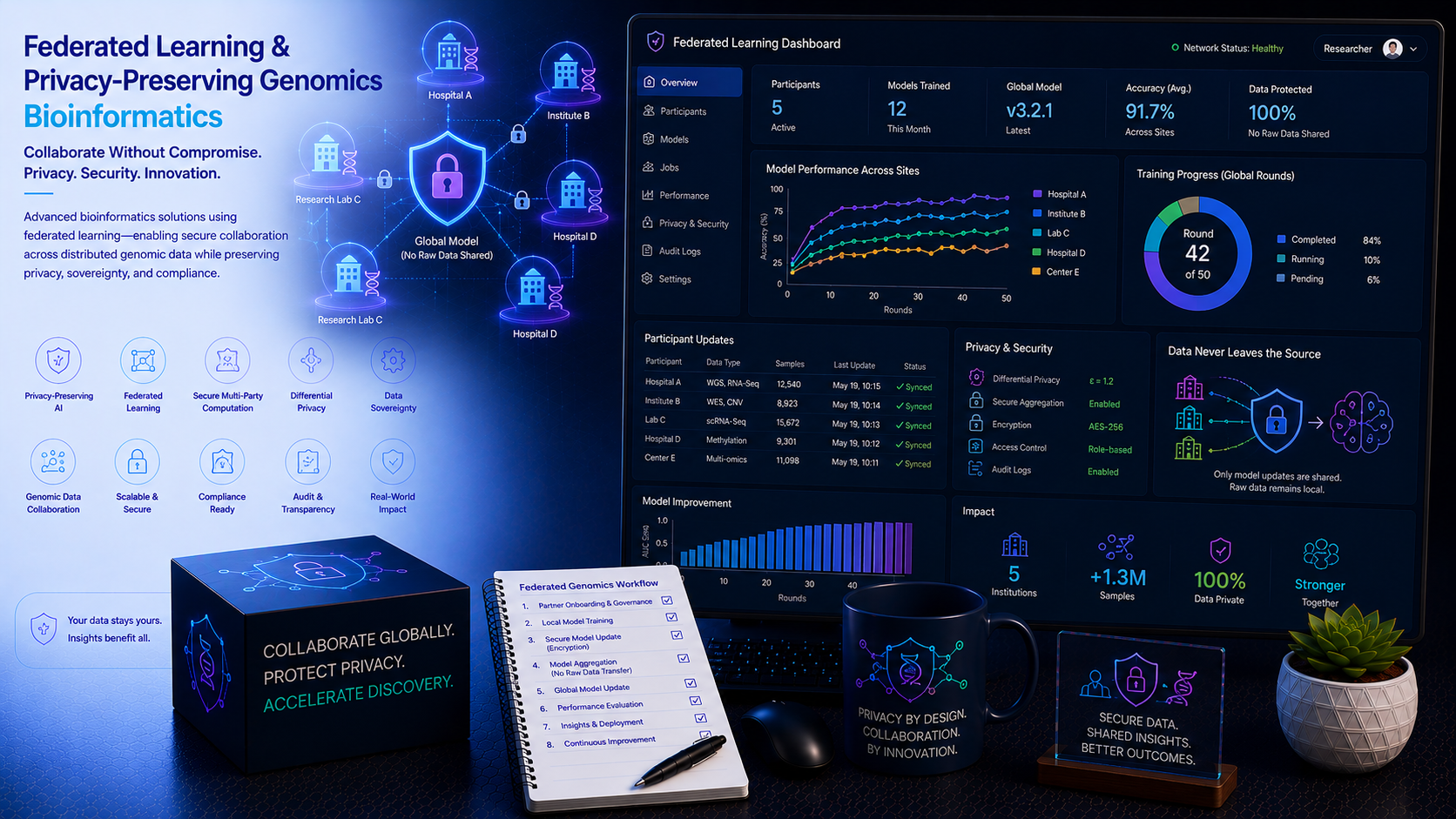
Genomic data is among the most sensitive personal information that exists — uniquely identifying, immutable, and carrying implications not just for the individual but for their biological relatives. As clinical genomic sequencing scales across NHS trusts, hospital networks, and international research consortia, and as pharmaceutical companies seek to derive insights from patient genomic data held by multiple independent institutions, the challenge of performing rigorous genomic analysis without centralising sensitive data has become a critical technical and regulatory priority. Federated learning, secure multi-party computation, differential privacy, and trusted execution environments now enable powerful genomic analyses — GWAS, polygenic risk score development, AI model training, and variant interpretation — to be performed across distributed data silos without any individual dataset ever leaving its institution. At BioinformaticsNext, we provide specialist federated learning and privacy-preserving genomics bioinformatics — supporting NHS organisations, pharmaceutical consortia, academic research networks, and genomics technology companies in designing, implementing, and validating privacy-preserving genomic analysis frameworks.
Federated Learning & Privacy Genomics: Privacy-Preserving Analysis & Cloud Bioinformatics
Expert bioinformatics for federated learning genomic analysis, differential privacy, secure multi-party computation, homomorphic encryption, trusted execution environments, and GDPR-compliant cloud bioinformatics across distributed genomic data networks.
The fundamental tension in clinical genomics research is between the scientific value of large, diverse datasets and the legal, ethical, and technical constraints on sharing sensitive patient genomic data. GDPR and the UK Data Protection Act impose strict requirements on the processing and transfer of genomic data classified as special category health data. Institutional data governance policies, research ethics frameworks, and patient consent terms further restrict data sharing. Yet the statistical power of genomic studies — GWAS, rare variant burden tests, polygenic risk score training — scales with sample size in ways that make single-institution datasets often inadequate. Privacy-preserving federated analysis resolves this tension: enabling multi-institutional genomic research at scale while keeping patient data within its institution of origin and respecting the full scope of applicable data protection obligations. At BioinformaticsNext, we provide the technical expertise to design and implement federated genomic analysis frameworks that are scientifically rigorous, computationally efficient, and fully aligned with GDPR, NHS data governance requirements, and regulatory expectations.
What We Support
Comprehensive federated learning and privacy-preserving genomics bioinformatics across distributed GWAS, AI model training, variant analysis, and secure cloud infrastructure design.
- Federated GWAS and meta-analysis across distributed genomic data silos without data sharing
- Federated polygenic risk score training and validation across multi-institutional cohorts
- Federated AI model training for genomic variant interpretation and clinical prediction
- Differential privacy implementation for genomic summary statistics and model parameters
- Secure multi-party computation (SMPC) for joint genomic analysis
- Homomorphic encryption for computation on encrypted genomic data
- Trusted execution environment (TEE) deployment for secure enclave genomic analysis
- GDPR-compliant cloud bioinformatics architecture design and data governance frameworks
- Synthetic genomic data generation for privacy-preserving model development and testing
- Privacy risk assessment and re-identification risk quantification for genomic datasets
Our Federated Learning & Privacy Genomics Services
Specialist privacy-preserving genomics — from federated GWAS design and differential privacy implementation through secure computation, GDPR-compliant cloud architecture, and synthetic genomic data generation.
All designs and implementations are tailored to your institutional data governance requirements, computational infrastructure, regulatory jurisdiction, and genomic analysis objectives.
1. Federated GWAS & Distributed Genomic Association Analysis REGENIE · Meta-Analysis · Federated · No Data Sharing · GWAS
Genome-wide association studies across distributed institutional datasets can be performed without centralising patient-level data — by running GWAS analyses locally at each site and combining only summary statistics through meta-analysis, or through more sophisticated federated regression approaches that iteratively share only model gradients or intermediate statistics rather than individual-level genotype and phenotype data.
- Summary statistics-based federated meta-GWAS — Coordinated GWAS analysis at each participating site using REGENIE, SAIGE, or PLINK2; standardised summary statistics generation in GWAS Catalog format; METAL and MR-MEGA fixed and random effects meta-analysis of site-level summary statistics; heterogeneity testing and site-specific effect size comparison; no individual-level data exchange required at any stage
- Federated regression and iterative GWAS — sPLINK and HAIL-based federated logistic and linear regression for GWAS without summary statistics aggregation; iterative gradient sharing with differential privacy noise addition per communication round; convergence monitoring and federated vs. centralised GWAS result concordance assessment; computational overhead and communication cost profiling per site
- Federated rare variant burden testing — Distributed SAIGE-GENE and REGENIE rare variant burden, SKAT, and SKAT-O tests across federated sites; site-level count matrix aggregation without individual phenotype-genotype linkage; federated collapsing test statistics combination; power analysis for federated rare variant studies given distributed sample sizes
- Quality control harmonisation across sites — Standardised QC protocol design for distributed GWAS sites; reference genome build alignment and liftover coordination; population stratification PC calculation harmonisation; ancestry outlier removal concordance; per-site QC metric reporting and flagging without sharing raw data
2. Differential Privacy for Genomic Analyses DP · ε-Differential Privacy · Noise Calibration · GWAS · PRS
Differential privacy provides a mathematically rigorous privacy guarantee — ensuring that the inclusion or exclusion of any single individual's data changes the output of an analysis by at most a quantifiable, bounded amount. Applied to genomic summary statistics, model gradients, and polygenic risk score parameters, differential privacy enables the sharing of analytical results with formal privacy protection that resists re-identification attacks even with auxiliary information.
- Differential privacy theory and parameter selection — Privacy budget (ε) specification aligned with regulatory requirements and institutional data governance; sensitivity analysis for genomic statistics (allele frequencies, regression coefficients, LD matrices); Gaussian and Laplace mechanism noise calibration for target ε and δ values; privacy-utility trade-off analysis for genomic GWAS and PRS applications
- DP-GWAS summary statistics — Differentially private allele frequency and summary statistic generation with calibrated noise addition; DP GWAS result comparison against non-private benchmark for statistical power assessment; post-hoc debiasing of DP summary statistics for meta-analysis compatibility; DP-compliant GWAS Catalog submission preparation
- Differentially private federated AI training — DP-SGD (differentially private stochastic gradient descent) implementation using Opacus and TensorFlow Privacy for genomic AI model training; per-sample gradient clipping and noise addition; privacy accountant tracking (Rényi differential privacy) across training epochs; privacy-accuracy trade-off optimisation for clinical genomics model training
- Genomic database and variant frequency privacy — DP-protected allele frequency database construction; differentially private population frequency reporting for gnomAD-style databases; Gaussian mechanism noise addition to variant count queries; privacy budget allocation across multiple database queries
3. Secure Multi-Party Computation & Homomorphic Encryption SMPC · HE · SEAL · MP-SPDZ · Secure GWAS
Secure multi-party computation (SMPC) and homomorphic encryption (HE) enable multiple parties to jointly compute a function over their combined private data without any party revealing its data to any other — providing cryptographic rather than statistical privacy guarantees. While computationally intensive, these approaches are increasingly practical for genomic applications and provide the strongest available privacy protection for multi-institutional genomic analysis.
- Secure multi-party computation for genomics — MP-SPDZ and MOTION-based SMPC protocol implementation for secure genomic association analysis; secret sharing scheme design for distributed genotype and phenotype data; secure inner product and logistic regression protocols for GWAS without revealing individual data to any party; communication round complexity and bandwidth requirement analysis for genomic dataset scales
- Homomorphic encryption for genomic computation — Microsoft SEAL and HElib-based partially and fully homomorphic encryption schemes for computation on encrypted genomic data; BFV and CKKS scheme selection for genomic integer and floating-point operations; encrypted allele frequency and Hardy-Weinberg test computation; encrypted GWAS chi-squared statistic calculation without decryption
- Practical HE genomic application design — Circuit depth and noise budget analysis for feasible HE genomic computations; batching and SIMD (Single Instruction Multiple Data) optimisation for parallel encrypted genotype processing; bootstrapping strategy for deep circuit evaluation; latency and throughput benchmarking for encrypted genomic analysis at realistic dataset scales
- Hybrid SMPC-DP approaches — Combined SMPC and differential privacy frameworks providing both cryptographic and statistical privacy guarantees; local vs. central differential privacy model selection; privacy amplification through secure aggregation; federated learning with secure aggregation (SecAgg) protocol implementation
4. GDPR-Compliant Cloud Bioinformatics & Trusted Execution Environments GDPR · TEE · Azure Confidential · AWS Nitro · NHS DSP Toolkit
Cloud bioinformatics for clinical genomics must satisfy GDPR special category data processing requirements, NHS Data Security and Protection (DSP) Toolkit obligations, and institutional data governance policies — while delivering the computational scalability that population-scale genomic analysis demands. We design and implement GDPR-compliant cloud bioinformatics architectures that enable secure, scalable genomic analysis within appropriate legal and technical safeguards.
- GDPR-compliant cloud architecture design — Data residency and sovereignty requirement mapping for UK and EU genomic data; AWS UK, Azure UK South, and GCP europe-west2 region configuration for NHS-compliant storage; data processing agreement (DPA) requirements for cloud provider engagement; encryption at rest and in transit specification; access control and audit logging design for clinical genomic data environments
- Trusted execution environment (TEE) deployment — Intel SGX and AMD SEV-based confidential computing enclave design for genomic analysis; Microsoft Azure Confidential Computing and AWS Nitro Enclaves configuration; remote attestation protocol design for multi-party TEE-based genomic analysis; GDPR Article 32 technical security measure compliance documentation for TEE-based deployments
- NHS DSP Toolkit and data access framework alignment — NHS Data Security and Protection Toolkit requirement mapping for genomic cloud deployments; UK Biobank, Genomics England, and NHS Digital data access agreement compliance architecture; Five Safes framework implementation for research data environments; Information Governance (IG) documentation support for data access application processes
- Federated cloud infrastructure design — Multi-cloud and hybrid on-premise/cloud federated bioinformatics architecture design; container orchestration (Kubernetes) for federated workload distribution; secure inter-site communication with mutual TLS and VPN configuration; federated identity and access management (IAM) for multi-institutional genomic analysis environments
5. Synthetic Genomic Data Generation & Privacy Risk Assessment Synthetic Data · VAE · GAN · Re-identification · Privacy Audit
Synthetic genomic data — computationally generated data with statistical properties matching real patient datasets but containing no actual patient genotypes — enables algorithm development, pipeline testing, and AI model pre-training without exposing sensitive real patient data. Privacy risk assessment quantifies the re-identification risk of genomic datasets and analytical outputs to inform data sharing decisions and safeguard implementation.
- Synthetic genomic data generation — Variational autoencoder (VAE) and generative adversarial network (GAN)-based synthetic SNP array and WGS data generation with realistic LD structure and allele frequency distributions; haplotype-aware synthetic genome generation with hapgen2 and SLiM population genetics simulation; synthetic electronic health record data generation for genomic phenotype simulation; utility evaluation: concordance of synthetic data with real data for downstream GWAS and PRS analysis
- Population genetics simulation — SLiM and msprime forward and coalescent simulation of realistic genomic diversity; demographic model-informed synthetic cohort generation; admixed population simulation for multi-ancestry dataset testing; rare variant spectrum simulation for synthetic rare disease cohort development
- Re-identification risk assessment — Genomic re-identification risk quantification using identity-by-descent (IBD) detection across reference populations; surname inference risk from Y-chromosome haplogroup analysis; quasi-identifier analysis for genomic data combined with demographic metadata; membership inference attack simulation against GWAS summary statistics and genomic AI model outputs
- Privacy impact assessment and data governance support — GDPR Article 35 Data Protection Impact Assessment (DPIA) bioinformatics content; anonymisation vs. pseudonymisation determination for genomic data; residual risk assessment after technical privacy-preserving measure implementation; data minimisation strategy design for genomic research data releases
Key Applications
Federated learning and privacy genomics across NHS networks, pharmaceutical consortia, academic research, and genomics technology platforms.
- Multi-NHS trust federated GWAS without patient data leaving institutions
- Pharmaceutical multi-biobank federated PRS training and validation
- Rare disease federated rare variant burden testing across specialist centres
- Federated genomic AI model training for clinical decision support
- GDPR-compliant cloud bioinformatics platform architecture for clinical genomics
- Synthetic genomic data generation for algorithm development and testing
- Privacy risk assessment for genomic data sharing decisions
- NHS DSP Toolkit-aligned genomic research data environment design
Tools, Technologies & Frameworks
Validated privacy-preserving computation tools and GDPR-compliant cloud infrastructure frameworks for federated genomic analysis.
- Federated GWAS: sPLINK, HAIL (distributed), REGENIE, SAIGE, METAL, MR-MEGA
- Differential Privacy: Opacus, TensorFlow Privacy, Google DP Library, OpenDP
- SMPC: MP-SPDZ, MOTION, ABY, Sharemind, FRESCO
- Homomorphic Encryption: Microsoft SEAL, HElib, OpenFHE, Concrete (Zama)
- TEE: Intel SGX, AMD SEV, Azure Confidential Computing, AWS Nitro Enclaves
- Federated ML: PySyft, Flower (flwr), FedML, OpenFL, IBM Federated Learning
- Synthetic Data: SLiM, msprime, hapgen2, SDV, CTGAN, TVAE
- Cloud: AWS UK (S3, SageMaker), Azure UK South (Confidential Computing), GCP europe-west2
- Containers: Docker, Singularity, Kubernetes, Nextflow (Tower), Snakemake
- Privacy Audit: ARX, SDMetrics, membership inference attack toolkits
Project Deliverables
Structured, technically rigorous, and governance-ready federated learning and privacy genomics outputs for every project.
- Federated analysis architecture design document with data flow diagrams and privacy guarantee specification
- Federated GWAS or meta-analysis summary statistics and results in standard formats
- Differential privacy parameter specification and privacy budget accounting documentation
- Privacy-utility trade-off analysis report with federated vs. centralised performance comparison
- GDPR-compliant cloud architecture specification with encryption, access control, and audit requirements
- Re-identification risk assessment report with residual risk quantification
- Synthetic genomic dataset with utility validation against real data statistical properties
- Full written technical and governance report with design rationale, implementation guide, and regulatory alignment
- GDPR Article 35 DPIA bioinformatics content preparation
- NHS DSP Toolkit evidence documentation for data security assurance
- TEE deployment implementation and remote attestation configuration
- SMPC or HE proof-of-concept implementation for specific genomic computation
- Federated AI model training and validation for clinical genomics applications
- Manuscript methods section for privacy-preserving genomic analysis publication
- Grant application federated genomics and privacy sections with preliminary data
- Long-term federated infrastructure support and privacy governance retainer
Frequently Asked Questions
Common questions from NHS organisations, pharmaceutical companies, academic consortia, and genomics technology companies.
Federated learning is a machine learning approach in which a model is trained across multiple data-holding institutions without any institution sharing its raw data. Instead, each site trains on its local data and shares only model updates — gradients, weights, or summary statistics — with a central aggregator that combines these into a global model. In genomics, this enables GWAS, polygenic risk score training, and clinical AI model development across multiple hospitals, biobanks, or research centres without any patient genomic or phenotypic data leaving its institution of origin. The resulting global model has the statistical power of the combined dataset while respecting the data governance constraints of each contributing institution.
Federated learning reduces privacy risk substantially compared to centralising raw data — but model gradients and summary statistics can still leak information about training data through gradient inversion attacks, membership inference attacks, and property inference attacks. A federated learning framework alone does not provide formal mathematical privacy guarantees. To achieve formal privacy protection, federated learning must be combined with additional privacy-enhancing technologies: differential privacy (adding calibrated noise to gradients or statistics), secure aggregation (using cryptographic protocols so the aggregator sees only the combined update, not individual site contributions), or trusted execution environments (encrypting computation within hardware enclaves). We design federated genomic analysis frameworks that combine these approaches to provide both practical and formally quantifiable privacy protection appropriate for patient genomic data.
Summary statistics-based federated meta-GWAS — where each site runs GWAS independently and shares only association statistics — is mathematically equivalent to centralised GWAS for most practical purposes, with negligible power loss when between-site heterogeneity is low. More sophisticated federated regression approaches that share model parameters iteratively can also closely approximate centralised GWAS results. The main power considerations are: (1) between-site phenotype definition and QC heterogeneity, which we address through standardised protocol design; (2) the statistical heterogeneity correction applied in meta-analysis; and (3) for rare variants, the minimum site-level cell count constraints needed to avoid revealing individual-level information. We quantify expected power for your federated study design at project scoping.
No — this is a critical misconception. Genomic data is inherently identifying and cannot be fully anonymised by removing direct identifiers such as name, date of birth, or NHS number. Even genome-wide summary statistics can be used to infer membership of a study population through linkage disequilibrium-based attacks. Individual genotype data can be linked to named individuals through genealogical databases, surname inference from Y-chromosome variants, and IBD-based relatedness to identified individuals. Under GDPR, pseudonymised genomic data — with identifiers removed but linkage theoretically possible — remains personal data subject to GDPR special category protections. We perform formal re-identification risk quantification and advise on appropriate technical safeguards based on the specific data type, disclosure context, and auxiliary information available to potential adversaries.
Absolutely. We assist with the federated learning, privacy-preserving computation, and data governance sections of grant applications — including federated GWAS design, differential privacy methodology, GDPR compliance architecture, and synthetic data generation plans. We have experience supporting applications to UKRI, Wellcome Trust, NIHR, EU Horizon Europe, and NIH, as well as industry-academic partnership grants involving sensitive genomic data. Please contact us as early as possible to allow time for any preliminary federated analysis design or proof-of-concept work needed to strengthen the application.
Related Research Areas & Services
Federated learning and privacy genomics connects to multiple complementary services we support.
- RWE & EHR Genomics — UK Biobank, NHS-linked, and multi-institutional EHR genomic analysis providing the scientific context for federated GWAS, PRS training, and clinical genomics integration across distributed data environments
- Clinical Genomics & Variant Interpretation — ACMG variant classification, rare disease genomics, and NHS diagnostic genomics applications that benefit from federated multi-site variant evidence aggregation
- Clinical AI Validation (EU AI Act) — EU AI Act technical documentation, FDA SaMD validation, and NHS procurement assessment for federated AI models trained on distributed genomic datasets
- Bioinformatics SaaS Consulting — Scientific credibility, pipeline validation, and go-to-market strategy for genomics SaaS products incorporating federated learning or privacy-preserving computation capabilities
- Genetics & Genomics — GWAS, Mendelian randomisation, polygenic risk scores, and population genetics providing the statistical foundation for federated genomic association analysis design
- Custom Software & Pipeline Development — Bespoke federated bioinformatics platforms, secure containerised pipeline deployment, GDPR-compliant data processing infrastructure, and federated orchestration framework development
Ready to Build Your Federated or Privacy-Preserving Genomics Programme?
Tell us about your genomic data environment, your participating institutions, your analysis objectives, and your data governance and regulatory requirements. Our federated learning and privacy genomics team will design a tailored privacy-preserving analysis framework — typically within 48 hours of your enquiry. All initial consultations are conducted in strict confidence. Whether you need federated GWAS design, differential privacy implementation, SMPC or homomorphic encryption for genomic computation, GDPR-compliant cloud architecture, synthetic genomic data generation, or privacy risk assessment, we are here to deliver expert, governance-aligned, and scientifically rigorous federated genomics from day one.