
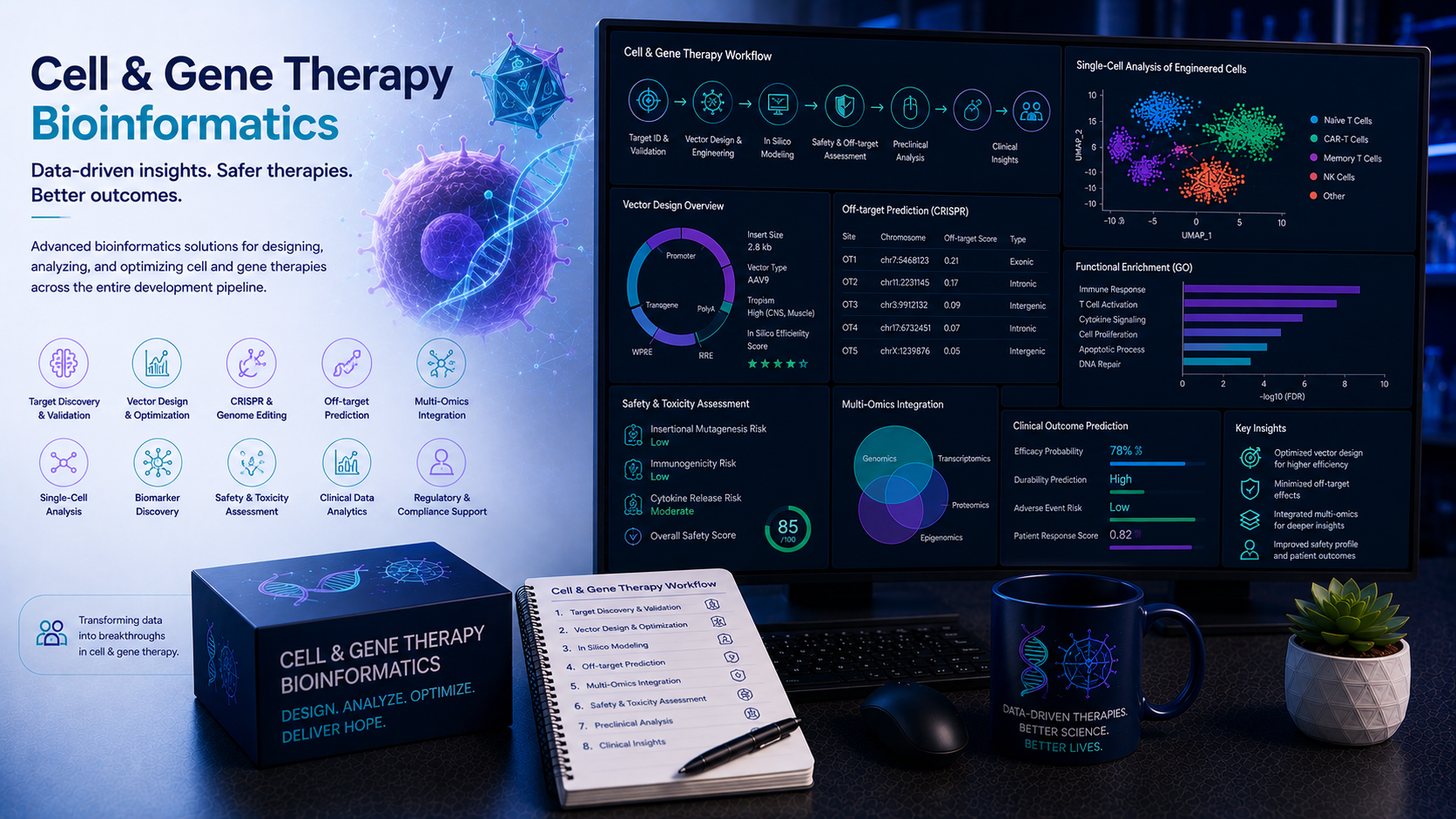
Cell and gene therapies represent the most transformative frontier in modern medicine — offering curative, single-administration treatments for genetic disorders, haematological malignancies, and solid tumours. From AAV and lentiviral vector design to CAR-T cell engineering, CRISPR genome editing, and ex vivo stem cell therapy, every stage of the cell and gene therapy pipeline generates complex biological data requiring expert bioinformatics analysis. At BioinformaticsNext, we provide specialist cell and gene therapy bioinformatics services — supporting vector characterisation, integration site analysis, genome editing profiling, immune cell multi-omics, and clinical biomarker development for pharmaceutical, biotech, and academic programmes worldwide.
Cell & Gene Therapy Bioinformatics: Computational Support Across the Full Development Pipeline
From vector design and integration site analysis to CAR-T profiling, genome editing characterisation, and regulatory submission support.
The cell and gene therapy field generates data of unprecedented complexity — whole-genome sequencing of edited cells, long-read sequencing for vector characterisation, single-cell transcriptomics of infused cell products, TCR repertoire tracking, integration site analysis from retroviral vectors, and multi-omics immune response profiling from clinical trial samples. Extracting meaningful, regulatorily defensible insight from this data requires expertise at the intersection of genomics, immunology, virology, and computational biology.
At BioinformaticsNext, we provide the full bioinformatics stack to support cell and gene therapy development — combining cutting-edge tools with deep experience in gene therapy vector biology, CRISPR editing, adoptive cell therapy, and clinical omics to accelerate your programme from bench to clinic with the highest standards of data quality, reproducibility, and regulatory readiness.
What We Support
Comprehensive bioinformatics support across viral vector gene therapy, genome editing, CAR-T and adoptive cell therapy, and ex vivo stem cell programmes.
- AAV, lentiviral, and adenoviral vector genome design, characterisation, and regulatory QC
- Integration site analysis (ISA) and genotoxicity risk assessment for regulatory submissions
- CRISPR-Cas9, base editing, and prime editing on-target efficiency and off-target profiling
- CAR-T, NK cell, and TIL product transcriptomic and epigenomic characterisation
- TCR and BCR repertoire analysis for adoptive cell therapy tracking and response monitoring
- Single-cell multi-omics of cell therapy products and patient immune responses
- Immunogenicity and immune response profiling from pre-clinical and clinical samples
- Biomarker discovery and patient stratification for clinical trial enrichment and safety monitoring
- Neoantigen and tumour antigen identification for personalised cell therapy programmes
Our Cell & Gene Therapy Bioinformatics Services
Specialist computational biology services tailored to the unique data challenges of viral vector gene therapy, genome editing, and adoptive cell therapy programmes.
All analyses are customised to your therapeutic modality, vector type, indication, and stage of development — from pre-clinical IND-enabling studies through to Phase I/II clinical trial sample analysis.
1. Viral Vector Design & Genome Characterisation AAV · Lentivirus · Long-Read Sequencing
The design, characterisation, and quality assessment of viral vectors underpins the safety and efficacy of every gene therapy programme. We provide comprehensive bioinformatics support for AAV, lentiviral, and adenoviral vector platforms — from in silico transgene cassette design through to long-read sequencing-based vector genome characterisation for regulatory submissions.
- AAV and lentiviral vector genome analysis — ITR integrity verification; promoter, enhancer, and poly-A signal selection; codon optimisation; SIN vector design confirmation; packaging signal and safety element characterisation
- Long-read sequencing vector characterisation — Oxford Nanopore and PacBio assembly and annotation of full vector genomes; ITR integrity scoring; empty capsid, truncated genome, and recombinant genome quantification for regulatory QC packages
- NGS vector QC — Illumina-based vector genome coverage analysis; transgene sequence verification; packaging contamination and wild-type reversion detection
- Tropism and transduced cell profiling — In silico AAV capsid variant and tissue tropism analysis; differential gene expression of vector-transduced vs. untransduced cells; transgene expression level quantification across target tissues
2. Integration Site Analysis (ISA) & Genotoxicity Risk Assessment INSPIIRED · Clonal Dynamics · Regulatory-Grade
For integrating viral vectors — lentiviral, gammaretroviral, and foamy virus — the genomic location of vector integration determines both insertional mutagenesis risk and long-term therapeutic cell persistence. ISA is a regulatory requirement for clinical gene therapy programmes and a critical safety tool at every development stage.
- Integration site identification and mapping — INSPIIRED, lentiSAFE, and custom pipeline-based integration site identification from linker-mediated PCR and targeted NGS data; precise chromosomal mapping at single-nucleotide resolution
- Genotoxicity risk scoring — Proto-oncogene proximity analysis; integration enrichment near TSS, enhancers, and cancer-associated loci; Genotoxicity Risk Score (GRS) calculation; cross-referencing against RTCGD and COSMIC databases
- Clonal abundance and longitudinal dynamics monitoring — Shannon entropy, Gini coefficient, and clonality index calculation; tracking of clonal frequencies across treatment timepoints; early detection of aberrant clonal expansion or oligoclonal outgrowth
- Regulatory-grade ISA reporting — Fully documented ISA reports formatted for IND, CTA, BLA, and MAA submissions; integration with CMC and non-clinical safety data packages
3. CRISPR & Genome Editing Bioinformatics On-Target · Off-Target · Base Editing · Prime Editing
CRISPR-Cas9, base editors, prime editors, and other programmable nucleases are central to next-generation gene therapy, cell therapy engineering, and ex vivo stem cell modification. Comprehensive computational characterisation of on-target editing efficiency and genome-wide off-target activity is essential for regulatory approval and product quality control.
- On-target editing efficiency analysis — CRISPResso2-based quantification of indel frequency, insertion and deletion spectra, and HDR outcomes from amplicon and whole-genome sequencing; allele-level editing characterisation
- Guide RNA design and off-target prediction — In silico guide RNA design with CHOPCHOP, Cas-OFFinder, and CRISPick; genome-wide off-target site prediction with mismatch and bulge tolerance modelling for SpCas9, SaCas9, Cas12a, and base editor variants
- Unbiased genome-wide off-target profiling — Computational analysis of GUIDE-seq, CIRCLE-seq, DISCOVER-seq, and CHANGE-seq experimental datasets; off-target site ranking and functional consequence assessment for regulatory safety packages
- Base and prime editing outcome characterisation — ABE and CBE product purity analysis; bystander editing quantification; RNA off-target transcriptomic analysis; pegRNA design support; scaffold incorporation and unintended edit detection
- Large structural variant detection — Chromosomal rearrangement, inversion, translocation, and large deletion detection at CRISPR cut sites from long-read sequencing and optical genome mapping data
4. CAR-T Cell & Adoptive Cell Therapy Bioinformatics scRNA-seq · Exhaustion · Persistence · Epigenomics
The clinical success of CAR-T cell therapies depends critically on the phenotypic composition, functional state, epigenetic programming, and persistence capacity of the infused cell product. We provide specialist bioinformatics for CAR-T, TCR-T, NK cell, and TIL programmes — from cell product characterisation to in vivo persistence and clinical response monitoring.
- CAR-T cell product transcriptomic profiling — Bulk and single-cell RNA-seq analysis of manufacturing products; T cell subset composition characterisation (naive, stem cell memory, central memory, effector, exhausted); correlation with clinical response outcomes
- T cell exhaustion and dysfunction scoring — Exhaustion gene signature scoring (TOX, PDCD1, LAG3, HAVCR2, TIGIT); transcription factor regulon analysis with SCENIC; exhaustion trajectory comparison between responder and non-responder products
- Epigenomic profiling — ATAC-seq chromatin accessibility analysis; identification of exhaustion-associated and stemness-associated chromatin states; CUT&RUN and CUT&TAG histone modification profiling
- In vivo persistence and TME interaction analysis — Longitudinal CAR-T expansion kinetics modelling; single-cell profiling of CAR-T and tumour cell interactions in biopsy samples; immunosuppressive cell type quantification and spatial localisation
5. TCR & BCR Repertoire Analysis VDJ · Clonotype Tracking · Diversity · MiXCR
TCR and BCR repertoire analysis is central to understanding adoptive cell therapy potency, anti-tumour immune responses, and the risk of on-target off-tumour toxicity. We provide comprehensive immune repertoire sequencing analysis across bulk, single-cell, and spatial platforms.
- Bulk and single-cell repertoire analysis — MiXCR, IMGT/V-QUEST, and immunarch-based VDJ gene usage, CDR3 distribution, and clonotype frequency analysis; 10x Genomics VDJ paired chain assembly with scTCR-seq and scBCR-seq clonotype-phenotype integration
- Clonal tracking and diversity metrics — Longitudinal clonotype frequency tracking from pre-infusion to memory timepoints; Shannon entropy, Simpson index, D50, and clonality calculations; identification of expanding clones associated with clinical response
- Antigen specificity prediction — ERGO, TCRdist, and NetTCR-based TCR-epitope specificity prediction; identification of tumour antigen-reactive and auto-reactive TCR clonotypes; public clonotype and convergent recombination analysis
6. Single-Cell Multi-Omics & Immunogenicity Profiling CITE-seq · Multiome · CRS · Safety Biomarkers
Single-cell technologies and immune response profiling are indispensable for characterising gene-modified cell products, patient immune responses, and therapy-related safety signals at the resolution required to understand therapeutic mechanisms and predict clinical outcomes.
- Single-cell RNA-seq and CITE-seq — Cell Ranger, Seurat, and Scanpy-based clustering and cell type annotation; ADT protein co-profiling with DSB normalisation; trajectory and RNA velocity analysis (scVelo, Monocle3); spatial transcriptomics for gene therapy target tissues
- 10x Multiome ATAC+Gene Expression — Joint chromatin accessibility and transcriptome analysis; gene regulatory network inference; transcription factor activity scoring with ArchR and Signac
- Immunogenicity and safety profiling — Anti-capsid and anti-transgene immune response characterisation; cytokine release syndrome (CRS) biomarker analysis from Olink or Luminex multiplex data; innate immune and type I interferon pathway activation scoring; complement activation profiling
- Patient pre-existing immunity stratification — NAb seropositivity analysis and exclusion criterion development; baseline immune status profiling for AAV gene therapy trial patient stratification
7. Biomarker Discovery, Neoantigen Identification & Patient Stratification ML Models · HLA · Neoantigen · CDx
Robust biomarkers are essential for patient selection, trial enrichment, response prediction, and safety monitoring. We apply multi-omics analysis, machine learning, and neoantigen prediction to discover, validate, and prioritise biomarker and immunotherapy target candidates from pre-clinical and clinical datasets.
- Genomic and transcriptomic biomarker discovery — Disease-causing variant classification and genotype-phenotype correlation; feature selection with LASSO, elastic net, and random forest for multi-gene expression signature development and cross-cohort validation
- Predictive machine learning models — Classification models for clinical response, toxicity risk, and disease progression prediction; cross-validation, calibration, and performance benchmarking; companion diagnostic (CDx) development support
- Neoantigen and tumour antigen identification — Mutect2/Strelka2 somatic variant calling; HLA-HD and OptiType HLA typing; NetMHCpan and pVACseq neoantigen-MHC binding and immunogenicity prediction; cancer-testis antigen and shared tumour antigen expression profiling for CAR-T target identification
- Minimal residual disease (MRD) monitoring — ctDNA and cell-free DNA analysis for MRD assessment in haematological malignancies treated with CAR-T; deep sequencing-based disease burden quantification across treatment timepoints
Key Applications
Bioinformatics applications across the full spectrum of cell and gene therapy modalities and disease indications.
- AAV vector characterisation and IND regulatory QC packages
- Lentiviral integration site analysis and genotoxicity risk assessment
- CRISPR on-target efficiency and genome-wide off-target safety profiling
- CAR-T product phenotypic characterisation and exhaustion profiling
- TCR/BCR repertoire tracking across adoptive cell therapy clinical trials
- HSC gene therapy engraftment and clonal safety monitoring
- Anti-vector and anti-transgene immunogenicity profiling
- CRS and neurotoxicity biomarker discovery for CAR-T safety
- Neoantigen prediction and TCR-T cell target identification
- Single-cell characterisation of gene therapy target tissues
- Patient stratification and companion diagnostic development
- IND, BLA, and MAA regulatory submission bioinformatics packages
Our Analytical Workflow
A structured, reproducible bioinformatics process meeting the scientific rigour and regulatory requirements of cell and gene therapy development.
Step 1 — Project Scoping Free
We discuss your therapeutic modality, vector type, disease indication, available data, regulatory context, and stage of development to define the bioinformatics approach and deliverables before any work begins.
Step 2 — Secure Data Receipt & QC
Encrypted receipt of sequencing and clinical data under NDA; comprehensive sequencing QC (FastQC, MultiQC, coverage analysis) and sample quality assessment before analysis begins.
Step 3 — Pipeline Configuration
Version-controlled pipeline deployment (Snakemake/Nextflow) tailored to your vector type, sequencing platform, and regulatory requirements; GxP-compatible workflow documentation available on request.
Step 4 — Vector, Editing, or Cell Analysis
Integration site mapping, on-target editing quantification, off-target profiling, vector genome characterisation, or CAR-T product transcriptomic analysis as appropriate to your programme.
Step 5 — Multi-Omics & Safety Profiling
Single-cell transcriptomics, TCR/BCR repertoire analysis, epigenomic profiling, immunogenicity characterisation, and genotoxicity risk assessment — all with full audit trail for regulatory purposes.
Step 6 — Visualisation & Reporting
Publication-ready figures — integration site chromosomal maps, clonality plots, UMAP single-cell plots, editing outcome charts — with a comprehensive written scientific report and regulatory context.
Step 7 — Regulatory & Manuscript Support Optional
Regulatory-grade ISA and editing reports for IND, CTA, BLA, and MAA submissions; optional manuscript preparation, patent application bioinformatics sections, and grant application computational data packages.
Step 8 — Long-Term Monitoring Support Optional
Ongoing retainer-based clinical trial sample analysis, longitudinal clonal dynamics reporting, and regulatory update support for long-term follow-up (LTFU) study requirements.
Tools & Technologies
Validated, industry-standard, and cutting-edge bioinformatics tools across all cell and gene therapy analysis workflows.
- Vector Characterisation: Minimap2, BWA-MEM2, Medaka, Flye, STAR, Bowtie2, Samtools
- Integration Site Analysis: INSPIIRED, lentiSAFE, sonicLength, hiAnnotator
- CRISPR Editing: CRISPResso2, CHOPCHOP, Cas-OFFinder, CRISPick, CRISPOR
- Off-Target Profiling: GUIDE-seq, CIRCLE-seq, DISCOVER-seq analysis pipelines
- Single-Cell Analysis: Cell Ranger, Seurat, Scanpy, scVI, Harmony, ArchR, Signac, Monocle3, scVelo, CellChat
- TCR/BCR Repertoire: MiXCR, IMGT/V-QUEST, immunarch, VDJtools, ERGO, TCRdist
- Immunogenicity & Proteomics: MaxQuant, Perseus, Olink NPX analysis, Luminex multiplex
- Neoantigen Prediction: Mutect2, NetMHCpan, pVACseq, MHCflurry, HLA-HD, OptiType
- Epigenomics: MACS2, ChromVAR, ArchR, deepTools, CUT&RUN pipelines
- Workflow: Snakemake, Nextflow, Docker, Singularity, AWS, HPC/SLURM, Git
Project Deliverables
A complete, structured set of outputs to advance your programme and support pre-clinical, clinical, and regulatory reporting.
- ISA report with genotoxicity risk scoring, clonality metrics, and chromosomal integration maps
- CRISPR editing efficiency report: on-target indel spectra, HDR outcomes, off-target prioritisation
- Vector genome characterisation: coverage plots, ITR integrity, and sequence variant identification
- Single-cell analysis outputs: cell type composition, UMAP visualisations, differential expression
- TCR/BCR repertoire: clonotype tables, diversity metrics, and longitudinal tracking visualisations
- Immunogenicity and biomarker results with ROC curves and model performance metrics
- Publication-ready figures (PDF, SVG, PNG at 300 dpi)
- Full written scientific report with methods, results, interpretation, and regulatory context
- Pipeline scripts and configuration files for complete analytical reproducibility
- Regulatory submission packages (IND, CTA, BLA, MAA support)
- GxP-compliant analysis with full audit trail documentation
- Patent application computational biology and sequence listing sections
- Manuscript methods section and supplementary figure legends
- Interactive integration site and clonal dynamics visualisation dashboards
- Companion diagnostic development and analytical validation support
- Long-term retainer for clinical trial sample monitoring and LTFU reporting
Why Choose BioinformaticsNext?
Specialist cell and gene therapy bioinformatics expertise — scientifically rigorous, regulatory-aware, and directly applicable to your clinical development programme.
Cell & Gene Therapy Specialism
Deep expertise in viral vector biology, CRISPR genome editing, adoptive cell therapy, and stem cell gene modification — ensuring every analysis reflects the biological complexity and regulatory expectations of your therapeutic programme.
Regulatory-Grade Outputs
Fully documented, version-controlled analyses with comprehensive methods sections designed for IND, CTA, BLA, and MAA submissions — including ISA reports, CRISPR off-target packages, and immunogenicity safety assessments.
End-to-End Capability
From vector genome characterisation and ISA through to single-cell CAR-T profiling, TCR repertoire tracking, and clinical biomarker development — we cover the entire cell and gene therapy bioinformatics stack in a single engagement.
Fast Turnaround
Most projects are delivered within 2–4 weeks of data receipt. Expedited timelines available for IND-enabling studies, regulatory submissions, and time-critical clinical trial milestones.
IP & Data Security
Strict confidentiality agreements, encrypted data transfer, and IP protection protocols as standard. NDAs signed before any sequence data, clinical data, or proprietary vector information is shared.
Flexible Engagement
Project-based, milestone-driven, or long-term retainer arrangements for ongoing clinical trial sample monitoring. We integrate with your CMC, non-clinical, and clinical teams as a seamless computational extension of your development group.
Frequently Asked Questions
Common questions from cell and gene therapy companies, CDMOs, and academic gene therapy groups.
Yes. ISA is a regulatory requirement for clinical programmes using integrating viral vectors — lentiviral, gammaretroviral, and foamy virus. Regulatory agencies including the FDA, EMA, and MHRA require ISA data to assess genotoxicity risk and monitor clonal dynamics. We produce ISA reports formatted and documented to meet these regulatory expectations for IND, CTA, and BLA submissions.
Yes. We perform comprehensive computational analysis of unbiased off-target profiling datasets including GUIDE-seq, CIRCLE-seq, DISCOVER-seq, and CHANGE-seq. We rank off-target sites by read frequency and functional consequence, annotate proximity to genes and regulatory elements, and produce off-target safety assessment reports suitable for IND regulatory submissions.
Yes. We have extensive experience with Oxford Nanopore Technologies (ONT) and PacBio long-read data for full-length AAV and lentiviral vector genome characterisation — including ITR integrity assessment, truncated genome quantification, and packaging contamination analysis. Long-read data is increasingly preferred for regulatory vector characterisation packages.
Yes. We provide longitudinal bioinformatics support for CAR-T clinical trials — including peripheral blood transcriptomics, TCR repertoire tracking, CAR-T persistence monitoring, CRS biomarker analysis, and tumour biopsy single-cell profiling — with outputs formatted for clinical study reports.
We have experience across haemoglobinopathies (sickle cell disease, beta-thalassaemia), primary immunodeficiencies, lysosomal storage disorders, haematological malignancies (B-ALL, DLBCL, multiple myeloma), solid tumour immunotherapy, neuromuscular disorders, ocular gene therapy, and liver-targeted gene therapy. Our approaches are adaptable to any cell or gene therapy modality and disease indication.
Yes. We produce fully documented, reproducible analyses with version-controlled pipelines, comprehensive methods sections, and structured safety assessment reports suitable for regulatory submission. All analyses are delivered with complete audit trails, parameter logs, and software version records. GxP-compatible workflows are available on request.
Absolutely. We assist with the bioinformatics sections of cell and gene therapy grant applications — including vector analysis workflows, editing characterisation methodology, single-cell analysis approaches, and preliminary computational data. Please contact us as early as possible in the grant preparation process.
Related Research Areas & Services
Cell and gene therapy bioinformatics draws on expertise across multiple complementary research domains we support.
- Immunology & Immuno-Oncology — Immune cell profiling, checkpoint biology, TCR/BCR repertoire analysis, and neoantigen identification for CAR-T and adoptive cell therapy programmes
- Cancer & Oncogenomics — Somatic variant calling, TMB and MSI scoring, neoantigen prediction, and tumour microenvironment profiling for haematological and solid tumour cell therapy indications
- Genetics & Genomics — Disease-causing variant characterisation, rare variant analysis, and patient genotype-phenotype correlation for gene therapy eligibility and dosing optimisation
- Drug Development & AI-Driven Discovery — AI-powered target identification, mechanism of action profiling, and patient stratification for cell and gene therapy programme support
- Structural & Functional Genomics — Epigenomic target characterisation, chromatin accessibility, and regulatory element analysis for gene therapy vector design and transgene expression optimisation
- Custom Software & Pipeline Development — Bespoke cell and gene therapy bioinformatics platforms, ISA tracking dashboards, and automated regulatory-grade pipeline deployment for internal teams
Ready to Advance Your Cell & Gene Therapy Programme?
Tell us about your therapeutic modality, your sequencing data, and your programme objectives. Our cell and gene therapy bioinformatics team will design a tailored computational plan — typically within 48 hours of your enquiry. Whether you need integration site analysis for a regulatory submission, CRISPR off-target profiling for an IND package, single-cell CAR-T characterisation, or clinical trial biomarker support, we are here to advance your programme from day one.